SECCION Crisis monetaria: US/EURO, dolar vs otras monedas

Gráfico del tipo de cambio del Dólar Americano al Euro - Desde dic 1, 2008 a dic 31, 2008

Evolucion del dolar contra el euro

US Dollar to Euro Exchange Rate Graph - Jan 7, 2004 to Jan 5, 2009

V. SECCION: M. PRIMAS

1. SECCION:materias primas en linea:precios


[Most Recent Quotes from www.kitco.com]


METALES A 30 DIAS click sobre la imagen
(click sur l´image)

3. PRIX DU CUIVRE

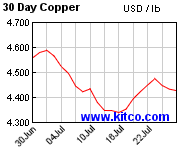
  Cobre a 30 d [Most Recent Quotes from www.kitco.com]

4. ARGENT/SILVER/PLATA

5. GOLD/OR/ORO

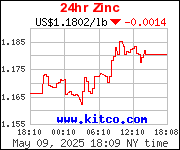
6. precio zinc

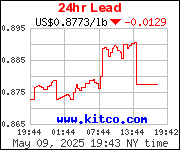
7. prix du plomb

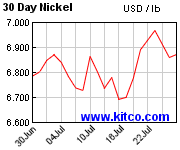
8. nickel price

10. PRIX essence


petrole on line

Find out how to invest in energy stocks at EnergyAndCapital.com.

azucar

azucar
mercados,materias primas,azucar,precios y graficos azucar i otros

30 jun 2009

JAPON: MEJORA PRODUCCION

"Aumenta la producción en Japón" : http://www.bbc.co.uk/mundo/economia/2009/06/090629_1211_japon_produccion_gtg.shtml?s

PERU: Inflación será cero en junio, enero-junio 0.37%

BCP: La inflación será cero en junio

11:39El Índice de Precios al Consumidor registraría un aumento acumulado, de enero a junio, de 0.37%, proyectó la entidad financiera.

La inflación en junio será nula o cero, debido a la baja en el precio del pollo y los alimentos en general, que compensaron el alza de otros precios, estimó el analista senior de Estudios Económicos del Banco de Crédito del Perú (BCP), Juan Carlos Odar.

Refirió que el precio del pollo ha registrado un descenso de seis por ciento en término promedio en junio, pese a los altibajos verificados en el transcurso de las últimas cuatro semanas.

En términos generales, el rubro alimentos presenta un descenso en junio y contribuye con una baja de 0.15 puntos porcentuales en el nivel de la inflación, observó.

Indicó que de esta manera la inflación acumulada de enero a junio se situaría en 0.37%, con lo cual mantendría el nivel observado de enero a mayo.

En tanto, la inflación anualizada (últimos 12 meses) continuaría disminuyendo y se ubicaría en 3.41%, nivel menor al registrado en el mes previo (mayo) de 4.21%, declaró a la agencia Andina.

“Parece cuestión de tiempo para que la inflación ingrese al rango meta del Banco Central de Reserva (BCR), de entre uno y tres por ciento, siendo razonable que se concrete en el tercer trimestre del año.”

De esta manera, coincidió con la proyección del presidente del BCR, Julio Velarde.

Odar anotó que la inflación se ha caído rápidamente en los últimos meses, reflejando resultados negativos en febrero y mayo pasados.

Sin embargo, desestimó que se atraviese una etapa de deflación, pues no se han registrado varios meses consecutivos de resultados negativos.

En ese contexto, afirmó que al parecer la inflación tendrá una importancia secundaria este año, a diferencia del año pasado.

En ese sentido, proyectó que la inflación se situaría en dos por ciento al término de 2009.

También mencionó que estarán a la expectativa de la publicación mañana (martes) de los indicadores adelantados de producción del Instituto Nacional de Estadística e Informática (INEI) sobre los sectores Agropecuario, Minería e Hidrocarburos, subsector Electricidad, así como del avance de la inversión pública.

“Estos indicadores servirán para estimar la producción de mayo, que se ha visto impactada, al igual que los precios internos y la inflación, por la situación internacional”, concluyó.

29 jun 2009

China: recuperacion?

9:26 | Con la mejora, el gigante asiático confía en que se logre el objetivo de crecer 8% este año pese a las épocas de crisis

HONG KONG (AP) – El director del banco central de China dijo el lunes que la economía del país estaba en recuperación y expresó confianza en que la meta de crecimiento del 8% prevista por el gobierno puede cumplirse este año.

Zhou Xiaochuan, gobernador del Banco Popular de China, dijo que las señales de una reversión en la tendencia a la baja de la tercera economía mundial habían comenzado a aparecer en marzo.

“Hemos notado que en tiempos recientes se está estabilizando y en realidad está tomando un tendencia positiva”, indicó Zhou a un grupo de periodistas en Hong Kong.

“Suponiendo que la crisis financiera internacional no empeore… en el tercer y cuarto trimestres la situación continuará mejorando y probablemente podremos lograr la meta de crecimiento trazada previamente”, destacó.

Beijing trató de aislar a China de la recesión mundial mediante un plan de estímulo de 586.000 millones de dólares (4 billones de yuanes) que promueve un mayor gasto en la construcción de autopistas y otras obras públicas.

El crecimiento económico de China declinó al 6,1% en el primer trimestre, el menor que se haya registrado desde 1992.

Zhou llegó el lunes a Hong Kong para aprobar un programa piloto que establece el uso de la moneda china, el yuan, en el comercio entre la China continental y la ex colonia británica, hoy territorio chino.

Este acuerdo es el más reciente esfuerzo de China para internacionalizar su moneda e intentar dejar de lado al dólar, la denominación predominante en el comercio global.

La economía de China está muy ligada a la de Estados Unidos. Beijing es el principal acreedor de Washington, ya que compra deuda estadounidense con sus amplias reservas de moneda extranjera.

Zhou dijo este fin de semana que no habrá cambios inesperados en la política china de reservas en moneda extranjera.

peru; Fondo de estabilización cerró el 2008 en US$1.800 mlls.


Se usará si ingresos del Estado caen más de 0,3% del PBI promedio de los últimos tres años

El saldo del fondo de estabilización fiscal (FEF) ascendió a US$1.806’564.536, monto que equivale a 1,4% del PBI. Por ley, este fondo puede acumular recursos hasta por un máximo equivalente al 4% del PBI.

El 71,7% del total ahorrado en el fondo proviene de transferencias del Tesoro Público realizadas el año pasado y, de ese monto (US$1.295 millones), el 99,5% proviene del saldo de libre disponibilidad del anteaño pasado. Es decir, eso fue lo que se ahorró durante ese año. Sin embargo, provenientes y a cuenta del ejercicio 2008, solo se realizaron transferencias por US$5,96 millones, originados principalmente por la venta de acciones del Estado en Edegel S.A.A., Cedegat S.A. y Pesca-Perú S.A.

NO HUBO EGRESOS
Los recursos del FEF se pueden utilizar cuando los ingresos del Estado caigan en más de 0,3% con respecto al PBI promedio de los últimos tres años. De ser el caso, se podrán utilizar esos fondos hasta por un monto equivalente a la disminución de ingresos que exceda el límite de 0,3% del PBI y hasta el 40% del FEF. Prioritariamente, estos recursos se utilizarán en programas de alivio a la pobreza.

PERU: LINEA DE CREDITO 6 MIL MILLONES NO HA SIDO PEDIDA

Crédito anunciado con FMI aún no ha sido solicitado

Fuentes oficiales desconocen si se ha tramitado línea de US$6.000 millones

Por: Katherine Subirana

La semana pasada, el presidente Alan García anunció la concertación de créditos de contingencia con organismos multilaterales hasta por US$9.000 millones, como medida preventiva ante la crisis financiera internacional.

Durante su exposición “Compromiso por el crecimiento y el empleo. 2009-2010”, realizada el pasado 10 de marzo, sostuvo que, de ese total, US$3.000 millones corresponden a la Corporación Andina de Fomento (CAF), el Banco Interamericano de Desarrollo (BID) y el Banco Mundial (BM); los otros US$6.000 millones pertenecen a una línea de facilidad del FMI.

En cuanto a esta última, el viceministro de Hacienda, José Arista, declaró a El Comercio que el MEF no tenía conocimiento de dicho pedido, y que en caso del FMI, este tiene trato directo con el Banco Central de Reserva (BCR).

CALIFICACIÓN EN CIERNES
El presidente del BCR, Julio Velarde, explicó que el FMI ha abierto la posibilidad de una ampliación de la línea de crédito para países con un fundamento económico sólido, y que el Perú debe confiar en que calificaríamos a ella. “Lo cierto es que nosotros creemos que sí calificamos”, declaró Velarde, sin dar más precisiones.

Por su parte, los representantes del FMI, Martín Kauffmann y Luis Breuer, precisaron que la línea de crédito del Perú con el fondo venció el año pasado, y que hasta el momento no hay ninguna solicitud para reactivarla.

En suma, pese al anuncio presidencial, por lo recogido en el MEF, BCR y FMI, no hay nada concreto sobre esa línea de US$6.000 millones.

En torno al crédito de la CAF, el viceministro Arista declaró que este sería de 350 millones y estaría destinado al proyecto del tren eléctrico.

Sobre el BM y al BID, se trataría de ampliar las líneas de crédito para tener fondos de contingencia.

QUÉ SE VIENE
Amortizaciones
Entre el 2009 y el 2011, el total de amortizaciones por deuda pública sería de US$3.900 millones de dólares.

Deuda y PBI
Las deudas de mediano y largo plazo en el 2008 llegaron a significar el 22,64% del PBI. En el 2011 bajaría a 18,65%.

HONDURAS:GOLPE DE ESTADO

condenan golpe de estado violento en honduras, toque de queda, estado de emergencia, apagon de la ciudad, captura de los medios de comunicacion, represion a los seguidores del presidente depuesto, cierran el espacio de comunicacion, intervienen embajadas de algunos paises, cierran radio, televisoras, diarios, ministra de relaciones exteriores secuestrada, corresponsales internacionales perseguidos, grave situacion, OEA condena, SIECA, ALBA, UE, USA.

spain: economia se contrae

Bernie Madoff sentenciado por un maxino de 150 años de carcel

cker


Washington Post

Madoff Sentenced To Maximum 150 Years In Jail

UPDATED at 11:34 a.m.:

Confessed Ponzi-schemer Bernie Madoff, who swindled investors out of as much as $65 billion, was sentenced moments ago to the maximum allowable 150 years in jail.

U.S. Judge Denny Chin characterized the Madoff scheme as "staggering," CNBC is reporting.

Chin said that Madoff did not do all he could do to aid investigators to help them recover swindled money or tell all he knows.

Chin said Madoff paid himself at least $250 million according to tax returns. He added that "symbolism" is important in sentencing.

He added that he did not receive a single letter from Madoff's friends or family seeking leniency.

Chin recounted one letter that strongly affected him. It told the story of a Madoff investor who had died of a heart attack. Madoff, presumably at the man's funeral, put his arm around the the widow and said, "Your money is safe." The widow then gave Madoff more money, all of which is gone.

Prosecutors asked for as much as 150 years in jail for Madoff. His lawyer, Ira Sorkin, asked for leniency and a 12-year-sentence for the 71-year-old Madoff.

Madoff: 'I Thought I Could Get Out Of it'

11:21 a.m.: Madoff is now making his statement to the court and began by saying: "I cannot offer you an excuse for my behavior," CNBC is reporting.

He said, "I thought I could get out of it. The harder I tried to get out of it, the deeper the hole. I could not accept for once in my life I had failed. I was responsible for a great deal of suffering and pain. I am in torment....This is a horrible guilt to live with."

Then Madoff, who had had his back to nine of his victims in the court, turned to them and said, "I am sorry. I know that doesn't help you."

He said: "How can you excuse deceiving a wife of 50 years?...How do you excuse deceiving investors and 200 employees" and lying to his sons.

"I made a terrible mistake," Madoff said, adding that he "left a legacy of shame to my family and my grandchidren."

Madoff spoke for about nine minutes.

Madoff Lawyer: I Represent 'Deeply Flawed Character'

11:11 a.m.: Madoff lawyer Ira Sorkin told U.S. District Judge Denny Chin that he (Sorkin) represents a "deeply flawed character" who is nevertheless, "not a number, not a statistic," CNBC reports.

He reminded the judge that "vengeance is not a part of punishment."

Sorkin said the $65 billion loss quoted in the press is "simply not true" and said it's possible to get $13.2 billion back for investors.

Sorkin is asking for 12 years of Madoff. Prosecutors want 150 years.

Victim To Madoff: 'May God Spare You No Mercy'

10:39 a.m.: "Do not confuse Bernie Madoff's prepared statement with remorse," victim Tom Fitzmaurice told U.S. District Judge Denny Chin, CNBC reports.

Fitzmaurice then turned to Madoff -- whose back is to his victims -- and said: "Madoff, your sons despise you, your marriage is one from hell. May God spare you no mercy."

Another victim alluded to Dante's "Inferno" and its three-headed devil, saying: "I hope Satan can grow a fourth mouth for Madoff."

Cripes.

Victim: I Had To Take Three Jobs After Madoff Swindled Me

10:26 a.m.: The second of the nine swindled victims who has to testify, widow Maureen Ebel, 61, just told the court that she lost her retirement savings and that she's working three jobs to pay the bills.

She then turned to Madoff -- who kept his back to her, CNBC reports -- and said: "Mr. Madoff, goodness is something you have been blind to your whole life. Goodness is better than all the yachts and homes you have. Mr. Madoff, I do not believe you."

The federal probation department recommends that Madoff get 50 years, Judge Denny Chin said, the Associated Press reports.

First Victim: 'We Did Nothing Wrong'

10:21 a.m.: One of the nine victims who has asked to testify, retired corrections officer Dominic Ambrosino, said he remembers the "exact moment" when he understood he lost his investments, thanks to Madoff's big swindle. The former c.o. wondered how he and his wife would pay his bills.

"We did nothing wrong," he said, according to CNBC.

The network reports that the victims are standing behind Madoff and he has maintained his back to them.

Judge To Madoff: I Will Impose 'Reasonable Sentence'

10:14 a.m.: U.S. District Judge Denny Chin told Madoff that would impose a "reasonable sentence," but did not tip his hand to what that would be. He noted that the most serious of the 11 criminal charges Madoff has confessed to carries a sentence of 20 years.

Madoff's victims will speak first, then Madoff lawyer Ira Sorkin, then Madoff and finally prosecutors have the last say.

Madoff Sentencing Set For Today

8:33 a.m.: Confessed multi-billion-dollar Ponzi schemer Bernie Madoff will be sentenced today by U.S. District Judge Denny Chin in Manhattan. Madoff faces up to 150 years in prison.

The hearing is scheduled to begin at 10 a.m. Madoff is expected to speak, and at least eight victims have asked to speak as well.

In March, Madoff confessed to 11 criminal charges, including money laundering and multiple counts of fraud. He told his sons in December that his firm, Bernard L. Madoff Investment Securities LLC was a "giant Ponzi scheme" and told FBI agents that he "paid investors with money that wasn't there." Madoff is a former head of the NASDAQ.

Madoff's lawyer, Ira Sorkin, has asked the judge for a 12-year sentence for the 71-year-old Madoff, saying he deserves leniency for turning himself in, not fleeing the country(!) and cooperating with authorities.

But prosecutors don't think Madoff has cooperated enough. So far, only about $1.2 billion of the $65 billion in stolen money and inflated earnings have been recovered. Finding the rest -- there are about 1,300 identified defrauded Madoff victims -- may take years, and figuring out how to do it is the big mystery of the case.

As such, today's sentencing represents the best approximation of satisfaction most victims may feel in this case.

At least two suicides have been attributed to the Madoff scandal. Investors in Britain and France each took their lives after losing millions in Madoff's hands.

Below, I talk about Madoff's sentencing this morning on Washington's Fox affiliate, WTTG-5.

Pay no attention to my goof, about halfway through, when I confuse scandal-plagued South Carolina governor "Mark Sanford" with scandal-plagued billionaire investment manager "Allen Stanford," which is who I meant. Hey, it was live TV. If your browser does not support the video, click here to view it.

-- Frank Ahrens
Sign up to get The Ticker on Twitter

By Frank Ahrens | June 29, 2009; 11:34 AM ET
Go to full archive for The Ticker »

COMMENTS

Please email us to report offensive comments.


Nah...he has plenty of friends in the US legal system that is run by the Chosen People. It's OFF TO ISREAL for bernie madhuffsky, to spend the billions of ill-gotten gains!!!!!

Posted by: yard80197 | June 29, 2009 9:56 AM

This evil beast has robbed, ruined and devastated more innocent people than even Barney Frank.

Life in prison, with no chance for parole.

Posted by: fury60 | June 29, 2009 11:12 AM

This guy is a devil and should never see light again. 50 years is just perfect. Check out GloomBoom.com for great insight on the economy.

Posted by: GloomBoomDotcom | June 29, 2009 11:24 AM

I'm so sorry for the people who lost their life savings to this bum, but some lessons can be learned #1 never put all your eggs in one basket #2 If it looks to good to be true, it is!The profits he was offering should have send up some red flags, greed is the root of all evil.

Posted by: rstull1949 | June 29, 2009 11:28 AM

This idea of "live blogging" from in front of the TV is pathetic. "Live" is generally understood to mean that you are there. He gets 150 years -- did you happen to note that on TV, intrepid reporter?

Posted by: Dawny_Chambers | June 29, 2009 11:37 AM

If Bush and Paulson had got their way Madoff would have got off scott free, under the Immunity Bush and Paulson wanted to include under the original blank check TARP request, which congress threw out and changed to the limited 800 billion TARP.

Now the Justice should go after the culprits in the multi Trillion dollar CDS Ponzi Scheme that brought America to Great Depressions II.


27 jun 2009

COMO VA LA GRIPE PORCINA?

De Panama

CORRUPCION: CASO STANFORD AGRAVA

CORRUPCION: CASO STANFORD AGRAVA

PERU:Las exportaciones totales cayeron 29,5% en mayo último

FRENTE AL MISMO MES DEL 2008

Las exportaciones totales fueron de US$2.054 millones en mayo, que representó una caída de 29,5% frente al mismo mes del 2008, según la Asociación de Exportadores (ÁDEX).

Sin embargo, viendo la evolución de las exportaciones totales de los últimos cinco meses, se observa que el menor monto exportado correspondió a enero del 2009 (US$1.560 millones). En febrero y marzo se observó una recuperación en los niveles de exportaciones totales, mientras que en abril (US$1.730 millones) se vio un leve descenso. En mayo último se regresó a la senda de una posible recuperación, señaló ÁDEX.

En el acumulado enero-mayo las exportaciones totales del país sumaron US$9.021 millones, 32,5% menos que en el mismo período del 2008, cuando las ventas al exterior ascendieron a US$13.363 millones. Con este resultado, las exportaciones peruanas acumuladas de los últimos 12 meses (junio del 2008-mayo del 2009) sumaron US$26.799 millones, lo que significa un decrecimiento de 14,8% respecto al período junio del 2007-mayo del 2008.

DESTINOS
En el caso de los destinos, Estados Unidos se ubicó en mayo en el tercer lugar (con 16,4% del total de las exportaciones peruanas), superado por China (17% del total) y Suiza (17,3% del total).

Otros mercados importantes fueron Canadá (8%), Japón (5,8%) y Venezuela (2,9%).

SECTORES
Entre enero y mayo, las exportaciones tradicionales ascendieron a US$6.694 millones, 35,3% menos que entre enero y mayo del 2008, mientras que las exportaciones no tradicionales sumaron US$2.326 millones, 22,9% menos que en el mismo lapso del 2008.

Solo en mayo, las exportaciones primarias registraron una caída de 29,4%, en tanto que las de valor agregado presentaron un decrecimiento de 25,7%.

Cabe resaltar que también disminuyeron las exportaciones de todos los metales, a excepción del oro, el plomo y el hierro. Las que más cayeron fueron las exportaciones de estaño (-98,4%), molibdeno (-90,9%), plata refinada (-65,4%), cobre (-41,6%) y zinc (-39,2%).

De otro lado, las ventas al extranjero del subsector de petróleo registraron una caída de 1,1% durante el quinto mes del año.

FRANCE: CEPE

Le Cepe (Centre d'études des programmes économiques) est un centre de formation permanente qui assure des formations économiques et statistiques tant pour des agents de l'État que pour des personnels d'entreprises ou des étrangers. Des formations inter-entreprises répondent aux besoins les plus fréquents et très spécialisés des professionnels qui ont à traiter des données statistiques et économiques. Des formations sur mesure et des formations spécifiques peuvent être mises au point par le Cepe à la demande d'un organisme « client ». Le Cepe dispense près de 300 journées de formation et accueille environ 700 stagiaires chaque année.

Le Crest est constitué, sur le site parisien :

  • du département de la recherche de l'Insee,
  • du laboratoire d'économie industrielle,
  • du laboratoire de finance-assurance,
  • du laboratoire de macro-économie,
  • du laboratoire de micro-économétrie,
  • du laboratoire de sociologie quantitative,
  • du laboratoire de statistique,

et, sur le site rennais :

  • du laboratoire de statistique et modélisation,
  • du laboratoire de statistique d'enquêtes.

Un sous-ensemble du Crest, le Groupe de recherche en économie et statistique (GRECSTA - URA D2200) est associé au CNRS.

Le Crest travaille sur les thèmes scientifiques et techniques faisant l'objet des enseignements de l'Ensae et de l'Ensai. L'Insee affecte des personnels au Crest pour y effectuer des recherches scientifiques en statistique ou en économie.

peru: comentario de america economia

http://www.americaeconomia.com/revista/282309-No-todo-lo-que-brilla-es-oro-en-Peru.NotaRevista.note.aspx

CORRUPCION:MADOFF 150 YEARS

26 jun 2009

Green Shoots' of Recovery? Don't Fall for the Media's Economic Triumphalism

'Green Shoots' of Recovery? Don't Fall for the Media's Economic Triumphalism

By Joshua Holland, AlterNet. Posted June 22, 2009.


A narrative is emerging that we're seeing the first signs that a recovery is around the corner, but the reality is less encouraging.

When a slew of absolutely depressing economic data were released in late May, economist Dean Baker, co-director of the Center for Economic and Policy Research, wrote: "these reports might have led to gloomy news stories, but... the media have obviously abandoned economic reporting and instead have adopted the role of cheerleader, touting whatever good news it can find and inventing good news when none can be found."

In other words, the green shoots narrative should be met with healthy skepticism. New York University economist Nouriel Roubini -- who earned the moniker "Doctor Doom" for correctly anticipating the crash -- says that rather than "green shoots," we're seeing some "yellow weeds" emerging from the cracks of our shattered system, and argues that there's every likelihood that a "recovery" will mean several years of sluggish, below-average growth for the industrialized economies.

Most economists do agree that extraordinarily aggressive interventions by our government and those of other key countries -- whatever criticism one may have of their specifics -- have averted, for the moment, the worst-case scenario: a deflationary "death spiral" in which people don't spend, firms lay off workers and state revenues dry up just when they're needed the most, causing yet more austerity and more downsizing.

But as New York Times' columnist Paul Krugman noted, those moves "make the conventionally minded uncomfortable, and they keep pushing for a return to normalcy." And there are a variety of stakeholders that have a vested interest in creating a perception that we're "returning to normalcy." Wall Street is trying to repay the government (but without letting the taxpayers off the hook for future losses) in order to escape limits on executive pay and other watery "conditions" attached to the public's largesse (Goldman Sachs' research department has been out front in shaping the green shoots narrative). The Obama administration is fending off conservative charges that his stimulus package -- of which only a small fraction has actually been spent in the four short months since Congress approved it -- is a failure. The Fed and other institutions are anxious about foreign investors' perceptions of the U.S. economy's overall health, and economic reporters and pundits are loath to admit that they've been sleeping with the fetid corpse of a dead economic paradigm known as Reaganomics.

Moreover, much of the business establishment has an interest in heading off any attempt to fundamentally transform the economy. After all, when things go south in the 21st century, the big fish are protected -- they get a bailout.

So we need to ask not only if a recovery is really over the horizon, but also what it might look like.

Structural Imbalances Remain

Consumer spending in the U.S. accounts for not only about 70 percent of American economic activity, but also about a sixth of the planet's. Gallup notes that consumer confidence is edging up -- thanks in part, no doubt, to all the talk of green shoots -- but (self-reported) consumer spending has plummeted by a whopping 41 percent compared to the same time last year.

This is the culmination of a long-term problem. Most people's wages have not been stagnant in recent years-- it's worse than that. For more than three decades the real incomes of all but those in the top 10 percent of the economic pile have actually declined.

We kept up our lifestyles, though -- first through massive numbers of women joining the workforce, and later by running deep into debt. That central economic disconnect has only accelerated with the recession.

That was then; what happens now? Americans' household wealth -- assets minus debt -- has dropped for seven consecutive quarters; it's fallen to the tune of $13.8 trillion since the middle of 2007 (which represents the loss of about 20 percent). In just the first three months of this year, American families lost almost a half-trillion dollars in the value of their homes and almost thee times that number in stocks and other equities. So we're broke.

And our credit's maxed out -- American homeowners now own, on average, just 41 percent of the equity in their homes, an all-time low. The picture in terms of revolving debt (you know, the plastic) -- almost $1 trillion worth in the U.S. -- isn't much better; last month, U.S. credit card defaults also reached an all-time high.

Americans are "de-leveraging" -- paying down or defaulting on debt and putting some pennies away for a rainy day. In the first three months of this year, U.S. households shed over $100 billion worth; they paid down credit card debt at a rate unseen in 30 years. It's a good idea to live within one's means, of course, but the trend represents what's known as the "paradox of thrift": when things get tough people save their money, and dollars put in the bank aren't spent in the economy at a time when they're needed most.

According to Barron's:

De-leveraging -- paying down debt and boosting savings -- will continue to weigh on consumer spending even after employment and income eventually turn up, which is still far away. That's what makes this cycle different from the ones before.

In the past, the hits to wealth were concentrated in equities, which were held mainly by the well-to-do. And they were cushioned by their real estate, private business holdings, fixed-income securities and ample cash. In the bubble, however, even the rich got into hock with multiple homes that they now can't afford to carry and can't unload.

In other words, investors may be feeling a bit less bearish based on the fact that unemployment claims are down a fraction, but most Americans continue to feel the pain. And don't look for a new wave of consumers in developing countries to step up and fill the void -- that's incredibly unlikely over the short or medium terms.

And there are a number of other factors to consider when weighing the likelihood that a robust recovery is in sight.

Real Estate Hasn't Hit Bottom

Of late, one of the green shoots being touted is some modestly good news -- or less terrible news -- in the real estate market. Housing starts -- new construction -- were up slightly last month, indicating to some that we might be reaching a "bottom" in the real estate market's decline.

But a deeper look suggests that there's not much reason to rejoice. Starts were up 17 percent in May over April's figures, but April was dead; new construction in May was still down by almost half compared to the same period last year.

Dean Baker also notes that new mortgage applications are very low, and builders' confidence is in the tank -- those in the construction industry aren't expecting a robust recovery anytime soon. Baker suggests that builders moving up planned projects to take advantage of the first-time homeowners' tax credit, which expires in November, is a likely cause of the rise in starts.

During the growth of the housing bubble, there was an enormous boom in construction, and inventories of unsold homes are now at about twice their historic levels. Economist Robert Schiller predicts that real estate prices may continue to decline for years to come, as they did in Japan following the burst of its real estate bubble in the 1990s.

And there are ominous signs that the worst is yet to come. Most disturbing is the "shadow inventory" of foreclosed homes that are not on the market, either because investors are holding out for better times or, more commonly, because banks don't want to take losses on their balance sheets, as they must do when a sale is made at a loss.

The Christian Science Monitor notes that "only 30 percent of foreclosed homes are currently on the market, meaning that some 500,000 sit vacant across the country, part of a vast 'phantom inventory' that the market has yet to grapple with."

As if that weren't enough, "option ARM" loans -- with very low interest rates for the first few years which then "reset" higher -- were popular during the boom. People figured they'd score a place, hold onto it for a few years and then have no trouble selling it down the road for a handy profit. But now many of those homeowners are unable to sell, and a million of them will face steep increases in their monthly payments over the next four years -- with about 750,000 resetting in the next two years alone. Susan Wachter, a professor of real estate finance at the Wharton School of Business, told Bloomberg News that as rates reset, it "will drive up the foreclosure supply, undermining the recovery in the housing market. … The option ARMs will be part of the reason that the path to recovery will be long and slow."

Other Shoes to Drop

Gas Prices:

They're up by more than 60 percent since the end of 2008, and it's likely to get worse. Crude oil prices have doubled during the same period, and the cost of refined gasoline appears to be lagging behind that of crude oil because demand has been low -- down globally by 2.6 million barrels per day over last year -- and oil stocks are high. As the economy starts chugging along again, demand will increase, and prices are likely to continue to rise. Most analysts expect the price of crude oil to increase by as much as 40 percent (from around $70 per barrel now) over the next year. The New York Times reported that "the national jump in prices, far larger than the normal seasonal increase, is pulling billions of dollars from the pockets of drivers. It threatens to curtail a modest recovery in consumer spending on items like apparel and electronics."

Risk of Inflation:

So far, firms and households have stopped buying, and that has kept inflation in check even as the Fed and other countries' central banks are pumping money into the system. But, according to Nouriel Roubini, "if central banks don't find a clear exit strategy from very easy monetary policies that have led to the doubling or tripling of the monetary base in the U.S. alone, eventually inflation and/or another dangerous asset and credit bubble will ensue when the global economy gets out of this severe recession" (the "monetary base" is the amount of cash in circulation combined with commercial banks' reserves at a given point in time).

The amount of public debt has gone through the roof and will continue to do so in the foreseeable future. Deficit spending is necessary when consumers and businesses tighten their purse strings, but there are consequences -- spiraling public debt. Policymakers may be tempted to "inflate their way" out of the problem -- inflation decreases the real value of the dollars one owes to other parties.

Krugman dismisses fears of inflation as ideologically grounded fearmongering, noting that in past recessions policymakers have deemed the strategy too painful to pursue. But as Roubini notes, "Inflation may indeed become the path of least resistance for policymakers, as it is easier to run the printing presses and cause inflation than it is to implement politically difficult tax increases or spending cuts."

Rising Interest Rates:

So far, fears of a massive run away from the dollar as the world's reserve currency or of foreign investors fleeing the U.S. market appear to be overstated. "Talk that foreign central banks will diversify out of their dollar and Treasury holdings is so far just talk," Chris Rupkey, chief financial economist at Bank of Tokyo-Mitsubishi, told Bloomberg News. "The worst financial crisis since the Great Depression is still ongoing, and foreign investors and central banks still have a safe haven demand for U.S. Treasuries."

But the demand for U.S. assets has declined in recent months, and as the public debt increases, the amount we'll have to pay on that debt in order to keep selling it will likely increase. That will create upward pressure on interest rates which may further limit the recovery in the medium term as businesses and families face higher interest rates for financing various purchases.

Tax Cuts Expiring:

The Bush-era tax cuts were an abomination of priorities; at the end of Bush's term in office, the top 1 percent of Americans bore the lowest share of the tax burden and raked in the largest chunk of the national income at any point in at least the last 20 years. It's good that they are set to expire -- it'll raise revenues and restore a semblance of equity to a system that's become painfully skewed toward the interests of an exceedingly small and very wealthy minority.

But in purely economic terms, it's likely to be another impediment to a robust recovery -- those cuts will expire at just around the time many green shoots optimists expect a return to at least respectable growth at the end of this year.

Similarly, (good) "cap-and-trade" legislation, if it passes Congress, is necessary for curtailing greenhouse gas emissions and averting catastrophic climate change. But it will result in an effective tax hike that may also slow down any potential recovery. (Again, this is not an argument for extending the Bush tax cuts or opposing new regulation of greenhouse gasses.)

Yellow Weeds

There are other potential obstacles to a robust recovery that are more technical in nature. Readers interested in a wonkier analysis should check out Roubini's piece, "Ten Risks to Global Growth." In it, he notes that one "cannot rule out a sharp snapback of [economic activity] for a couple of quarters, as the inventory cycle and the [stimulus spending] lead to a short-term growth revival." But "unless structural weaknesses are resolved," he predicts that climbing indicators over the short term will prove to be only an illusion of economic health.

Yet the green shoots crowd predicts an end to the recession -- already the longest and most painful in decades -- toward the end of this year. They see it as a V-shaped dip -- a sharp decline followed by an equally strong period of recovery. That's what has happened in recent decades, following "normal" periods of recession.

But a more likely outcome is a U-shaped recession ending (that is, being declared over -- wages and employment typically lag behind the official end of a recession) sometime next year, with a long and painful tail, which may then be followed by a period of less-than-stellar economic performance for several years.

And it's entirely possible that those other shoes will fall, pushing us into a W-shaped double-dip recession -- with a bit of growth followed by a second period of contraction -- which would be unlike anything we've experienced in recent memory.

So, some key questions: For all the optimistic chatter about green shoots, what kind of so-called recovery will we actually experience? How can we have a "return to normalcy," whatever that is, if we refuse to initiate the kind of structural changes that would lead to widely shared prosperity -- the widespread economic security that a consumer-driven economy like ours requires in order to sustain growth? Will we start building things again? Will we balance our trade deficit?

Washington's maneuvers may have slowed our descent, but so far, these questions remain largely unaddressed.

__._,_.___

25 jun 2009

SPAIN: EUROPA SE ALEJA

dificultades con españa

CHINA: Comprar chino

COMPRAS CHINAS

Etats-Unis : hausse inattendue des nouvelles inscriptions aux chômage

[ 25/06/09 - 16H22 - actualisé à 16:22:00 ]

Le nombre de nouveaux chômeurs inscrits a augmenté aux Etats-Unis au cours de la semaine close le 20 juin, selon les chiffres corrigés des variations saisonnières publiés jeudi par le département du Travail à Washington. Le ministère a recensé 627.000 nouvelles demandes d'allocations en une semaine, soit 15.000 de plus que la semaine précédente, alors que les analystes tablaient sur un recul à 600.000 nouveaux dossiers.

Le nombre des demandes de la semaine précédente a été revu en hausse, à 612.000, au lieu de 608.000 annoncées initialement.

La moyenne des inscriptions sur quatre semaines, chiffre jugé plus représentatif d'une tendance, a légèrement augmenté après deux semaines consécutive de baisse, remontant à 616.750 ( 0,1%).

Le nombre de chômeurs indemnisés, après avoir baissé la semaine dernière pour la première fois depuis le début de l'année, est de nouveau remonté pendant la semaine terminée le 13 juin, pour atteindre 6,738 millions, soit 0,4% de plus que sept jours plus tôt.

En revanche, en moyenne sur quatre semaines, le nombre de chômeurs indemnisés a décru, reculant à 6,759 millions, après avoir atteint la semaine précédente un niveau record de 6,763 millions.

La proportion des chômeurs indemnisés dans la population active reste à 5,0%, son plus haut niveau depuis décembre 1982.

"Le plus important problème, c'est moins les chiffres hebdomadaires en soi que la persistance des demandes d'allocations (à ce niveau). Il faudrait que leur niveau tombe en-dessous des 500.000 (demandes par semaine) avant de voir un réel ralentissement dans la montée croissante du taux de chômage", estime Jon Ogg, analyste du site 24/7 Wall St.

Selon les derniers chiffres officiels, le taux de chômage aux Etats-Unis était de 9,4% fin mai. Le président américain Barack Obama et plusieurs responsables de la banque centrale estiment que le chômage pourrait atteindre 10% cette année.

"Le marché du travail se contracte, mais moins qu'il y a quelques mois (...) Les augmentations (des demandes d'allocation) sur les deux dernières semaines sont davantage une conséquence des difficultés du secteur automobile américain, entraînant fermetures d'usines et de concessionnaires", tempèrent de leur côté les économistes de Moody's.


USA: BERNANKE Y BAMERICA

http://online.wsj.com/article/SB124595321560755201.html#mod=2_1362_topbox

VENEZUELA-USA: ¿Amigos de nuevo?

"¿Amigos de nuevo\?" : http://www.bbc.co.uk/mundo/america_latina/2009/06/090624_2044_analisis_embajadores_irm.shtml?s

Colombia, en recesion

"Colombia, en recesión" : http://www.bbc.co.uk/mundo/economia/2009/06/090625_2123_colombia_recesion_gm.shtml?s

BRASIL: Lula a punto de decidir sobre el Amazonas

"Lula a punto de decidir sobre el Amazonas" : http://www.bbc.co.uk/mundo/america_latina/2009/06/090624_1734_brasi_controversia_amazonas_jrg.shtml?s

PERU: KBURNEO,No estamos en recesión… Entonces, ¿en qué estamos?

No estamos en recesión… Entonces, ¿en qué estamos?
Gestion (24/06/2009)

POR KURT BURNEO.

Catedrático - Universidad San Ignacio de Loyola.

El ministro de Economía del régimen aprista señaló recientemente que, dado que el PBI al primer trimestre creció en 1.8%, previendo un crecimiento bajo en el segundo trimestre y un repunte importante en el último semestre del año, la economía no está y no estará en recesión. Entonces, ¿qué calificativo se le da a una economía (como la peruana) cuya actividad viene en términos desestacionalizados reduciéndose desde noviembre del 2008? Por supuesto, es posible entrar al preciosismo académico de discutir la definición técnica de recesión, la que usa el NBER en los EE.UU., o la definida por el comportamiento de algunas series pre establecidas, pero en fin, si no se quiere llamar a esto recesión, pues que se le llame como quiera, mas, ¿es relevante el nombre que se ponga para revertir los actuales efectos adversos: caída del empleo, recaudación, importaciones, exportaciones etc.? ¿O estos no existen tampoco?

Más importante es hacer notar la inacción macroeconómica actual de las autoridades económicas: Solo esperarían que la tasa de interés activa se reduzca como resultado de las recientes reducciones de la tasa de interés de referencia del Banco Central e impulsar la inversión y que el denominado Plan de Estímulo Económico (PEE) desde el tercer trimestre dinamice el gasto de capital y la demanda interna. Aunque dicho sea de paso, la necesidad de impulsar el gasto esconde discutibles asignaciones de recursos estatales como, por ejemplo, ahora el programa Mivivienda financiará créditos de hasta US$ 59,000. ¿Gente de limitados recursos?

La macroeconomía se complica más por la gestión reactiva en el manejo de conflictos, y así por efecto demostración, proliferan las demandas sociales basadas en acciones de fuerza, en varias localidades del país. Ello afectará adversamente la confianza de los inversores y a la vez pone en agenda que la promoción de la inversión pasa también por un indispensable grado de legitimación social, sobre todo en sectores extractivos de la economía. Obviar esto último garantiza en el tiempo la situación antes descrita, afectando negativamente la inversión privada, justo en el momento en que se viene desacelerando la demanda interna.

Por otro lado, se equivoca el ministro de Economía del gobierno aprista cuando insiste en que el PBI crecerá este año en 3.5%. Para lograr este pronóstico, entre mayo y diciembre de este año la economía peruana debería de crecer en alrededor de un (¿plausible?) 4.9%. En contraste, "fanáticos pesimistas" de una consultora local sitúan la tasa de crecimiento en 1.5% para este año; en tanto, las "aves de mal agüero" del Latin Focus Consensus redujeron su predicción de crecimiento de 3.3 a 2.9%. Si bien pareciera ser posible alguna recuperación de la demanda interna en el último cuatrimestre del año por la efectivización del PEE, de no empeorarse el contexto externo y con una oportuna política de reducción de tasas de interés de referencia por el Banco Central, en el mejor de los casos este año el crecimiento estaría en alrededor de 1.5%.

No es, pues, como las autoridades económicas piensan, que cuanto mayor sea la tasa de crecimiento anunciada más optimistas estarán consumidores e inversores. Al contrario, cuanto menos realizables sean estas proyecciones, más dudas e incertidumbre se generan en ellos, aumentando la probabilidad de desacelerarse el gasto de consumo e inversión… justamente el efecto contrario de lo buscado por el oficialismo económico.

Por otro lado, la terca insistencia en señalar –a manera de consuelo para las expectativas de la gente- que el Perú, al presentar una tasa de crecimiento pequeña para este año, está menos mal que otros países, no ayuda mucho para mejorar las percepciones macroeconómicas; excepto si se asumiese equivocadamente que los peruanos somos más felices porque argentinos, mexicanos, bolivianos y chilenos estén peor que nosotros. Al final, los anuncios del ministro de Economía sobre tasas de crecimiento, creo que deberían ser tomados con la misma seriedad que el de un anterior pronóstico suyo de un ciclo expansivo de 15 años para los precios de materias primas (predicción hecha a finales del 2007)… Se equivocó solo por 14 años para que esta sea cumplida.

FMI: El número dos cree que la crisis podrá acabar "antes de lo previsto"

Lipsky asegura que la recuperación llegará a un ritmo diferente en función de las regiones y augura que Asia saldrá de la recesión antes que otros continentes


París. (EFE).- El 'número dos' del Fondo Monetario Internacional (FMI), John Lipsky, afirmó que la crisis económica podrá acabarse “antes de lo previsto” aunque señaló que para ello hace falta “afrontar desafíos muy importantes”.

“Hay una posibilidad de que volvamos a un crecimiento positivo más pronto de lo que se esperaba, pero el desafío sigue siendo importante”, afirmó Lipsky durante una conferencia organizada en París sobre la crisis mundial y sus consecuencias en los países emergentes y en vías de desarrollo.

El 'número dos' del FMI indicó que, pese a los signos positivos, se mantiene la incertidumbre y todavía pesan “algunas amenazas” sobre la economía mundial. “El miedo a un revés grave ha sido superado y los riesgos de una crisis bancaria extensa se han atenuado”, indicó Lipsky.

Lipsky destacó la importancia de mantener las estrategias de esfuerzo financiero emprendidas en la mayor parte de los países y aseguró que éstas son particularmente importantes en las economías menos desarrolladas.

Estos países “han reaccionado mejor que en el pasado a la crisis económica”, indicó el responsable del FMI, quien aseguró que tienen “un margen más estrecho” para afrontar las dificultades. Junto al esfuerzo financiero, Lipsky destacó la importancia de vigilar las finanzas públicas para afrontar en las mejores condiciones la salida de la misma.

Según el dirigente del Fondo, los países desarrollados deben ayudar a los que están en vías de desarrollo y los pobres a afrontar las consecuencias de la crisis. “Es posible que sea necesario aportar un apoyo suplementario si los riesgos de caída se materializan pero hay poco margen presupuestario y el retorno a la viabilidad es esencial”, indicó.

Lipsky reveló que en las próximas semanas el FMI va a revisar al alza “ligeramente” sus previsiones de crecimiento económico, en particular, las relativas al año próximo.

Señaló, sin embargo, que muchos de los indicadores, en particular el desempleo, tardarán en mejorar, sobre todo en los países menos desarrollados, más afectados por la crisis porque han visto caer sus exportaciones hacia los países ricos, así como la entrada de capitales vía inversión o envíos de dinero de los inmigrantes.

El responsable del FMI afirmó que, aunque la economía está interconectada, la recuperación económica llegará a un ritmo diferente en función de las regiones mundiales y auguró que Asia saldrá de la recesión antes que otros continentes.

En el mismo foro, la ministra francesa de Economía, Christine Lagarde, por su parte, destacó la importancia de las medidas “audaces” adoptadas por el FMI, que ha triplicado la ayuda a los países más pobres por decisión del pasado G-20 de Londres. “No podemos dejar que una crisis nacida en los países ricos y que se explica por una disfunción de nuestros sistemas de regulación, ponga en entredicho los esfuerzos de desarrollo emprendidos desde hace diez años. Es un deber de solidaridad internacional”, aseguró.

En este sentido, la responsable francesa de Economía aseguró que su país pedirá en la próxima cumbre del G-20 que se revise si los objetivos de ayuda al desarrollo marcados en Londres se están llevando a cabo.

Lagarde indicó que Francia mantendrá su esfuerzo presupuestario en ayuda al desarrollo pese a la caída del Producto Interior Bruto del país. La ministra se mostró partidaria de una reforma de las instituciones internacionales, como el FMI y el Banco Mundial (BM) que de más peso a los países en vías de desarrollo y que tenga en cuenta “las responsabilidades compartidas en la gestión de los bienes públicos mundiales”.

USA:La economía se contrae 5,5% 1 trimestre 09

La caída del 6,3% en los tres últimos meses del año pasado y de 5.5% en el primer trimestre

El retroceso rebaja en dos décimas las previsiones


Washington. (EFE).- El Producto Interior Bruto (PIB) estadounidense se contrajo a una tasa anualizada del 5,5% en el primer trimestre del año, dos décimas menos que lo calculado previamente. En el último trimestre del 2008 la contracción de la economía fue del 6,3%.

El departamento de Comercio había calculado inicialmente que la recesión de enero a marzo alcanzó una tasa anualizada del 6,1%, pero en mayo la bajó al 5,7% y hoy dejó la cifra definitiva en el 5,5%.

Los analistas habían previsto que el Gobierno dejaría sus estimaciones sin cambios. La revisión de los números apunta a una ralentización de la caída de la economía estadounidense respecto a finales del año pasado debido a un repunte del consumo y una bajada más aguda de las importaciones.

Estos efectos se vieron parcialmente contrarrestados por una reducción más rápida a principios de año de la inversión en inventarios y de la construcción comercial, según informó el departamento de Comercio.

El sector automovilístico continúa siendo un freno para la economía, pero la caída se aminora. La producción de vehículos restó 1,26 puntos porcentuales al PIB en el primer trimestre del año, frente a los 2 puntos porcentuales del cuarto trimestre del 2008.

El BCE presta a los bancos el récord de 442.240 millones durante un año

SUPER REPO

Inyecta todo el efectivo que las entidades han pedido al 1%, una medida que ayudará especialmente a España por su sistema hipotecario

24/06/2009 | Actualizada a las 14:41h | Economía

Fráncfort (Alemania).(EFE).- El Banco Central Europeo (BCE) prestó a los bancos comerciales de la zona del euro 442.240 millones de euros durante un año, la cantidad máxima que la entidad ha adjudicado hasta ahora en una subasta, para facilitar la concesión de créditos a largo plazo.


El BCE inyectó todo el efectivo que las entidades de crédito solicitaron a un tipo de interés fijo del 1 por ciento, una medida que ayudará especialmente a España por su sistema hipotecario.

La entidad informó hoy de que en su primera operación de refinanciación con un año vencimiento (exactamente 371 días) participaron 1.121 bancos, un número extremadamente alto.

Con esta medida extraordinaria el BCE quiere facilitar a los bancos comerciales que concedan créditos a largo plazo y de este modo apoyar la reactivación de la economía de los países del euro, que atraviesa la peor recesión desde la Segunda Guerra Mundial.

La operación se liquidará mañana y vencerá el 1 de julio de 2010, cuando los bancos comerciales de la zona del euro deberán devolver el efectivo al BCE.

24 jun 2009

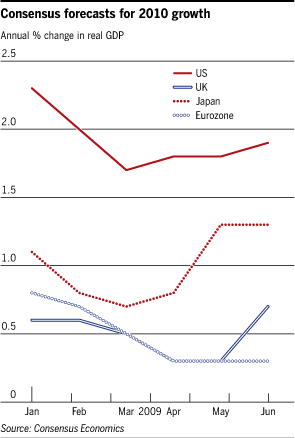
Martin Wolf’s chart of the week: consensus forecasts for 2010

June 19, 2009 3:00pm

This chart shows what the consensus of forecasts thinks of the green shoots argument.

Consensus forecasts for 2010

Consensus forecasts for 2010

COLOMBIA: RECESION TECNICA

La Fed mantiene las tasas en casi cero,

pero indica mejora del panorma econ

Dow Jones Newswires

WASHINGTON (Dow Jones)--La Reserva Federal de Estados Unidos mantuvo el miércoles las tasas de interés cerca de cero, a la vez que destacó las nuevas señales de estabilidad económica.

"La información recibida desde que el Comité de Mercados Abiertos de la Fed se reunió en abril sugiere que el ritmo de la contracción económica se está desacelerando", sostuvo el FOMC en un comunicado emitido tras su reunión de política monetaria de dos días.

"Las condiciones en los mercados financieros han, en general, mejorado en los meses recientes", agregó.

El FOMC votó 10 a 0 a favor de mantener la meta para la tasa interbancaria federal entre cero y el 0,25%, un rango mínimo histórico.

Además, el comité reiteró que probablemente mantendrá las tasas en niveles bajos durante un período prolongado.

La tasa de descuento para los bancos comerciales y de inversión también permaneció en su nivel previo, del 0,5%.

La decisión sobre las tasas coincidió con las expectativas de los economistas en Wall Street.

Por otra parte, las autoridades reiteraron que planean comprar para el final del año hasta US$1,25 billones en valores respaldados por hipotecas de empresas auspiciadas por el Gobierno y hasta US$200.000 millones en deuda de ese tipo de empresas. Como se había anunciado previamente, el banco central prevé comprar además hasta US$300.000 millones en títulos del Tesoro estadounidense para el otoño.

El FOMC no expresó preocupación hacia un posible aumento en la tasa de inflación. "Los precios de la energía y otros bienes básicos han aumentado en los últimos tiempos. Sin embargo, es probable que la sustancial cantidad de recursos desocupados sofoque las presiones sobre los costos, y el Comité espera que la inflación permanezca moderada durante algún tiempo".

Pese a ello, los miembros del banco central eliminaron referencias previas al riesgo de que la inflación podría permanecer por debajo de niveles deseados, un indicio de que no ven la deflación como un riesgo.

ENTREVISTAS TV CRISIS GLOBAL

NR.: Director, no presidente ---------------------------------------------- Bruno Seminario 1 ------------------------- Bruno Seminario 2 -------------------- FELIX JIMENEZ 1 FELIZ JIMENEZ 2 FELIX JIMENEZ 3, 28 MAYO OSCAR DANCOURT,ex presidente BCR ------------------- Waldo Mendoza, Decano PUCP economia ---------------------- Ingeniero Rafael Vasquez, parlamentario 24 set recordando la crisis, ver entrevista en diario

Etiquetas

Peru:crisis impacto regional arequipa,raul mauro

Temas CRISIS FINANCIERA GLOBAL

QUIEN SOY?
claves para pensar la crisis

MATERIAS PRIMAS
-Metales
-Cobre
- plata
- oro
- zinc
- plomo
- niquel
- petroleo

-Tipo de cambio

- LA CRISIS

- BOLSA VALORES
- BANCOS
- PBI PAISES
- USA: DEFICIT GEMELOS
- UE: RIEN NE VA PLUS

CONTAGIO: CANALES

- PERU: DIAGRAMA DE CONTAGIO
- PERU: IMPACTO EN BOLSA
- MEXICO: HAY CRISIS?

LA PRENSA
COMENTARIO DE HOY

- DIARIOS DE HOY
NLACES

Coyuntura
Bancos centrales
Paginas Recomendadas

BLOGS

economiques
Interes

VIDEO

- Economia videos
- Crisis financiera global

TRICONTINENTAL

- AFRICA: daniel
- EUROPA: helene
- ASIA:
- AMERICA

COLUMNAS AMIGAS

Chachi Sanseviero

ETIQUETAS
por frecuencia de temas
por alfabetico

EVENTOS

FOTOS DEL PERU

GONZALO EN LA RED

JOBS
VOZ ME CONVERTIDOR
CLIMA
SUDOKU
PICADURAS

LOGO

LIBRO de GONZALO

La exclusion en el Peru

-Presentacion

- introduccion

- contexo economico

- crisis de la politica

- excluidos de las urbes

- excluidos andinos

- contratapa

VIDEOS ECONOMICOS
Crisis Enero 2009
Krugman
Globalizacion 1
Globalizacion 2
Crisis Brasil
Crisis bancaire
Karl marx revient

TODOS LOS DERECHOS RESERVADOS

GOOGLE INFORMA


PRESS CLIPPINGS-RECORTES PRENSA-PRESSE..

ETIQUETAS alfabetico