SECCION Crisis monetaria: US/EURO, dolar vs otras monedas

Gráfico del tipo de cambio del Dólar Americano al Euro - Desde dic 1, 2008 a dic 31, 2008

Evolucion del dolar contra el euro

US Dollar to Euro Exchange Rate Graph - Jan 7, 2004 to Jan 5, 2009

V. SECCION: M. PRIMAS

1. SECCION:materias primas en linea:precios


[Most Recent Quotes from www.kitco.com]


METALES A 30 DIAS click sobre la imagen
(click sur l´image)

3. PRIX DU CUIVRE

  Cobre a 30 d [Most Recent Quotes from www.kitco.com]

4. ARGENT/SILVER/PLATA

5. GOLD/OR/ORO

6. precio zinc

7. prix du plomb

8. nickel price

10. PRIX essence


petrole on line

Find out how to invest in energy stocks at EnergyAndCapital.com.

azucar

azucar
mercados,materias primas,azucar,precios y graficos azucar i otros
Mostrando entradas con la etiqueta JAPON. Mostrar todas las entradas

28 ago 2012

Fwd: LEAP/E2020 Press Review on the Global Systemic Crisis


GLOBAL SYSTEMIC CRISIS

In This Issue:

• The untenable irresponsibility of QE in summer 2012 - the US, British and Japanese central banks out of the game
• 2012-2013: End of Euroland's consolidation of its budget-finance operations / Launching of the first pro-active common socio-economic policies / Acceleration of the distinction between Euroland-EU
• BOK unexpectedly cuts key rate to 3%
• Case for US and Global Recession Right Here, Right Now; Recognizing the Limits of Madness; Permabears?
• One-on-One with Robert Shiller
•  The Political Anticipation Method©: 10 week online training course
• Brazil Industry Continues in Slide
• Disaster Declared in 26 States as Drought Sears U.S.
• Potential Pentagon cuts cloud Farnborough mood
• Gold the answer to currency wars
• PSA supprime 8 000 emplois en France, dont 6 500 nets
• U.S. moving submersibles to Persian Gulf to oppose Iran
• 'For Russia, it's about more than just Syria'
• San Bernardino Becomes Third California City Seeking Bankruptcy
• USDA Slashes Corn Outlook; Forecast Sends Prices Surging
• A very promising e-democracy project, particularly adapted for Euroland future democratic challenges!

Featured Links

• LEAP / Europe 2020
• GlobalEurope Anticipation Bulletin (website)
• Global systemic crisis - All our selected news
• GlobalEurope Press Review (NM blog)


The untenable irresponsibility of QE in summer 2012 - the US, British and Japanese central banks out of the game
As we had shown last January in the GEAB N°61, the US Federal Reserve is facing an unsolvable dilemma from now on, whether or not to launch QE3: «Will the Fed have the means to launch a QE3? The answer is "yes" if one takes only the legal, financial and economic factors into account. The way the Fed works in theory allows it to freely take this kind of decision. But even under the conditions of a "traditional" decision, QE3 will not be a choice made with a glad heart. A new cycle of monetization will only be the product of a US sovereign debt downgrade put under the pressure of the credit rating agencies or investors. Will the banks agree to finance the Fed? Such a question is of little relevance. In an idling financial market, lending funds to the Fed will still be a good deal. Admittedly, interest rates are weak, but the risk is zero. However, if one considers the question from the geopolitical and political angle, the answer is "no".
LEAP/E2020 - Exerpt GEAB N°66 (June 2012)
 
2012-2013: End of Euroland's consolidation of its budget-finance operations / Launching of the first pro-active common socio-economic policies / Acceleration of the distinction between Euroland-EU
By mid-2012, as we have already indicated in preceding GEAB issues, Euroland will be endowed with a whole set of new national leaders (Spain, Italy, Greece, France, Slovenia, Belgium,…) and the following months there will be elections in Germany. Euroland will thus be led by men and women who, for the most part, came to power after the start of the crisis.
LEAP/E2020- Excerpt GEAB N°62 (February 2012)
 
BOK unexpectedly cuts key rate to 3%
Korea's central bank cut the key interest rate for the first time in more than three years on Thursday, underscoring its urgency to cushion the bitter impact of the eurozone debt crisis on the local economy. Bank of Korea (BOK) Gov. Kim Choong-soo and his six fellow policymakers lowered the benchmark 7-day repo rate by a quarter percentage point to 3 percent for July. It marked the first rate cut since February 2009.
Korea Times
 
Case for US and Global Recession Right Here, Right Now; Recognizing the Limits of Madness; Permabears?
I think the entire global economy is in recession and said so on July 6, 2012 in Plunging New Orders Suggest Global Recession Has Arrived. However, we need to define the term "recession". Contrary to popular myth, recession does not mean two consecutive quarters of economic contraction. Rather, two consecutive quarters of economic contraction is a sufficient, but not necessary condition.
Mish's
 
One-on-One with Robert Shiller
The One-on-One series continues with Yale Professor Robert Shiller. He predicted the current housing meltdown which is now five years old. If you think we are at the bottom, think again. When asked, "If the current housing crisis was a baseball game, what inning would it be?" Shiller replied, "Maybe we're in the fourth."
USA Watchdog
 
The Political Anticipation Method©: 10 week online training course
LEAP/E2020 is re-launching its political anticipation© training courses! Henceforth these will be completely on line and in three languages (German, English and French) to begin with (Spanish will be added to the list shortly thereafter).
LEAP/FEFAP
 
Brazil Industry Continues in Slide
Despite a raft of recent stimulus measures, data released last week showed Brazilian industry continuing to perform poorly over recent months, as it reacts to the crisis in Europe and lower global demand for commodity exports. Industrial production shrank in May for the third consecutive month according to data released by the Instituto Brasileiro de Geografia e Estatística (IBGE, Brazilian Institute of Geography and Statistics).
The Rio Times
 
Disaster Declared in 26 States as Drought Sears U.S.
The declaration makes farmers and ranchers in 1,016 counties -- about a third of those in the entire country -- eligible for low-interest loans to help them weather the drought, wildfires and other disasters, Agriculture Secretary Tom Vilsack said today. The USDA is also changing procedures to allow disaster claims to be processed more quickly and reducing the penalty ranchers are assessed for allowing livestock to graze on land set aside for conservation.
Bloomberg
 
Potential Pentagon cuts cloud Farnborough mood
The threat of massive cuts to the U.S. Defense Department budget come early January is casting a cloud of uncertainty over the Farnborough International Airshow taking place this week. In a process known as sequestration, automatic cuts of around a half trillion dollar over the next 10 years will hit the Pentagon unless lawmakers and the White House take action. The cuts would be in addition to a roughly $487 billion scaling back of military spending over the next decade that is already under way.
Market Watch
 
Gold the answer to currency wars
Hedge fund manager says yellow metal should be an integral part of investor portfolios. Global capital markets specialist and best-selling author James Rickards says that the ongoing currency wars are a combination of deflationary and inflationary factors that could leave painful scars on the global economy.
China Daily
 
PSA supprime 8 000 emplois en France, dont 6 500 nets
Le 1er constructeur automobile français, PSA Peugeot Citroën, a provoqué un choc jeudi en annonçant la fin de la production de voitures en 2014 à l'usine d'Aulnay (Seine-Saint-Denis), où travaillent plus de 3 000 salariés, et un plan global de 8 000 suppressions de postes en France.
Libération
 
U.S. moving submersibles to Persian Gulf to oppose Iran
The Navy is rushing dozens of unmanned underwater craft to the Persian Gulf to help detect and destroy mines in a major military buildup aimed at preventing Iran from closing the strategic Strait of Hormuz in the event of a crisis, U.S. officials said...
Chicago Tribune
 
'For Russia, it's about more than just Syria'
The conflict in Syria is increasingly putting a strain on relations between Russia and the West. However, experts agree that at the heart of the matter is not just the future of Syria. It's become somewhat of a ritual. If, once in a while, the Russian government does criticize Syrian President Bashar al-Assad, Western media and politicians immediately celebrate it as a change of course.
Deutsche Welle
 
San Bernardino Becomes Third California City Seeking Bankruptcy
The city council of San Bernardino, California, voted on Tuesday to file for bankruptcy, marking the third time in recent weeks a city in the most populous U.S. state has opted to seek protection from its creditors. The decision by the leaders of San Bernardino, a city of about 210,000 residents approximately 65 miles east of Los Angeles, followed a report by city staff that said the city faced an imminent financial crisis.
CNBC
 
USDA Slashes Corn Outlook; Forecast Sends Prices Surging
A scorching drought across the Midwest will slash corn yields by much more than most analysts had expected, the government said in a report that reignited a record rally in grain prices. Field corn plants with wilted and dying leaves stand in a dry field in Idaville, Indiana, U.S. The U.S. Department of Agriculture said the crop will average just 146.0 bushels an acre, down 20 bushels from its June estimate...
CNBC
 
A very promising e-democracy project, particularly adapted for Euroland future democratic challenges!
Voxe.org is an international team of young innovators that build online tools that help contextualize, compare and debate political platforms. Their search for country partners..
Voxe.org
 

This special Press Review reviews articles from the French and Engligh-speaking international online media relating to the unfolding global crisis.
It is delivered freely on a weekly basis to 60,000 recipients worldwide.
Subscription / Contact: centre@europe2020.org
To unsubscribe: click below

Unsubscribe.


--
sobre crisis financiera global
http://www.betaggarcian.blogspot.com/

24 ago 2011

Dile a los alemanes que los "austriacos " tenían razón

What is the secret to Germany's economic success, part 2?

Economy | | 16 August 2011 09:00


Data out today show that German economic growth slowed sharply in the last quarter, with the economy growing at a weak 0.1% rate in the April-June quarter. Growth in the previous quarter was also revised down. to 1.3% from 1.5%.
Moreover while the euro zone-wide slowdown was not as severe, the data do show growth slowing from 0.8% in Q1 to 0.2% in the latest quarter. In essence, the euro zone economy is at stall speed and on the verge of recession.
Let me say a few words about Germany's economic success in light of the latest data.
First, whenever I write a post, I like to look into my archives and see what I have said about the topic in the past. That usually means I end up linking to and quoting those posts as a mental note for myself, but also as a quality check. It's easy to say one thing due to the exigent circumstances of the times and then flip-flop to saying something else three months later. my links serve as my way of avoiding this.
When I checked in the archives, here's what I found first:
The bottom line: the fundamentals of the German economy are relatively good and support continued long-term growth.
Nevertheless, I am sceptical of the pace of German recovery for two reasons. First, Germany is fully integrated with the rest of Europe where many economies are struggling with debt issues, weakening demand for German exports…
Second, domestic demand remains weak in Germany. …German retail sales increased 1.2% in 2010… That this weak 1.2% increase in 2010 is the highest reading since 2005 and cause for optimism tells you that domestic demand growth is a sticky wicket for the German economy. Demographic factors almost certainly come into play here… [Claus Vistesen's] post on an aging… points to an increasing burden from Germany's social programs for pensioners. And German national debt of over 77% of GDP reflects this burden.
These headwinds point to moderating growth. And if the European periphery spirals down, it will drag Germany down with it via trade and financial linkages. Germany needs to develop internal demand, especially if it is going to pay for its social programs…
Overall, we should credit Germany for building a recovery based not just on exports, but on capital investment and saving. One reason that Germany is a manufacturing and export powerhouse is because it has invested in those businesses… And that is definitely worthy of emulation.
-What is the secret to Germany's economic success?
I stole the title from that post because I want to expand on it here. Germany has a large internal domestic economy that insulates it from exogenous shocks much as America's large economy does. However, this effect only goes so far. So, this time, rather than extol Germany for the virtues of its economic success I want to talk more at length about the growth problems there.
Demographics
First, Notice that a decline in household spending was a major contributor to the fall in Germany's growth. Germany is aging. And that speaks to declining consumption demand and declining growth - just as it does in Italy and Japan, two other advanced economies mired in near zero growth with similar demographics. This is what is killing those highly indebted nations.
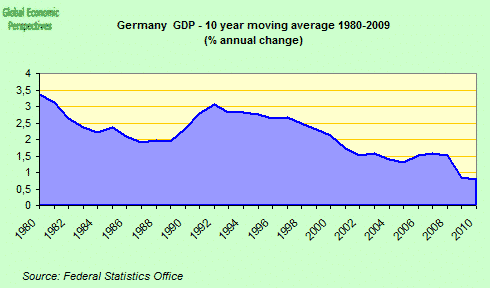
Look at the chart below and you can see the slowing growth.
German Long Term GDP
Germany is trade-dependent
Moreover, there is also the trade connection. Germany's export machinery creates a lot of economic volatility. That's why German's lead export group is pushing for Eurobonds. As I put it when the sovereign debt crisis was first beginning, Spain's debt woes and Germany's intransigence lead to double dip.
If Spain is forced to run austerity measures as seems likely, in stage two, this shifts their government deficit markedly down. Given Spain's poor labour competitiveness, sticky wage prices and inability to depreciate the currency, all of the adjustment falls onto the private sector in the form of reduced net savings (which could include larger debt burdens). But, the thing to realize is that total GDP in Spain is lower in this scenario, which means total imports are lower, which means Germany's total export volume is lower. This is a deflationary scenario.
And I use Spain here as a metaphor for the entire periphery. The euro zone is on the verge of a double dip, especially in view of the contractionary fiscal policies in the periphery. There is zero chance Germany can escape this unscathed.
Germany's banks are under-capitalised
Everyone knows the peripheral bailouts are about German and French banks. The European banks were undercapitalised before the crisis and are still undercapitalised today. The real problem for the Germans is the recklessness of their banking sector. We saw the bailouts of Commerzbank, IKB and WestLB, HSH Nordbanken, and so on. The Irish debacle is about bankers gone wild in Ireland AND Germany. I should also point out how reckless German banks like Hypo Real Estate have been implicated in misadventures in Spain. And just to reinforce how wild German banks went, we have to remember that even Deutsche Bank, the biggest and most well-respected German bank, was getting hand outs from the U.S Federal Reserve to prevent its insolvency during the liquidity crisis in 2008-2009. In terms of economic weakness, this may be less relevant. But in terms of potential sovereign defaults or a banking crisis it is very relevant.
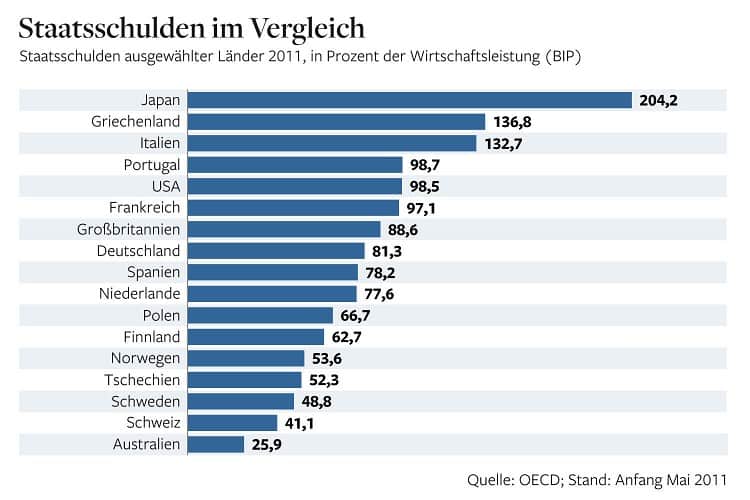
Germany does have a high debt load
I think this graphic from Die Welt makes that clear. Germany's fiscal record is significantly worse than Spain's over the last decade before the credit crisis such that it still has a higher debt-to-GDP ratio even today.
National Debt comparison
My point: There are a lot of reasons Germany has been doing well: wage restraint, educated workforce, low unemployment, etc. I could go on and on. But in a global growth slowdown, the Germans will not be immune any more this go round than they were last time when their contracted more violently than most along with the other export-dependent aging society, Japan. Austerity in the west, debt overhangs in the periphery and monetary tightening in emerging markets will act to slow demand globally. And this will certainly impact Germany.
If Germany wants continued economic success, its government must do a much better job in leading the euro zone out of its existential crisis. If the periphery sinks, we all sink.
__._,_.___

16 ago 2011

Científicos rusos pronosticaron terremoto de Japón hace 14 años

Científicos rusos pronosticaron terremoto de Japón hace 14 años

Tema de actualidad: Fuertes terremotos sacuden Japón

Científicos rusos pronosticaron terremoto de Japón hace 14 años
© REUTERS/ Aly Song
15:40 16/03/2011
Vladivostok (Rusia), 16 de marzo, RIA Novosti.
Científicos de la ciudad rusa de Vladivostok pronosticaron en 1997 que habría un seísmo devastador en el noreste de Japón este año.
"Auguramos que en 2011 habría una serie de sacudidas de magnitud equivalente o superior a 10 grados en la zona de Kanto. Y es precisamente esta parte de Japón la que ha sufrido ahora los mayores estragos", manifestó a RIA Novosti Valeri Abrámov, jefe del laboratorio de Geología y Tectonofísica Regional en el Instituto del Pacífico anexo a la filial de la Academia de Ciencias de Rusia en el Lejano Oriente.
Para avalar sus palabras, Abrámov enseñó el ejemplar de una revista local, "Obras del club de profesores de la UNESCO", que publicó aquel pronóstico en 1997. El vaticinio se sustentaba en una inmensa base de datos acerca de la actividad sísmica en el Lejano Oriente y se remitía, entre otras cosas, al poderoso terremoto de 1923 en Japón. Tras analizar toda la información, los investigadores usaron fórmulas especiales para comprobar el carácter cíclico de tales seísmos.
El Consulado General de Japón en Vladivostok, según Abrámov, solicitó y recibió en mayo de 2006 el pronóstico y los materiales relacionados pero se ignora qué uso les dio finalmente. Por las mismas fechas se produjo en Japón un terremoto bastante fuerte que, a juicio del investigador ruso, presagiaba lo ocurrido el 11 de marzo de 2011.
Las autoridades de Japón, en su opinión, estaban avisadas del terremoto y podían haber evitado una parte de los daños. "Si hubieran disminuido desde principios de 2011 la presión energética sobre las centrales nucleares, habrían prevenido fugas de radiación desde los reactores. Todo parece indicar que científicos japoneses, basándose en estudios propios, descartaban la posibilidad de un temblor", señaló.
__._,_.___
.

__,_._,___

Uranio y otras timbas


The Death of the Nuclear Power Renaissance
How Japan's Nuclear Disaster has Affected Global Sentiment

Eric Fry
Eric Fry
Reporting from Laguna Beach, California...

Chris Mayer, editor of Mayer's Special Situations, shared this bit of investment wisdom with his subscribers yesterday:

"Charlie Munger, the long-time Vice Chairman of Berkshire Hathaway, says there are three buckets where investment ideas go: 'Yes,' 'No' and 'Too Hard.' I think uranium is too hard."

We would not quarrel with that logic; and we certainly would not quarrel with Chris's caution. As an early, and indefatigable, bull on uranium, Chris led his subscribers to some very large gains in the sector. After yesterday's selloff, some of those gains were much smaller than they had been. Nevertheless, Chris told his subscribers to "hit the bid" on two of the uranium plays he had recommended.

"I think we should sell our two uranium holdings," Chris wrote. "We'll book a 73% gain on Kalahari Minerals (KAH:lsx) and a 10% gain on Paladin Energy (PDN:tsx; PALAF:pink sheets). The latter is down 23% today. Once, we were up 70% on the name. So this is a disappointment. But Kalahari is a very nice win for a stock we held little more than a year."

Uranium is "too hard" indeed. On the other hand, nothing is very easy these days. Following the Nikkei's vertical plunge during the last two days, most stock markets around the globe also posted minus signs. From the highs of March 11 - the day the 9.0 quake struck - to the lows of today, Japan's Nikkei Index plunged more than 20%. The would-be buyers of Japanese stocks apparently decided that widespread devastation and smoldering nuclear power plants are not bullish phenomena.

Following the Nikkei's example, the MSCI EAFE Index of international stocks dropped 7% during the last three trading sessions and erased its gains for the year-to-date. Here in the States, stocks are also wobbling. But buying interest seems to await every selloff. On Monday morning, the Dow Jones Industrial Average sliced through 12,000 immediately after the opening bell and fell as much as 140 points. But as the lunchtime hour was drawing to a close - about the time the third martinis were making their way to the lunch tables - investors regained their bravado.

No tsunami carnage or atomic plumes were going to get in the way of their "Buy" orders! Nosirree! And no Middle East civil wars were either. After all, Warren Buffet bought Lubrizol. That had to count for something, right?

By day's end, the Dow had trimmed its losses to a mere 51 points, while nearly reclaiming the 12,000 mark. In this morning's trading session, the Dow is attempting an encore. After tumbling nearly 300 points at the opening bell, the Dow has shaved its losses to only 150 points (as of this moment). Even so, the NASDAQ Composite Index has slipped into the loss column for the year-to-date, while the Dow and S&P 500 are flirting with a similar fate.

Tomorrow is another day, of course. But tomorrow's news stories probably won't look dramatically different from today's. One possible exception may be the news stories circulating about the nuclear power industry.

According to today's headlines, the post-quake crisis at several Japanese reactors is a "Three Mile Island event" that will stop the growth of nuclear power dead in its tracks. A gaggle of government officials around the world are saying as much...and we take them at their word, sort of.

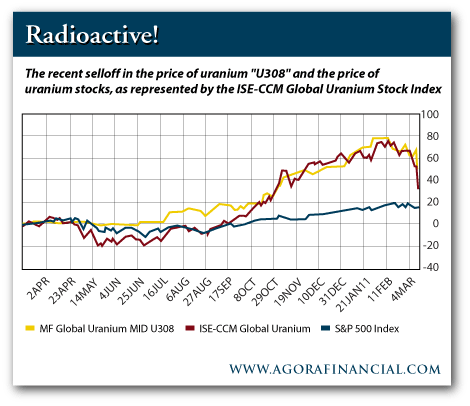
Obviously, the unfolding nuclear tragedy in Japan is not a non- event...as the harrowing volatility in global stock markets attests. The uranium sector, in particular, is in full meltdown mode: The ISE- CCM Global Uranium Stock Index has plummeted 27% during the last week. The price of uranium itself ("U308") is down a similar amount. Not a good week for the uranium bulls.

Uranium Selloff and Uranium Stock Performance

But just maybe, tomorrow's headlines about the fate of nuclear power will not resemble today's. Just maybe, tomorrow's headlines will be less bearish. Our respected colleague, Chris Mayer, is not optimistic. "The nuclear power renaissance is dead," he says flatly in the column below. Chris makes a compelling argument. And it almost never pays to disagree with the man (which is why we almost never do). But we suspect that nuclear power will live to fight another day...and will do so within an "investable timeframe."

As regular readers of The Daily Reckoning may recall, your editor named uranium as his "Trade of the Decade." Two months ago, this call looked brilliant (or lucky). Today, not so much. Two months ago, uranium and uranium stocks were both sitting atop plump 50% gains for the decade- to-date. But those gains have shriveled to single digits.

So where to from here?

Admittedly, given the crisis in Japan, uranium might not be the "Trade of 2011." But we think uranium investments still have a solid shot at performing well throughout the rest of the decade. In other words, we'll keep dancin' with the one who brung us - not just for sentimental reasons, but for stone-cold economic reasons. Environmental disasters notwithstanding, nuclear power remains an extremely competitive and compelling alternative to fossil-fuel-powered electricity generation.

The opponents of nuclear power tend to portray the contrast between nukes and hydrocarbon-generated electricity as a choice between adopting a rabid hyena or a Golden Retriever puppy. But the contrast is not quite that extreme or simplistic. A more accurate metaphor might be choosing between sleeping under a guillotine blade every night or sleeping in an airport smoking lounge. As long as the blade never falls, that's a much better - and healthier - place to sleep.

That's the nuclear industry's critical challenge: preventing that blade from falling, no matter what. The newest nuclear technologies purport to achieve exactly that. Meanwhile, the world's coal-fired power plants are continuously converting the earth's atmosphere into a smoking lounge. This reality will not change, which is one very big reason why the demise of nuclear power may have been greatly exaggerated.

Nuclear power has played - and continues to play - an essential role in worldwide power generation. More to the point of this discussion, nuclear power's role is growing most rapidly in the economies of the world that are growing most rapidly. The Fukushima disaster won't change that trend.

To be sure, the world's newfound anxieties about nuclear power are probably not nothing; but they may not be very much of anything. For starters, many of the "concerned" individuals who are voicing anti-nuke viewpoints are individuals who happen to have an additional agenda or two in their hip pockets. Many of these individuals are either members of an opposition party in their particular country or are members of some group that has long opposed nuclear power.

In the midst of the crisis, no one wishes to oppose these dissident voices. But once the crisis passes, the dissident voices may have to yell a little louder if they wish to be heard...and these voices might have to yell really, really loudly if the price of crude oil surges toward $150 or $200 a barrel.

Secondly, many of the folks who are issuing the harshest anti-nuke remarks reside in countries like Germany and the US that were already hostile to nuclear power.

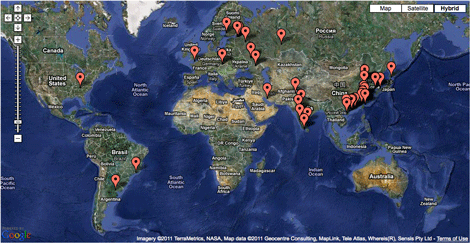
The map below, courtesy of the World Nuclear Association, identifies the locations of nuclear power plants that are currently under construction. Of these, 42% reside in China; 16% in Russia and 11% in India. The G-7 countries, combined, account for only 3% of all nuclear plants currently under construction!


So if you are an investor in uranium, do you really care that Germany might not renew some nuclear power licenses or that Switzerland will find a new way to stall construction of three new nuclear plants?
Even in the Developed World, the news for the nuclear industry is not all bad. At the very same moment that the Swiss and the Germans were pandering to their publics, the French, Spanish and Italians were promising full-speed ahead on their nuclear power programs.

"France will continue to rely on nuclear power," Bloomberg News reports. "Spain, which is extending the life of existing plants, said Fukushima won't hold back its nuclear policy. Italy's environment minister said the earthquake won't make the country reconsider to build new plants."

"We can't switch to renewables overnight," says French Environment Minister Nathalie Kosciusko-Morizet said. "For the foreseeable future, we will need nuclear."

So will the rest of the world. Net-net, the long-term prognosis for nuclear power may not be as grim as the near-term headlines suggest.


Dots
Dots

The Daily Reckoning Presents
Japan's "Three Mile Island"

Chris Mayer
Chris Mayer
Japan's nuclear disaster is tragic on many levels. My focus here, though, will be on what it means for uranium investments and the world's energy markets.

The main worry is that the situation in Japan chills the industry in the same way Three Mile Island did in 1979. Will political pressures quash the nuclear renaissance? It's too early to know for sure how this will play out, but we can make some guesses.

First, some context...

Japan's disaster affected at least six nuclear reactors. In total, 11 reactors in Japan have had emergency shutdowns and will be offline for months. The focus right now is on the nuclear reactors at a 40-year-old power plant that are experiencing partial meltdowns. These reactors are at the Fukushima Daiichi power plant, run by Tokyo Electric Power Co. (TEPCO). There are six reactors in total on this site, ranging from 35 to 40 years old. The number 1 reactor is the second oldest in Japan and is 40 years old.

It's not certain how much radiation is escaping from the plant, but clearly, the news is going from bad to worse.

The shutdown of these reactors removes about one quarter of Japan's total nuclear generating capacity and 4% of its total electrical generating capacity. For TEPCO, the Fukushima site is about half of its nuclear capacity and about one-third of its total capacity.

To replace its lost nuclear power, TEPCO will likely make up the difference by importing more liquefied natural gas (LNG) and oil. This could create something of a shock in the energy markets, though it is hard to say. Yes, Japan has to replace lost energy sources. But it will have less demand as factories close and as economic activity grinds to a halt in some regions. As it is, Japan is the world's third-largest oil importer and second-largest LNG importer. In addition to LNG and oil, Japan will likely tap the coal markets to help make up the gap.

Then, too, there are political wild cards. If Japan orders its existing reactor fleet to shut down temporarily, the impact on global energy markets will be that much larger.

The political wild cards are the most worrisome thing for uranium investors - and not only in Japan. It didn't take long before a US politician - in this case, Rep. Ed Markey (D-MA.) - warned of "another Chernobyl" and predicted "the same thing could happen here." He called for an immediate suspension of licensing procedures for the new AP1000 reactors that have been crawling their way through the regulatory process for seven years.

Of course, the US is not the focus of the uranium story. The US hasn't built a new nuclear plant since 1979, after the Three Mile Island disaster. Even so, old reactors supply 20% of US electricity.

In Europe, too, opponents of nuclear power jumped on the issue. Germany's Chancellor Angela Merkel called for an immediate safety inspection of the country's 17 nuclear plants. And opponents called for Germany to abandon plans to extend the lives of 10 European reactors. They also wanted Germany to close its oldest plants. European regulators are supposed to meet early this week in Brussels.

Still, two-thirds of the 324 proposed new reactors will come from outside Europe or the US. The uranium story is mainly an Asian story. China, Vietnam and Thailand have over 100 nuclear plants on the drawing boards. What they do will mean a lot as far as the nuclear renaissance is concerned.

Already, Thailand's prime minister said that Japan's incident would "impact the decision of whether to build nuclear plants in Thailand." China, however, reaffirmed its commitments. But Asian power plants had not advanced smoothly, even before this whole disaster happened. About a year ago, Indonesia postponed its first nuclear plant after protests from villagers.

So this is where we are.

One of the great risks anyone investing in uranium takes on - the risk that another catastrophe sets the industry back - has finally unsheathed its sword.

How much will facts matter in the debate about nuclear power?

The fact is that all energy sources have risks, as The Wall Street Journal editorial column points out today. There are rig explosions, tanker spills and mining accidents. Still, nuclear has the most devastating consequences of error.

William Tucker outlines more facts in a column entitled, "Japan Does Not Face Another Chernobyl." He points out, "You can't have a 'runaway reactor,' nor can a reactor explode like a nuclear bomb. A commercial reactor is to a bomb what Vaseline is to napalm. Although both are made from petroleum jelly, only one of them has potentially explosive material."

He follows with some technical explanations about how new reactors do not share the design flaws of older reactors. His conclusion:

"What the Japanese earthquake has proved is that even the oldest containment structures can withstand the impact of one of the largest earthquakes in recorded history. The problem has been with the electrical pumps required to operate the cooling system. It would be tragic if the result of the Japanese accident were to prevent development of Generation III reactors, which eliminate this design flaw."

Still, I wonder how much facts will matter in this case. How much did logic and reason dictate what happened after the BP Horizon oil spill? The US government banned all drilling for a time. It didn't matter how safe your rig was. And a de facto moratorium still exists, with new drilling permits incredibly difficult to come by. Why would it be different with nuclear power?

I don't expect sudden enlightenment on the part of the public or politicians. I expect they will do what is easy and what plays well on TV. The easy thing to do is to quash development of new reactors, one way or another.

As I say, it's too early to know for sure how this will play out. Your guess is probably as good as mine. My guess is this: The nuclear renaissance is dead.

I think we should sell our two uranium holdings. We'll book a 73% gain on Kalahari Minerals (London:KAH) and a 10% gain on Paladin Energy (Toronto:PDN). The latter is down 23% today. Once, we were up 70% on the name. So this is a disappointment. But Kalahari is a very nice win for a stock we held little more than a year.

At the moment, I'm undecided on Cameco (NYSE:CCJ), which I recommended early last year to the subscribers of Capital & Crisis. It's the biggest and best-capitalized company in the uranium sector. We'll still need uranium to feed existing reactors. And not all planned reactors will die on the drawing boards. If you hold anything in uranium, this would be the one to hold.

I may be completely wrong about how the uranium story plays out. Maybe people look past Japan and continue to merrily build nuclear plants around the world. Somehow, I don't think that will happen. In any case, it seems prudent to book some gains and move on to easier ideas.

As Charlie Munger likes to say, there are three buckets where investment ideas go: "Yes," "No" and "Too Hard." I think uranium is too hard.

Regards,

Chris Mayer,
for The Daily Reckoning


Dots
Dots

Bill Bonner
Who Will Buy the Bonds Japan Needs to Sell?

Bill Bonner
Bill Bonner
Reckoning from Baltimore, Maryland...

The world seemed to hold its breath yesterday. People watched videos of the tsunami...of the earthquake...of the nuclear reactors. Japan's nuclear reactors were on the verge of a meltdown.

Here at The Daily Reckoning, we predicted a meltdown in Japan - but not that kind of meltdown!

In January, seers and forecasters turned in their predictions for the year ahead. Now, we are in March, and we have already run into two major events that no one predicted.

First, the Arab world exploded. Now, the blow-ups are happening in the least-explosive part of the world, Japan.

Japanese stocks sold off yesterday. If they were a bargain when we recommended them a couple weeks ago, they are an even bigger bargain today. US stocks didn't do much of anything.

Perhaps some kind of turning point has been reached.

Japan has been suffering from a manmade disaster for the last 20 years. It is a long, slow, painful form of national economic suicide. Now it is time to pick up the pace. This from Bloomberg:

The Bank of Japan poured a record amount of cash into the financial system and doubled the size of its asset-purchase program to shield the economy from the effects of the nation's strongest earthquake on record.

The central bank pumped 15 trillion yen ($183 billion) into money markets to assure financial stability amid a plunge in stocks and surge in credit risk. Governor Masaaki Shirakawa and his board also increased their facility that buys assets from government bonds to exchange- traded funds to 10 trillion yen.

"We are providing as much funds as needed to dispel anxiety in financial markets," Kazushige Kamiyama, an official in charge of the central bank's money market operations, said before the policy announcement. "We will continue to add ample funds to stabilize financial markets."
It used to be that central banks were charged with maintaining the integrity of the people's money. Then, mission creep set in. Maintaining full employment was added to the job description. And then, Ben Bernanke took it upon himself to boost stock prices. Higher stock prices would encourage people to spend and invest, he thought.

And now, the Bank of Japan takes another step. It is playing a leading role in earthquake remediation - like the Red Cross or the National Guard.

The Bank of Japan is going all out. Not only is it putting emergency funds into the economy, it's also stepping up its own QE program.

What else can it do? It was already doing all it could. The BOJ has been "zero bound" for the last 15 years - meaning, it has been lending money as cheaply as it possibly could. If monetary policy were a pair of pants it would be around Japan's ankles. And fiscal policy? The country already has $20 of debt for every dollar of tax receipts. What's left? Thirty dollars, surely - or bankruptcy!

There's unconventional stimulus too. That's right...the old printing press...is getting a good workout.

Onward!

And more thoughts...

The Japanese camel has a remarkably strong back. He's held up to more than two decades of counter-cyclical stimulus programs...and central government debt that now measures 200% of GDP.

The poor long-suffering beast has seen everything. The Japanese trusted the government with their retirement money. The government spent the money. And yet, bond buyers seem none the wiser. They still lend to the Japanese government at less than 2% yield.

And now the old-timers are beginning to dis-save. That is, after saving so much for their retirements, now they are retired. And now they are drawing down their savings.

This puts the Japanese government is in a real fix. Net savings in Japan are now negative. So, who will buy the bonds Japan needs to sell in order to rebuild its economy? Who will buy the bonds Japan needs to sell in order to rebuild its infrastructure? Who will buy the bonds Japan needs to sell in order to fund its government? Who will buy the bonds Japan needs to sell in order to pay back the people who bought bonds last year...and the year before...and all the way back to 1990?

The answer is likely to be: no one.

Instead, Japan will be forced into more QE, forced to print money to make up for the money she can no longer borrow.

This will have a couple knock-on effects. First, the Japanese famously helped Europe and America finance their deficits and bailouts. Recently, Japan funded a major part of Europe's bond sales - helping to hold down rates. Also, the last time we looked, Japan had the largest stash of US bonds in the world.

Under pressure to bring money back to the home island, you can expect Japan to be doing some selling - which might be the final straw.

Second, the Japanese are making such an obvious mess of their finances that they are bound to attract attention. Investors might notice that the Japanese aren't the only ones. As we've pointed out several times, the developed economies all now count on low interest rates, huge deficits, and printing press money. Even with these massive in-puts of cash and credit grease, the economy still barely creaks forward. Without the extra grease, they will probably slip backward.

*** The ides of March are upon us already. Little blue flowers are pushing their way up through the cold earth. There are buds on lilac bushes. Cherry trees are already in bloom... Another winter seems to be history already. Where did it go?

They seem to go by so fast now...and now we've already put our clocks forward. Here it is, 5PM... It is bright and sunny outside.

We're worried about the way time seems to be speeding up. As near as we can tell, we're in good health...but we can only expect to live a decade or two more. What a pity it would be if they went by too fast.

We're on the downhill slope now. Picking up speed as we go down. Every year that goes by will find us with less hair...less muscle...maybe even less able to think clearly and remember where we left the car keys. Next year, is nothing to look forward to in other words, not compared to this year.

The odd thing is that we tend to think about things that will happen in the future...and we're impatient. We tell ourselves to "slow down...smell the flowers...enjoy the here and now." But the here and now never seems as good as tomorrow.

We're looking forward to finishing the fences...to having the orchard cleaned up...to fixing up the loft apartment in the barn. But why? What will we do next? What's the point?

We are racing ahead...but only so that time can rush forward to meet us.

Regards,

Bill Bonner
for The Daily Reckoning


__._,_.___

15 ago 2011

Has The Tsunami In Japan Destroyed The Japanese Economy?

Posted on sáb 12 mar 2011 15:07:47 

The entire world is in a state of mourning today as details regarding the horrific damage caused by the massive tsunami in Japan continue to trickle in. The magnitude 8.9 earthquake that caused the tsunami was the largest earthquake that Japan has ever experienced in modern times. Waves as high as 30 feet swept over northern Japan. The tsunami waters reached as far as 6 miles inland, and authorities have already recovered hundreds of dead bodies. Those of us that have seen footage of this disaster on television will never forget it. But this nightmare is not over yet. There have been dozens of aftershocks, and many of them have been quite large. In fact, there have been 19 earthquakes of at least magnitude 6.0 in the area over the last 24 hours. So what is this disaster going to do to the 3rd largest economy in the world? Japan already had a national debt that was well over 200 percent of GDP. Could this be the "tipping point" that pushes the Japanese economy over the edge and into oblivion?
It is hard to assess the full scope of the damage to Japan at this point, but virtually everyone agrees that much of northern Japan is a complete and total disaster area at this point. Many towns have essentially been destroyed. Some are estimating that the economic damage from this disaster will be in the hundreds of billions of dollars. Others believe that the final total will be in the trillions of dollars.
Fortunately, major cities such as Tokyo came through this event relatively unscathed and most of the major manufacturing facilities are not in the areas that were most directly affected by the earthquake and the tsunami.
But let there be no doubt, this was a nation-changing event. Japan will never quite be the same again.
Also, it isn't just Japan that will be affected by this. The truth is that economic ripples from this event will be felt all over the world.
An economist from High Frequency Economics, Carl Weinberg, told AFP the following about the economic consequences of this disaster....
"There is no way to assess even the direct damage to Japan's economy or to the global economy. This is a sad day for Japan, and economic aftershocks could affect the whole world's economy."
It is literally going to take months to figure out exactly how much damage has been done. Let us just hope that we don't see any more major earthquakes in the area.
The Japanese are a very resilient people and the Bank of Japan is already vowing that it will be doing whatever is necessary to ensure the stability of the financial markets. The Bank of Japan has announced that it is going to provide as much liquidity as necessary to keep the Japanese economy functioning normally.
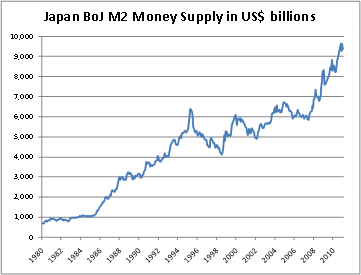
But the truth is that the Bank of Japan has already been printing money like crazy....
aligncenter size-full wp-image-1966
Is a tsunami of new yen really going to solve the economic damage that has been done by the earthquake and the tsunami?
Of course not.
The truth is that the economy of Japan was already deeply struggling before this disaster.
The national debt of Japan is now well over 200% of GDP and there seems to be no doubt that they will need to borrow massive amounts of money to deal with the aftermath of this crisis.
Up until now the Japanese government has been able to borrow money at ultra-low interest rates of around 1.30 percent for 10-year bonds, drawing on a huge pool of savings from its own citizens.
But in light of what has just happened, will the citizens of Japan still have enough resources to continue to fund the rampant spending of the Japanese government?
At this point, it is estimated that this gigantic mountain of debt breaks down to 7.5 million yen for every single citizen of Japan.
Politicians in Japan have been pledging for years to do something about all of this debt, but nobody has been able to make much progress.
Even before this disaster, the major credit rating agencies were warning that they may have to downgrade Japanese government debt. The earthquake and the tsunami are certainly not going to make the Japanese even more credit-worthy.
Hideo Kumano, the chief economist at Dai-ichi Life Research Institute, has said that a "tipping point" will come when world financial markets finally recognize that the government of Japan simply cannot afford to service its debt any longer....
"It's hard to predict when the bond market might collapse, but it would happen when the market judges that Japan's ability to finance its debt is not sustainable anymore."
Is the massive tsunami that just hit Japan such a tipping point?
Other countries such as Greece and Ireland would have already collapsed if it had not been for the massive international bailouts that they received.
So who is going to bail Japan out?
This could potentially be one of the greatest economic disasters that the world has seen since World War 2.
With the world already on the verge of a major financial collapse, this is the last thing that world financial markets needed.
In fact, much of the rest of the world had been hoping that an influx of capital from Japan would help to stabilize things.
For example, Japanese insurance companies had recently announced that they were planning on buying up lots of European sovereign debt, but now obviously those plans are on hold. As a result of this disaster, Japanese insurance companies will be forced to sell off assets like crazy in order to pay settlements. But as Zero Hedge is correctly pointing out, without Japanese financial institutions stepping in to soak up Eurozone bonds this is going to make the European sovereign debt crisis even worse.
But right now the focus in on the devastation in Japan. At the moment it is unclear how much of the economic infrastructure of Japan has survived.
For example, as USA Today is reporting, some factories cannot even be reached by phone at this point....
Toyota's phone calls to its plants in affected areas were not being answered, said Shiori Hashimoto, a spokeswoman in Tokyo. The Toyota City-based carmaker began production at a new plant in Miyagi this year that makes Yaris compact cars and has capacity to make 120,000 vehicles a year.
What is clear is that the cost of recovering and rebuilding after this disaster is going to put extraordinary financial stress on the Japanese government.
Julian Jessop of Capital Economics certainly does not sound optimistic about what this is going to mean for the Japanese economy....
"Japan's economic recovery has lost momentum and a large part of the reconstruction costs will add to the government's significant debt burden."
Hopefully the full extent of the damage is not as bad as many are now fearing.
But the truth is that this is a huge, huge event for a world economy that was already on the verge of collapse.
May our thoughts and our prayers be with the Japanese people at this time.
This is truly one of the biggest disasters that any of us have ever seen, and Japan will never be the same again.
.
__,_._,___

Scientific American: Chernobyl ahora

Contaminantes radioactivos vida "útil" en la atmósfera:
Iodine-131 decae rapidamente en unos 3 meses
cesio-137 y estroncio 90, ambos tienen aproximadamente 30 años de vida media,
plutonio-239, uno de los principales isótopos en los reactores nucleares, tiene una media la vida de más de 24.000 años.


The worst nuclear plant accident in history: Live from Chernobyl

By Charles Choi | Mar 15, 2011 08:00 AM | 3
Choi in control room for reactor No. 4 at ChernobylCHERNOBYL, Ukraine—The face mask and three radiation monitors I'm wearing here are grim reminders that I'm at the site of the worst nuclear accident in history. On April 26, 1986, 1:23:44 A.M. local time, explosions destroyed reactor No. 4 at the Chernobyl nuclear power plant, releasing approximately 400 times more radioactive fallout than the atomic bomb dropped on Hiroshima, according to the International Atomic Energy Agency.

Now, almost 25 years after the disaster, the Ukrainian government has officially opened the area up for tourism. But just how safe is the zone now?

Radiation
After the explosions, it was unclear how contaminated the surroundings were, so the authorities declared an arbitrary 30-kilometer distance from the reactor off-limits, and roughly 115,000 people were evacuated from the area. This "exclusion zone" is now open to tourism.

I drove to Chernobyl with health physicist Vadim Chumak at the Research Center for Radiation Medicine at the Health physicist Vadim ChumakAcademy of Medical Sciences of Ukraine and his colleagues. A car shuttles there every week to collect stool samples from workers to test for any plutonium they might have accidentally absorbed. (Science, like journalism, can be a dirty job, but someone has to do it.)

The world is normally bathed in a low level of radiation. In Kiev, where I started my trip, one normally receives 0.1 millionths of a sievert every hour. This is pretty much the level of radiation we saw on the road on the roughly two-hour, 150-kilometer drive into the exclusion zone, but readings on our dosimeter temporarily climb up to 4.76 millionths of a sievert per hour when our car passes through the old path of the radioactive plume from the destroyed reactor.

How safe this area is now after the accident depends on what radioactive material was released and where it went. There are four kinds of radionuclides or radioactive isotopes that are of special concern at the site. Iodine-131 is rapidly absorbed by the thyroid gland and increases the risk of childhood thyroid cancer. Cesium-137 mimics potassium inside the body, seeking out muscle. Strontium-90 acts like calcium, attracted to bone. Plutonium-239 and other isotopes can stay in the body indefinitely, irradiating organs.

These four materials escaped from the explosions to varying distances, given factors such as their mass and melting points. Iodine-131 and cesium-137 were both very broadly transported hundreds of kilometers, while strontium-90 remained in dust just 30 kilometers from the power plant and plutonium traveled only four kilometers or so.
Iodine-131 decays rapidly, and was virtually gone from the environment after only three months, Chumak says. However, cesium-137 and strontium-90 both have approximately 30-year half-lives, meaning they each take roughly three decades for half their material to decay, and plutonium-239, one the main isotopes in nuclear reactors, has a half-life of more than 24,000 years.


After the disaster, both emergency workers dubbed "liquidators" and natural forces helped to reduce airborne levels of radiation. The liquidators sprayed detergents and latex-like binding solutions from helicopters and automobiles to bind contaminants. The roads were paved to cover radioactive dust, while ploughs flipped soil over to bury polluted soil. Meanwhile, rain helped contaminants migrate down into the ground.

The exclusion zone was possibly safe for tourism "about five years after the accident," Chumak says. Still, just because one can tour the area does not mean everywhere here is safe to tread. There are hot spots that remain highly contaminated, especially in the path of the radioactive plume. Where tourists are allowed to go and how long they will be allowed to stay will be strictly controlled to keep their risks of exposure down.

And there are some places here that remain too dangerous for tourists to go, such as the sarcophagus.

Inside the sarcophagus
Soon after firefighters extinguished the blazes from the explosions at Chernobyl, workers quickly built a structure of steel and concrete technically known as the Shelter Object but commonly known as the sarcophagus to entomb the remains of the damaged reactor and keep any more contaminants from escaping. It remains one of the most radioactive areas in the zone.

entrance to a "hot room" at the facility where workers at Chernobyl change their clothingNowadays, workers here maintain the corroding sarcophagus, monitor the radioactive material inside, and decontaminate what they can. To enter the structure with them, I strip down to only my underwear in a "clean room" and walk in a hospital gown and slippers into a "hot room," where I put on the pure white outfit given to everyone on site—scrubs, a jacket, trousers, a scrub cap, socks, gloves and a mask with the highest-grade filter available for dust. On top of that I don an overcoat, a hardhat and crusty boots. In addition, I am carrying the radiation radiation badgebadge I had when I entered the 30-kilometer exclusion zone, a second radiation badge I was given when I entered the area of the plant, and a personal electronic dosimeter to tell me exactly how much radiation I am receiving.

(The workers don't normally wear lead shielding, and neither do I. Although lead can protect against radiation, it slows you down, thus increasing the dose you ultimately receive.)

The maximum dose of radiation that workers here are generally allowed on a daily shift is 0.1 thousandths of a sievert, the level of radiation one gets from a 90-minute transatlantic flight or from four hours watching a plasma screen television, says Vladimir Malyshev, chief safety officer at the Chernobyl nuclear power plant. When I am standing right in front of the sarcophagus, the readings leap up to 0.12 thousandths of a sievert per hour, or 1,200 times that seen in Kiev.

After passing an electronic checkpoint—one of a half-dozen or so that I stopped at—I find myself in the dark, gutted remains of the control room for reactor No. 4. Here engineers made the fateful errors that poisoned the Earth.

After returning from the sarcophagus, I leave everything I wore outside in a locker in the hot zone and take a mandatory shower to wash away any potential contamination. I don't think I've ever wanted to be clean more in my life.

Life and wildlife
Although Chernobyl might be safe for a day of tourism, living there is another question. The Ukrainian government did allow people who originally lived in the exclusion zone to resettle on an individual basis. For instance, some areas within 30 kilometers of the explosions are relatively clean, and the elderly would probably not absorb unhealthy levels of radiation in what time they had left, Chumak says.

However, some places remain too dangerous for resettlement. "People might be allowed to live in the 30-kilometer zone, but I don't expect anyone to live within the 10-kilometer zone, ever," Chumak says. "There's some plutonium there."

Officials there did say I should look out for wildlife in the zone. "A mad wolf attacked six people here recently," Malyshev says.

The disaster's impact on wildlife in the zone remains hotly contested. For instance, radiation biologist Ron Chesser at Texas Tech University in Lubbock and his colleagues suggest the area is thriving with life now that humans have left, finding that the wild boar population there has grown 10 to 15 times than what it was before the accident, and that other fauna are often seen in the area, such as wolves, rabbits, red deer, black storks and moose. Their genetic work suggests that any effects of radiation are subtle enough to not lead to any mutations passed down across generations, with the animals perhaps acclimatizing to any damage by boosting their genetic repair mechanisms. As bad as the radiation is, the effects of humans on the environment might have been worse, Chesser concludes.

On the other hand, biologist Tim Mousseau at the University of South Carolina at Columbia and his colleagues have found that species richness of forest birds was reduced by more than half when comparing sites with normal background levels of radiation to sites with the highest levels in the exclusion zone, and the numbers of bumblebees, grasshoppers, butter ies, dragonflies and spiders decreased too. Analysis of more than 7,700 barn swallows in Chernobyl and other areas in Ukraine and Europe suggested ones from in or near the exclusion zone had higher levels of abnormalities such as deformed toes, beaks and eyes or aberrant coloration, and recent work also suggests that birds living in areas with high levels of radiation around Chernobyl have smaller brains.

Both teams stand by their own work and suggest the other made errors related to geographic variability.

radar gridTourist attraction?
So what can tourists see at Chernobyl? One can often see and feed giant catfish in the 22-square-kilometer nuclear power plant cooling pond, although during cold weather, the pond is frozen over and covered in snow. In the distance, one can also see a giant radar grid roughly 150 meters high—taller than the Great Pyramid of Giza's current height—once meant to track any nuclear missiles launched from the United States. "It needed a lot of power, which is why it was near Chernobyl," Chumak explains.

The city of Pripyat, abandoned after the accident, is frozen in time, with the Communist hammer and sickle still adorning streetlights here. Nature is reclaiming the area, with white birch and green pines hiding many of the blocky Soviet buildings and animal tracks fresh on the snow still covering the ground here in the first week of March.

By a dock near a riverside cafe in Pripyat, the scientists I traveled with started gathering pussy willows, completely unbidden. These flowers bloom under the snow, and the men want to bring them back for International Women's Day on March 8. "These mean spring," says physicist Vitalii Volosky at the Research Center for Radiation Medicine in Kiev.

Despite the official announcement, tourism to Chernobyl is nothing new—trips have been going there for about a decade. The recent publicity regarding tourism may have its roots in the economic impact of Chernobyl—even two decades after the disaster, roughly 6 percent of the national budgets of both Ukraine and Belarus were still devoted to Chernobyl-related benefits and programs, according to a 2005 report from the Chernobyl Forum, comprised of eight United Nations agencies and the governments of Ukraine, Belarus and Russia. "There is this motivation there to do what can be done to return some of this land to productive use," Mousseau says.

Among those who lived through the disaster, the idea of tourism to Chernobyl brings up strong emotions, just as it might for New Yorkers dealing with 9/11. "If we are wise, we will make Chernobyl a museum for humankind just like Hiroshima and Nagasaki," Chumak says.

Among the younger generation in Kiev, there is real interest in visiting. "My son really wants to go, as do a couple of young students here," Chumak says.

Still, for others, tourism to Chernobyl holds no attraction. "Personally, every trip I make there is not a positive one," says physicist Elena Bakhanova at the Research Center for Radiation Medicine in Kiev. "It was a human error, a sign of human foolishness."
Images: Charles Q. Choi in the control room for destroyed reactor No. 4 at the Chernobyl nuclear power plant; Health physicist Vadim Chumak at the Research Center for Radiation Medicine at the Academy of Medical Sciences of Ukraine in Kiev. He is wearing a respirator mask with the highest-grade filter available against aerosols, to protect against airborne contamination; The entrance to a "hot room" at the facility where workers at Chernobyl change their clothing. In the "clean room," I took off all my clothing except my underwear. In the hot room, I was given clothing to wear in the sarcophagus; Visitor's badge and radiation badge. The visitor's badge has a microchip scannable at electronic checkpoints. The radiation badge is a dosimeter that measures my exposure to radiation—the silver disk on the badge measures the radiation my skin received, while the black bump measured the levels deeper tissues experienced; This giant radar grid relatively close to the Chernobyl nuclear power plant was once meant to track any nuclear missiles launched from the United States. It is roughly 150 meters high, taller than the Great Pyramid of Giza's current height. Credit for all images: Charles Q. Choi.
Charles ChoiAbout the Author: Charles Q. Choi (@cqchoi) is a frequent contributor to Scientific American. His work has also appeared in The New York Times, Science, Nature and Wired, among others. In his spare time, he has traveled to all seven continents. This post is the first in a series of stories from Chernobyl that Choi has written for Scientific American.
The views expressed are those of the author and are not necessarily those of Scientific American.


http://www.scientificamerican.com/blog/post.cfm?id=the-worst-nuclear-plant-accident-in-2011-03-14


__._,_.___

ENTREVISTAS TV CRISIS GLOBAL

NR.: Director, no presidente ---------------------------------------------- Bruno Seminario 1 ------------------------- Bruno Seminario 2 -------------------- FELIX JIMENEZ 1 FELIZ JIMENEZ 2 FELIX JIMENEZ 3, 28 MAYO OSCAR DANCOURT,ex presidente BCR ------------------- Waldo Mendoza, Decano PUCP economia ---------------------- Ingeniero Rafael Vasquez, parlamentario 24 set recordando la crisis, ver entrevista en diario

Etiquetas

Peru:crisis impacto regional arequipa,raul mauro

Temas CRISIS FINANCIERA GLOBAL

QUIEN SOY?
claves para pensar la crisis

MATERIAS PRIMAS
-Metales
-Cobre
- plata
- oro
- zinc
- plomo
- niquel
- petroleo

-Tipo de cambio

- LA CRISIS

- BOLSA VALORES
- BANCOS
- PBI PAISES
- USA: DEFICIT GEMELOS
- UE: RIEN NE VA PLUS

CONTAGIO: CANALES

- PERU: DIAGRAMA DE CONTAGIO
- PERU: IMPACTO EN BOLSA
- MEXICO: HAY CRISIS?

LA PRENSA
COMENTARIO DE HOY

- DIARIOS DE HOY
NLACES

Coyuntura
Bancos centrales
Paginas Recomendadas

BLOGS

economiques
Interes

VIDEO

- Economia videos
- Crisis financiera global

TRICONTINENTAL

- AFRICA: daniel
- EUROPA: helene
- ASIA:
- AMERICA

COLUMNAS AMIGAS

Chachi Sanseviero

ETIQUETAS
por frecuencia de temas
por alfabetico

EVENTOS

FOTOS DEL PERU

GONZALO EN LA RED

JOBS
VOZ ME CONVERTIDOR
CLIMA
SUDOKU
PICADURAS

LOGO

LIBRO de GONZALO

La exclusion en el Peru

-Presentacion

- introduccion

- contexo economico

- crisis de la politica

- excluidos de las urbes

- excluidos andinos

- contratapa

VIDEOS ECONOMICOS
Crisis Enero 2009
Krugman
Globalizacion 1
Globalizacion 2
Crisis Brasil
Crisis bancaire
Karl marx revient

TODOS LOS DERECHOS RESERVADOS

GOOGLE INFORMA


PRESS CLIPPINGS-RECORTES PRENSA-PRESSE..

ETIQUETAS alfabetico