SECCION Crisis monetaria: US/EURO, dolar vs otras monedas

Gráfico del tipo de cambio del Dólar Americano al Euro - Desde dic 1, 2008 a dic 31, 2008

Evolucion del dolar contra el euro

US Dollar to Euro Exchange Rate Graph - Jan 7, 2004 to Jan 5, 2009

V. SECCION: M. PRIMAS

1. SECCION:materias primas en linea:precios


[Most Recent Quotes from www.kitco.com]


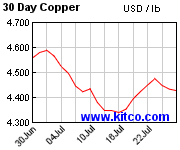
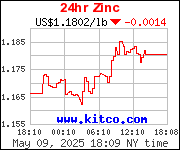
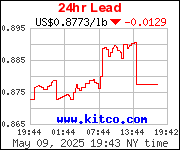
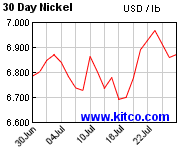
METALES A 30 DIAS click sobre la imagen
(click sur l´image)

3. PRIX DU CUIVRE

  Cobre a 30 d [Most Recent Quotes from www.kitco.com]

4. ARGENT/SILVER/PLATA

5. GOLD/OR/ORO

6. precio zinc

7. prix du plomb

8. nickel price

10. PRIX essence


petrole on line

Find out how to invest in energy stocks at EnergyAndCapital.com.

azucar

azucar
mercados,materias primas,azucar,precios y graficos azucar i otros

13 sept 2009

Fwd: Elements of Deflation, Part 2 - John Mauldin's Weekly E-Letter


---------- Forwarded message ----------
From: John Mauldin <wave@frontlinethoughts.com>
Date: 2009/9/12
Subject: Elements of Deflation, Part 2 - John Mauldin's Weekly E-Letter
To: ggarcianunez@gmail.com


This message was sent to ggarcianunez@gmail.com.

Send to a Friend | Print Article | View as PDF | Permissions/Reprints
Thoughts from the Frontline Weekly Newsletter
Elements of Deflation, Part 2
by John Mauldin
September 11, 2009
Visit John's MySpace Page

In this issue:
Elements of Deflation, Part 2
The Velocity Factor
Y=MV
Sir, I Have Not Yet Begun to Print
There Are No Good Choices
Washington DC, San Diego, and New Orleans, etc.

Just as water is formed by the basic elements hydrogen and oxygen, deflation has its own fundamental components. Last week we started exploring those elements, and this week we continue. I feel that the most fundamental of decisions we face in building investment portfolios is correctly deciding whether we are faced with inflation or deflation in our future. (And I tell you later on when to worry about inflation.) Most investments behave quite differently depending on whether we are in a deflationary or inflationary environment. Get this answer wrong and it could rise up to bite you.

The problem is that there is not an easy answer. In fact, the answer is that it could be both. Today I got another letter from Peter Schiff, who seems to be ubiquitous. He says the rise in gold is because of rising inflation expectations among investors. Gold is predicting inflation. Maybe, but the correlation between gold and inflation for the last 25-plus years has been zero. I rather think that gold is rising in terms of value against most major fiat (paper) currencies because it is seen as a neutral currency. The Fed and the Obama administration seem to be pursuing policies that are dollar-negative, and they give no hint of letting up. The rise in gold above $1,000 does not really tell us anything about the future of inflation.

In fact, it is my belief that if the Fed were to withdraw from the scene of economic battle, the forces of deflation would be felt in short order. The answer to the question "Will we have inflation in our future?" is "You better hope so!"

I wrote in 2003, when Greenspan was holding down rates too long in order to spur the economy, that the best outcome or endgame over the course of the full cycle would be stagflation. I still think that is the most likely scenario. The Fed will fight deflation and knows how to do that. They also know what to do when inflation becomes too high. But there is a cost.

It is not a matter of pain or no pain; it is a matter of choosing which pain we will face and for how long, and perhaps in what order. As I wrote a few weeks ago, like teenagers, we as an economic polity have made some very bad choices. We are now in a scenario where there are no good choices, just less-bad ones.

In a normal world, the amount of monetary and fiscal stimulus we are witnessing would produce inflation in very short order. That is what has the gold bugs of the world excited. It is their moment. They keep repeating that Milton Friedman taught us that inflation was always and everywhere a matter of too much money being printed. The answer to that is that the statement is mostly true, but not always and not everywhere (think Japan). The reality is somewhat more nuanced. Let's review something I wrote last year about the velocity of money, and this time we are going to go into the concept a little more deeply. This is critical to your understanding of what is facing us.

The Velocity Factor

When most of us think of the velocity of money, we think of how fast it goes through our hands. I know at the Mauldin household, with seven kids, it seems like something is always coming up. And what about my business? Travel costs are way, way up; and as aggressive as we are on the budget, expenses always seem to rise. Compliance, legal, and accounting costs are through the roof. I wonder how those costs are accounted for in the Consumer Price Index? About the only way to deal with it, as my old partner from the 1970s Don Moore used to say, is to make up the rise in costs with "excess profits," whatever those are.

Is the Money Supply Growing or Not?

But we are not talking about our personal budgetary woes, gentle reader. Today we tackle an economic concept called the velocity of money, and how it affects the growth of the economy. Let's start with a few charts showing the recent high growth in the money supply that many are alarmed about. The money supply is growing very slowly, alarmingly fast, or just about right, depending upon which monetary measure you use.

First, let's look at the adjusted monetary base, or plain old cash plus bank reserves (remember that fact) held at the Federal Reserve. That is the only part of the money supply the Fed has any real direct control of. Until very recently, there was very little year-over-year growth. The monetary base grew along a rather predictable long-term trend line, with some variance from time to time, but always coming back to the mean.

But in the last few months the monetary base has grown by a staggering amount. And when you see the "J-curve" in the monetary base (which is likely to rise even more!) it does demand an explanation. There are those who suggest this is an indication of a Federal Reserve gone wild and that 2,000-dollar gold and a plummeting dollar are just around the corner. They are looking at that graph and leaping to conclusions. But it is what you don't see that is important.

jm091109image001

Now, let's introduce the concept of the velocity of money. Basically, this is the average frequency with which a unit of money is spent. Let's assume a very small economy of just you and me, which has a money supply of $100. I have the $100 and spend it to buy $100 worth of flowers from you. You in turn spend the $100 to buy books from me. We have created $200 of our "gross domestic product" from a money supply of just $100. If we do that transaction every month, in a year we would have $2400 of "GDP" from our $100 monetary base.

So, what that means is that gross domestic product is a function not just of the money supply but how fast the money supply moves through the economy. Stated as an equation, it is Y=MV, where Y is the nominal gross domestic product (not inflation-adjusted here), M is the money supply, and V is the velocity of money. You can solve for V by dividing Y by M.

Now let's dig a little deeper. Y, or nominal GDP, can actually written as Y=PQ, that is, GDP is the Price paid times the total Quantity of goods sold. Therefore, since Y=MV, the equation can be written as MV=PQ. But the point is that Price (P) is tied to the velocity (V) of money. You can increase the supply of money, and if velocity drops you can still see a drop in the "P," or inflation.

Now, let's complicate our illustration just a bit, but not too much at first. This is very basic, and for those of you who will complain that I am being too simple, wait a few paragraphs, please. Let's assume an island economy with 10 businesses and a money supply of $1,000,000. If each business does approximately $100,000 of business a quarter, then the gross domestic product for the island would be $4,000,000 (4 times the $1,000,000 quarterly production). The velocity of money in that economy is 4.

But what if our businesses got more productive? We introduce all sorts of interesting financial instruments, banking, new production capacity, computers, etc.; and now everyone is doing $100,000 per month. Now our GDP is $12,000,000 and the velocity of money is 12. But we have not increased the money supply. Again, we assume that all businesses are static. They buy and sell the same amount every month. There are no winners and losers as of yet.

Now let's complicate matters. Two of the kids of the owners of the businesses decide to go into business for themselves. Having learned from their parents, they immediately become successful and start doing $100,000 a month themselves. GDP potentially goes to $14,000,000. But, in order for everyone to stay at the same level of gross income, the velocity of money must increase to 14.

Now, this is important. If the velocity of money does NOT increase, that means (in our simple island world) that on average each business is now going to buy and sell less each month. Remember, nominal GDP is money supply times velocity. If velocity does not increase and money supply stays the same, GDP must stay the same, and the average business (there are now 12) goes from doing $1,200,000 a year down to $1,000,000.

Each business now is doing around $80,000 per month. Overall production on our island is the same, but is divided up among more businesses. For each of the businesses, it feels like a recession. They have fewer dollars, so they buy less and prices fall. They fall into actual deflation (very simplistically speaking). So, in that world, the local central bank recognizes that the money supply needs to grow at some rate in order to make the demand for money "neutral."

It is basic supply and demand. If the demand for corn increases, the price will go up. If Congress decides to remove the ethanol subsidy, the demand for corn will go down, as will the price.

If the central bank increased the money supply too much, you would have too much money chasing too few goods, and inflation would rear its ugly head. (Remember, this is a very simplistic example. We assume static production from each business, running at full capacity.)

Let's say the central bank doubles the money supply to $2,000,000. If the velocity of money is still 12, then the GDP would grow to $24,000,000. That would be a good thing, wouldn't it?

No, because only 20% more goods is produced from the two new businesses. There is a relationship between production and price. Each business would now sell $200,000 per month or double their previous sales, which they would spend on goods and services, which only grew by 20%. They would start to bid up the price of the goods they want, and inflation would set in. Think of the 1970s.

So, our mythical bank decides to boost the money supply by only 20%, which allows the economy to grow and prices to stay the same. Smart. And if only it were that simple.

Let's assume 10 million businesses, from the size of Exxon down to the local dry cleaners, and a population which grows by 1% a year. Hundreds of thousands of new businesses are being started every month, and another hundred thousand fail. Productivity over time increases, so that we are producing more "stuff" with fewer costly resources.

Now, there is no exact way to determine the right size of the money supply. It definitely needs to grow each year by at least the growth in the size of the economy, plus some more for new population, and you have to factor in productivity. If you don't then deflation will appear. But if the money supply grows too much, then you've got inflation.

And what about the velocity of money? Friedman assumed the velocity of money was constant. And it was from about 1950 until 1978 when he was doing his seminal work. But then things changed. Let's look at two charts, the first from Stifel Nicolaus Capital Markets.

Here we see the velocity of money for the last 109 years. The left side of the chart shows the velocity of money using both M2 and M3 (measures of the money supply.)

jm091109image002

Notice that the velocity of money fell during the Great Depression. And from 1953 to 1980 the velocity of money was almost exactly the average for the last 100 years. Lacy Hunt, in a conversation that helped me immensely in writing this letter, explained that the velocity of money is mean reverting over long periods of time. That means one would expect the velocity of money to fall over time back to the mean or average. Some would make the argument that we should use the mean from more modern times since World War II, but even then mean reversion would mean a slowing of the velocity of money (V), and mean reversion implies that V would go below (overcorrect) the mean. However you look at it, the clear implication is that V is going to drop. In a few paragraphs, we will see why that is the case from a practical standpoint. But let's look at the first chart.

Y=MV

And then let's go back to our equation, Y=MV. If velocity slows by 30% (which it well has in terms of M3 – and it is down more than 15% in terms of M2) then money supply (M) would have to rise by that percentage just to maintain a static economy. But that assumes you do not have 1% population growth, 2% (or thereabouts) productivity growth, and a target inflation of 2%, which mean M (money supply) would need to grow about 5% a year, even if V were constant. And that is not particularly stimulative, given that we are in recession. And notice in the chart below that M2 has not been growing that much lately, after shooting up in late 2008 as the Fed flooded the market with liquidity.

jm091109image003

Bottom line? Expect money-supply growth well north of what the economy could normally tolerate for the next few years. Is that enough? Too much? About right? We won't know for a long time. This will allow armchair economists (and that is most of us) to sit back and Monday morning quarterback for many years.

But this is important. The Fed is going to continue to print money as long as they are not confident deflation is no longer a problem. They can't tell us what that number is because they don't know. My guess is if they did tell us the markets would simply throw up, especially the bond market, which would of course make the situation from a deflation-fighting point of view even worse.

Sir, I Have Not Yet Begun to Print

Remember the story of John Paul Jones? An American naval officer during the American Revolution (the French gave him a medal, although the British referred to him as a pirate), he engaged a larger British ship off the coast Yorkshire. He literally tied his boat to the larger ship and they shot cannons and guns at point blank range. Legend has it that he was asked to surrender, as his ship was sinking. He is supposed to have replied, "Sir, I have not yet begun to fight!"

When faced with the possibility of deflation, I can almost hear Bernanke saying, "Sir, I have not yet begun to print!"

When will they know when enough is enough? When the velocity of money stops falling. When we see two quarters in a row where the velocity of money is rising, then it is time to start investing in inflation hedges.

Now, why is the velocity of money slowing down? Notice the significant real rise in velocity from 1990 through about 1997. Growth in M2 was falling during most of that period, yet the economy was growing. That means that velocity had to have been rising faster than normal. Why? It is financial innovation that spurs above-trend growth in velocity. Primarily because of the financial innovations introduced in the early '90s, like securitizations, CDOs, etc., we saw a significant rise in velocity.

And now we are watching the Great Unwind of financial innovations, as they went to excess and caused a credit crisis. In principle, a CDO or subprime asset-backed security should be a good thing. And in the beginning they were. But then standards got loose, greed kicked in, and Wall Street began to game the system. End of game.

What drove velocity to new highs is no longer part of the equation. The absence of new innovation and the removal of old innovations (even if they were bad innovations, they did help speed things up) are slowing things down. If the money supply had not risen significantly to offset that slowdown in velocity, the economy would already be in a much deeper recession.

The Fed has more room to print money than most of us realize. How much more? My bet is that we'll find out. Will they print too much at some point? Probably.

There Are No Good Choices

What we are looking at in our near future is not inflation. We are in a period where the Fed is in the process of reflating, or at least attempting to do so. They will eventually be successful (though at what cost to the value of the dollar one can only guess). One can have a theoretical argument about whether that is the right thing to do, or whether the Fed should just leave things alone, let the banks fail, etc. I find that a boring and almost pointless argument.

The people in control don't buy Austrian economics. It makes for nice polemics but is never going to be policy. My friend Ron Paul is not going to be allowed to make monetary policy, although he might get a bill through that actually audits the Fed. I am much more interested in learning what the Fed and Congress will actually do and then shaping my portfolio accordingly.

A mentor of mine once told me that the market would do whatever it could to cause the most pain to the most people. One way to do that would be to allow deflation to develop over the next few quarters, thereby probably really hurting gold and other investments, before inflation and then stagflation become (hopefully) the end of our perilous journey. Which of course would be good for gold. If you can hold on in the meantime.

Is it possible that we can find some Goldilocks end to this crisis? That the Fed can find the right mix, and Congress wakes up and puts some fiscal adults in control? All things are possible, but that is not the way I would bet.

While there are some who are very sure of our near future, I for one am not. There are just too damn many variables. Let me give you one scenario that worries me. Congress shows no discipline and lets the budget run through a few more trillion in the next two years. The Fed has been successful in reflating the economy. The bond markets get very nervous, and longer-term rates start to rise. What little recovery we are seeing (this is after the double-dip recession I think we face) is threatened by higher rates in a period of high unemployment.

Does the Fed monetize the debt and bring on real inflation and further destruction of the dollar? Or allow interest rates to rise and once again push us into recession? (A triple dip?) There will be no good choice. The Fed is faced with a dual mandate, unlike other central banks. They are supposed to maintain price equilibrium and also set policy that will encourage full employment. At that point, they will have to choose one over the other. There are no good choices. I can construct a number of scenarios. All end with the same line: there are no good choices.

Washington DC, San Diego, and New Orleans, etc.

It is time to hit the send button. I have struggled through this letter with a very upset stomach. I rarely eat pizza, but my son and his friends ordered and I ate half of a very good pizza with everything, which I very rarely do. It really kicked my gut. Maybe that is why I am a little more bearish than normal tonight.

I fly to Washington, DC on Sunday and will have dinner with good friend Neil Howe (of Fourth Turning fame). I am really looking forward to that. Neil is a very interesting dinner partner. I do some consulting on Monday and then catch a long night flight to San Diego. I will be at the Schwab conference on Tuesday, September 15. If you are going to be there, look me up. I will be at the Altegris booth at the first break and then the Gemini booth with my partners from CMG, where we will be talking about the new mutual fund. (You can learn more about it by reading a report I have prepared, entitled "How to Deal with Volatility in Extraordinary Markets - Introducing the CMG Absolute Return Strategies Fund." Simply click here.) And there will be books there!

That is my only trip in September. But then it gets interesting. I celebrate my 60th birthday the first weekend of October, then fly to New Orleans to be at the annual New Orleans Conference, October 8-11. The speaker line-up is better than ever. I find this to be one of the best conferences I go to very year. I have been attending on and off for over 25 years. You should think about this one. http://www.neworleansconference.com/speaker-eblast-JohnMauldin/

Then I will spend the next weekend in Detroit, then probably go to New York, then Philadelphia for a CMG conference October 20, then down to Houston, over to Orlando, stop to change clothes and pack at home, and then fly off on a whirlwind trip to Argentina, Brazil, and Uruguay, speaking at a series of CFA conferences. Denver and Orlando in mid-November, and nothing else so far. Switzerland and London in January.

Trey came home tonight a little discouraged, with four of his friends. He had been at his first school dance (8th grade). "Dad, I got a Bohac." This is bad. Mr. Bohac is a very reasonable, pleasant enough fellow. However, he is also the vice-principal, and as such is the nemesis of 8th-grade boys. When you get called down for whatever reason, you get what they call a Bohac, which means you have to go to his office. I grimaced. What had he done? A fight? Girls? My mind went through a dozen bad scenarios in about 3 seconds. My stomach, already roiled, immediately got worse.

As it turns out, he simply wore the wrong kind of shorts to the dance. Seems he didn't know the dress code for the dance here in Highland Park. He evidently was not the only one. When he changed and all the kids left the house, I must confess I did not see any difference. Oh well. With any luck, this will be his only Bohac this year. And Dad can live with that.

I'll leave you with this thought I gleaned from a newsletter from Australia called The Privateer (www.the-privateer.com).

"In 1909, the US federal government had an annual budget of $US 0.8 Billion. With this it governed a population of just over 90 million people. The cost of government was about $9 per capita. In 2009, the US federal government has an annual budget of $US 3,550 Billion. With this it governs a population of just over 300 million people. That's a cost of about $11,675 per capita."

Are we 1200 times better off?

Have a great week. With all my flying, I might make it through a few books on my desk this week. I will let you know if anything should be on your radar screen.

Your trying to Muddle Through analyst,

John Mauldin
John@FrontLineThoughts.com

Copyright 2009 John Mauldin. All Rights Reserved

Note: The generic Accredited Investor E-letters are not an offering for any investment. It represents only the opinions of John Mauldin and Millennium Wave Investments. It is intended solely for accredited investors who have registered with Millennium Wave Investments and Altegris Investments at www.accreditedinvestor.ws or directly related websites and have been so registered for no less than 30 days. The Accredited Investor E-Letter is provided on a confidential basis, and subscribers to the Accredited Investor E-Letter are not to send this letter to anyone other than their professional investment counselors. Investors should discuss any investment with their personal investment counsel. John Mauldin is the President of Millennium Wave Advisors, LLC (MWA), which is an investment advisory firm registered with multiple states. John Mauldin is a registered representative of Millennium Wave Securities, LLC, (MWS), an FINRA registered broker-dealer. MWS is also a Commodity Pool Operator (CPO) and a Commodity Trading Advisor (CTA) registered with the CFTC, as well as an Introducing Broker (IB). Millennium Wave Investments is a dba of MWA LLC and MWS LLC. Millennium Wave Investments cooperates in the consulting on and marketing of private investment offerings with other independent firms such as Altegris Investments; Absolute Return Partners, LLP; and Plexus Asset Management. Funds recommended by Mauldin may pay a portion of their fees to these independent firms, who will share 1/3 of those fees with MWS and thus with Mauldin. Any views expressed herein are provided for information purposes only and should not be construed in any way as an offer, an endorsement, or inducement to invest with any CTA, fund, or program mentioned here or elsewhere. Before seeking any advisor's services or making an investment in a fund, investors must read and examine thoroughly the respective disclosure document or offering memorandum. Since these firms and Mauldin receive fees from the funds they recommend/market, they only recommend/market products with which they have been able to negotiate fee arrangements.

Send to a Friend | Print Article | View as PDF | Permissions/Reprints


You have permission to publish this article electronically or in print as long as the following is included:

John Mauldin, Best-Selling author and recognized financial expert, is also editor of the free Thoughts From the Frontline that goes to over 1 million readers each week. For more information on John or his FREE weekly economic letter go to: http://www.frontlinethoughts.com/learnmore

To subscribe to John Mauldin's E-Letter please click here:
http://www.frontlinethoughts.com/subscribe.asp

To change your email address please click here:
http://www.frontlinethoughts.com/change.asp

If you would ALSO like changes applied to the Accredited Investor E- Letter, please include your old and new email address along with a note requesting the change for both e-letters and send your request to wave@frontlinethoughts.com

To unsubscribe please refer to the bottom of the email.

PAST RESULTS ARE NOT INDICATIVE OF FUTURE RESULTS. THERE IS RISK OF LOSS AS WELL AS THE OPPORTUNITY FOR GAIN WHEN INVESTING IN MANAGED FUNDS. WHEN CONSIDERING ALTERNATIVE INVESTMENTS, INCLUDING HEDGE FUNDS, YOU SHOULD CONSIDER VARIOUS RISKS INCLUDING THE FACT THAT SOME PRODUCTS: OFTEN ENGAGE IN LEVERAGING AND OTHER SPECULATIVE INVESTMENT PRACTICES THAT MAY INCREASE THE RISK OF INVESTMENT LOSS, CAN BE ILLIQUID, ARE NOT REQUIRED TO PROVIDE PERIODIC PRICING OR VALUATION INFORMATION TO INVESTORS, MAY INVOLVE COMPLEX TAX STRUCTURES AND DELAYS IN DISTRIBUTING IMPORTANT TAX INFORMATION, ARE NOT SUBJECT TO THE SAME REGULATORY REQUIREMENTS AS MUTUAL FUNDS, OFTEN CHARGE HIGH FEES, AND IN MANY CASES THE UNDERLYING INVESTMENTS ARE NOT TRANSPARENT AND ARE KNOWN ONLY TO THE INVESTMENT MANAGER.

John Mauldin is the President of Millennium Wave Advisors, LLC (MWA) which is an investment advisory firm registered with multiple states. John Mauldin is a registered representative of Millennium Wave Securities, LLC, (MWS) an NASD registered broker-dealer. MWS is also a Commodity Pool Operator (CPO) and a Commodity Trading Advisor (CTA) registered with the CFTC, as well as an Introducing Broker (IB). Millennium Wave Investments is a dba of MWA LLC and MWS LLC. All material presented herein is believed to be reliable but we cannot attest to its accuracy. Investment recommendations may change and readers are urged to check with their investment counselors before making any investment decisions.

Opinions expressed in these reports may change without prior notice. John Mauldin and/or the staffs at Millennium Wave Advisors, LLC may or may not have investments in any funds cited above. John Mauldin can be reached at 800-829-7273.


EASY UNSUBSCRIBE click here:
http://www.frontlinethoughts.com/unsubscribe.asp
Or send an email To: wave@frontlinethoughts.com
This email was sent to ggarcianunez@gmail.com


Thoughts from the Frontline
3204 Beverly Drive
Dallas, Texas 75205


--
http://www.betaggarcian.blogspot.com/

Fwd: Macroperu Interesante


---------- Forwarded message ----------
From: bruno seminario <lbseminario@gmail.com>
Date: 2009/9/12
Subject: Macroperu Interesante
To: macroperu@yahoogroups.com


Dos buques abren una nueva ruta entre Europa y Asia por el Ártico

El deshielo acorta un 27% el tránsito de mercancías de Seúl a Rotterdam

RAFAEL MÉNDEZ - Madrid - 12/09/2009

 
Vota
Resultado Sin interésPoco interesanteDe interésMuy interesanteImprescindible 87 votos
Imprimir   Enviar

El Ártico está cada vez más transitado. Conforme el hielo se retira en verano -atribuido al calentamiento global- empresarios y gobiernos miran al norte. Esta vez ha sido un armador alemán el que ha utilizado el hasta ahora intransitable paso del Noreste -la ruta que une Asia y Europa a través de Siberia- para llevar en dos de sus buques material para una central de gas que Rusia construye allí. Los cargueros iban escoltados por dos rompehielos (le quita mérito, pero había que asegurar la carga) aunque los propietarios afirman que su presencia no hubiera hecho falta, que sólo un día encontraron hielo en el 40% de la superficie.

La noticia en otros webs

La temperatura en el Polo Norte es la mayor en 2.000 años

La firma Beluga Group, con sede en Bremen, recibió a principios de año el encargo de General Electric de transportar dos turbinas de gas entre la bahía de Ulsan (Corea del Sur) y Surgut, en Siberia. "En abril de 2009 solicitamos permiso a las autoridades rusas para cruzar el paso del Noreste", explica la portavoz de la empresa en un correo electrónico. "La autorización fue aprobada el 21 de agosto después de que el ministerio ruso de Agricultura, el de Defensa y el servicio secreto comprobaran varios cientos de documentos". No debían de estar acostumbrados a expedir un permiso así. Aunque la ruta la habían utilizado antes buques rusos ayudados por rompehielos, según la empresa, sus buques Fraternity y Foresight son los primeros cargueros en completar el paso.

Los cargueros dejaron la bahía coreana de Ulsan el 23 y el 28 de julio y se reunieron en Vladivostok. El 31 de agosto, ya entrando en el Ártico, se les unieron los rompehielosRossia y Let Polbey y el lunes pasado llegaron a Novy Port, en la costa de Siberia. La carga total del convoy era de 44 contenedores de 200 toneladas. El Fraternity descargó allí y prosiguió viaje el jueves hacia Rotterdam. El Foresight se encuentra descargando actualmente en las barcazas que llevarán su destino final a Surgut, donde se construye una central de gas en ciclo combinado de 800 megavatios.

Que dos cargueros hayan llegado a Novy Port desde Corea es un orgullo para sus armadores pero es, sobre todo, un símbolo de cómo ante nuestros ojos el mundo está cambiando rápidamente.

Walt Meier, científico del centro nacional del Hielo de EE UU (NSIDC, por sus siglas en inglés), explica por teléfono que la evidencia es irrefutable. "En los últimos 30 años [desde que los satélites de EE UU miden cada dos días el hielo ártico] la tendencia es muy clara. Hay menos hielo y es más fino. Hay variaciones naturales y repuntes, pero el descenso sólo se explica con el aumento de las temperaturas que muchos científicos han ligado a la emisión de gases de efecto invernadero de origen humano". Las palabras de Meier demuestran que los científicos cada vez con menos reparos vinculan el calentamiento global con los bruscos cambios observados en el Ártico. Un estudio de otro centro oficial estadounidense y publicado en la revista Science el pasado 4 de septiembre concluyó que la última década ha sido la más cálida en la zona en 2.000 años.

El Ártico es especialmente sensible al calentamiento. Al ser en la mayor parte agua que se hiela y se funde -no como la Antártida, que tiene tierra bajo el hielo- una leve subida se nota y genera una espiral negativa. Cuando el hielo se retira deja paso al agua, que a su vez absorbe radiación solar que antes era reflejada por el hielo. Como resultado, el Ártico se calienta más y más.

Aunque la extensión mínima de hielo se dio el 16 de septiembre de 2007, el verano 2009 será el tercer año con menos hielo. "Ha habido un repunte y hay oscilaciones, pero la tendencia es muy clara", insiste Meier. Si el año pasado se abrió el paso del Noroeste (la ruta por Canadá) este año ha quedado libre de hielo la del Noreste (Siberia).

El profesor de Relaciones Internacionales de la Universidad Pompeu Fabra y experto en el Ártico, Pablo Pareja, explica que el Paso del Noreste es especialmente interesante para Japón y Rusia. "Japón importa el 80% de su energía a través del Mar Meridional de China, unas aguas que se disputan China, Taiwan, Vietnam y Filipinas y que están infestadas de piratas. Para ellos tener una ruta alternativa es crucial. También es importante para Rusia, porque controlaría una importante ruta marítima a través de la cual podría dar salida a sus materias primas de Siberia".

Hay más ventajas. La ruta entre Japón y Hamburgo es un 27% más corta si se hace por el Ártico que por el Canal de Suez, y también evita los piratas de Somalia. La empresa Beluga asegura que prepara nuevos buques para aprovechar las entre seis y ocho semanas que calcula que el paso será navegable en verano los próximos años. En unos días, el hielo volverá a ganar terreno y a cerrar el paso.

El deshielo abre paso también a los yacimientos de gas y petróleo que esconden las aguas árticas y las disputas entre los países por controlar un territorio hasta ahora sin dueño. Todos los países ribereños han reclamado a la ONU su soberanía hasta casi el polo, Rusia plantó una bandera en el lecho marino bajo el Polo Norte y Canadá planea instalar una base militar en pleno paso del Noroeste para mostrar sus intenciones.

El ministro danés de Exteriores, Per Stig Moller, explicaba a este diario el pasado mayo que también hay riesgos: "En unos años podemos tener un vertido como el Exxon Valdez en el Ártico. Tenemos que prepararnos".

__._,_.___
Recent Activity
Visit Your Group
Give Back

Yahoo! for Good

Get inspired

by a good cause.

Y! Toolbar

Get it Free!

easy 1-click access

to your groups.

Yahoo! Groups

Start a group

in 3 easy steps.

Connect with others.

.

__,_._,___


--
http://www.betaggarcian.blogspot.com/

9 sept 2009

Fwd: Macroperu How Did Economists Get It So Wrong?


---------- Forwarded message ----------
From: Angel Marces <marcesticeran@yahoo.com>
Date: 2009/9/8
Subject: Macroperu How Did Economists Get It So Wrong?
To: macroperu@yahoogroups.com
Cc: ophelimos <ophelimos_team@yahoogroups.com>


De nuevo Krugman pone el dedo en la llaga. Esta vez rescata la vigencia de Lord Keynes, le prende fuego a los circunstanciales consensos academicos y tiende puentes hacia la vanguardia.
El proposito final es, claro esta, definir mejor la silueta de los "targets" de ambos bandos, lo cual permite repartir de manera uniforme y con ventilador.
Saludos
Angel
 
 
September 6, 2009

How Did Economists Get It So Wrong?


I. MISTAKING BEAUTY FOR TRUTH

It's hard to believe now, but not long ago economists were congratulating themselves over the success of their field. Those successes — or so they believed — were both theoretical and practical, leading to a golden era for the profession. On the theoretical side, they thought that they had resolved their internal disputes. Thus, in a 2008 paper titled "The State of Macro" (that is, macroeconomics, the study of big-picture issues like recessions), Olivier Blanchard of M.I.T., now the chief economist at the International Monetary Fund, declared that "the state of macro is good." The battles of yesteryear, he said, were over, and there had been a "broad convergence of vision." And in the real world, economists believed they had things under control: the "central problem of depression-prevention has been solved," declared Robert Lucas of the University of Chicago in his 2003 presidential address to the American Economic Association. In 2004, Ben Bernanke, a former Princeton professor who is now the chairman of the Federal Reserve Board, celebrated the Great Moderation in economic performance over the previous two decades, which he attributed in part to improved economic policy making.

Last year, everything came apart.

Few economists saw our current crisis coming, but this predictive failure was the least of the field's problems. More important was the profession's blindness to the very possibility of catastrophic failures in a market economy. During the golden years, financial economists came to believe that markets were inherently stable — indeed, that stocks and other assets were always priced just right. There was nothing in the prevailing models suggesting the possibility of the kind of collapse that happened last year. Meanwhile, macroeconomists were divided in their views. But the main division was between those who insisted that free-market economies never go astray and those who believed that economies may stray now and then but that any major deviations from the path of prosperity could and would be corrected by the all-powerful Fed. Neither side was prepared to cope with an economy that went off the rails despite the Fed's best efforts.

And in the wake of the crisis, the fault lines in the economics profession have yawned wider than ever. Lucas says the Obama administration's stimulus plans are "schlock economics," and his Chicago colleague John Cochrane says they're based on discredited "fairy tales." In response, Brad DeLong of the University of California, Berkeley, writes of the "intellectual collapse" of the Chicago School, and I myself have written that comments from Chicago economists are the product of a Dark Age of macroeconomics in which hard-won knowledge has been forgotten.

What happened to the economics profession? And where does it go from here?

As I see it, the economics profession went astray because economists, as a group, mistook beauty, clad in impressive-looking mathematics, for truth. Until the Great Depression, most economists clung to a vision of capitalism as a perfect or nearly perfect system. That vision wasn't sustainable in the face of mass unemployment, but as memories of the Depression faded, economists fell back in love with the old, idealized vision of an economy in which rational individuals interact in perfect markets, this time gussied up with fancy equations. The renewed romance with the idealized market was, to be sure, partly a response to shifting political winds, partly a response to financial incentives. But while sabbaticals at the Hoover Institution and job opportunities on Wall Street are nothing to sneeze at, the central cause of the profession's failure was the desire for an all-encompassing, intellectually elegant approach that also gave economists a chance to show off their mathematical prowess.

Unfortunately, this romanticized and sanitized vision of the economy led most economists to ignore all the things that can go wrong. They turned a blind eye to the limitations of human rationality that often lead to bubbles and busts; to the problems of institutions that run amok; to the imperfections of markets — especially financial markets — that can cause the economy's operating system to undergo sudden, unpredictable crashes; and to the dangers created when regulators don't believe in regulation.

It's much harder to say where the economics profession goes from here. But what's almost certain is that economists will have to learn to live with messiness. That is, they will have to acknowledge the importance of irrational and often unpredictable behavior, face up to the often idiosyncratic imperfections of markets and accept that an elegant economic "theory of everything" is a long way off. In practical terms, this will translate into more cautious policy advice — and a reduced willingness to dismantle economic safeguards in the faith that markets will solve all problems.


II. FROM SMITH TO KEYNES AND BACK

The birth of economics as a discipline is usually credited to Adam Smith, who published "The Wealth of Nations" in 1776. Over the next 160 years an extensive body of economic theory was developed, whose central message was: Trust the market. Yes, economists admitted that there were cases in which markets might fail, of which the most important was the case of "externalities" — costs that people impose on others without paying the price, like traffic congestion or pollution. But the basic presumption of "neoclassical" economics (named after the late-19th-century theorists who elaborated on the concepts of their "classical" predecessors) was that we should have faith in the market system.

This faith was, however, shattered by the Great Depression. Actually, even in the face of total collapse some economists insisted that whatever happens in a market economy must be right: "Depressions are not simply evils," declared Joseph Schumpeter in 1934 — 1934! They are, he added, "forms of something which has to be done." But many, and eventually most, economists turned to the insights of John Maynard Keynes for both an explanation of what had happened and a solution to future depressions.

Keynes did not, despite what you may have heard, want the government to run the economy. He described his analysis in his 1936 masterwork, "The General Theory of Employment, Interest and Money," as "moderately conservative in its implications." He wanted to fix capitalism, not replace it. But he did challenge the notion that free-market economies can function without a minder, expressing particular contempt for financial markets, which he viewed as being dominated by short-term speculation with little regard for fundamentals. And he called for active government intervention — printing more money and, if necessary, spending heavily on public works — to fight unemployment during slumps.

It's important to understand that Keynes did much more than make bold assertions. "The General Theory" is a work of profound, deep analysis — analysis that persuaded the best young economists of the day. Yet the story of economics over the past half century is, to a large degree, the story of a retreat from Keynesianism and a return to neoclassicism. The neoclassical revival was initially led by Milton Friedman of the University of Chicago, who asserted as early as 1953 that neoclassical economics works well enough as a description of the way the economy actually functions to be "both extremely fruitful and deserving of much confidence." But what about depressions?

Friedman's counterattack against Keynes began with the doctrine known as monetarism. Monetarists didn't disagree in principle with the idea that a market economy needs deliberate stabilization. "We are all Keynesians now," Friedman once said, although he later claimed he was quoted out of context. Monetarists asserted, however, that a very limited, circumscribed form of government intervention — namely, instructing central banks to keep the nation's money supply, the sum of cash in circulation and bank deposits, growing on a steady path — is all that's required to prevent depressions. Famously, Friedman and his collaborator, Anna Schwartz, argued that if the Federal Reserve had done its job properly, the Great Depression would not have happened. Later, Friedman made a compelling case against any deliberate effort by government to push unemployment below its "natural" level (currently thought to be about 4.8 percent in the United States): excessively expansionary policies, he predicted, would lead to a combination of inflation and high unemployment — a prediction that was borne out by the stagflation of the 1970s, which greatly advanced the credibility of the anti-Keynesian movement.

Eventually, however, the anti-Keynesian counterrevolution went far beyond Friedman's position, which came to seem relatively moderate compared with what his successors were saying. Among financial economists, Keynes's disparaging vision of financial markets as a "casino" was replaced by "efficient market" theory, which asserted that financial markets always get asset prices right given the available information. Meanwhile, many macroeconomists completely rejected Keynes's framework for understanding economic slumps. Some returned to the view of Schumpeter and other apologists for the Great Depression, viewing recessions as a good thing, part of the economy's adjustment to change. And even those not willing to go that far argued that any attempt to fight an economic slump would do more harm than good.

Not all macroeconomists were willing to go down this road: many became self-described New Keynesians, who continued to believe in an active role for the government. Yet even they mostly accepted the notion that investors and consumers are rational and that markets generally get it right.

Of course, there were exceptions to these trends: a few economists challenged the assumption of rational behavior, questioned the belief that financial markets can be trusted and pointed to the long history of financial crises that had devastating economic consequences. But they were swimming against the tide, unable to make much headway against a pervasive and, in retrospect, foolish complacency.


III. PANGLOSSIAN FINANCE

In the 1930s, financial markets, for obvious reasons, didn't get much respect. Keynes compared them to "those newspaper competitions in which the competitors have to pick out the six prettiest faces from a hundred photographs, the prize being awarded to the competitor whose choice most nearly corresponds to the average preferences of the competitors as a whole; so that each competitor has to pick, not those faces which he himself finds prettiest, but those that he thinks likeliest to catch the fancy of the other competitors."

And Keynes considered it a very bad idea to let such markets, in which speculators spent their time chasing one another's tails, dictate important business decisions: "When the capital development of a country becomes a by-product of the activities of a casino, the job is likely to be ill-done."

By 1970 or so, however, the study of financial markets seemed to have been taken over by Voltaire's Dr. Pangloss, who insisted that we live in the best of all possible worlds. Discussion of investor irrationality, of bubbles, of destructive speculation had virtually disappeared from academic discourse. The field was dominated by the "efficient-market hypothesis," promulgated by Eugene Fama of the University of Chicago, which claims that financial markets price assets precisely at their intrinsic worth given all publicly available information. (The price of a company's stock, for example, always accurately reflects the company's value given the information available on the company's earnings, its business prospects and so on.) And by the 1980s, finance economists, notably Michael Jensen of the Harvard Business School, were arguing that because financial markets always get prices right, the best thing corporate chieftains can do, not just for themselves but for the sake of the economy, is to maximize their stock prices. In other words, finance economists believed that we should put the capital development of the nation in the hands of what Keynes had called a "casino."

It's hard to argue that this transformation in the profession was driven by events. True, the memory of 1929 was gradually receding, but there continued to be bull markets, with widespread tales of speculative excess, followed by bear markets. In 1973-4, for example, stocks lost 48 percent of their value. And the 1987 stock crash, in which the Dow plunged nearly 23 percent in a day for no clear reason, should have raised at least a few doubts about market rationality.

These events, however, which Keynes would have considered evidence of the unreliability of markets, did little to blunt the force of a beautiful idea. The theoretical model that finance economists developed by assuming that every investor rationally balances risk against reward — the so-called Capital Asset Pricing Model, or CAPM (pronounced cap-em) — is wonderfully elegant. And if you accept its premises it's also extremely useful. CAPM not only tells you how to choose your portfolio — even more important from the financial industry's point of view, it tells you how to put a price on financial derivatives, claims on claims. The elegance and apparent usefulness of the new theory led to a string of Nobel prizes for its creators, and many of the theory's adepts also received more mundane rewards: Armed with their new models and formidable math skills — the more arcane uses of CAPM require physicist-level computations — mild-mannered business-school professors could and did become Wall Street rocket scientists, earning Wall Street paychecks.

To be fair, finance theorists didn't accept the efficient-market hypothesis merely because it was elegant, convenient and lucrative. They also produced a great deal of statistical evidence, which at first seemed strongly supportive. But this evidence was of an oddly limited form. Finance economists rarely asked the seemingly obvious (though not easily answered) question of whether asset prices made sense given real-world fundamentals like earnings. Instead, they asked only whether asset prices made sense given other asset prices. Larry Summers, now the top economic adviser in the Obama administration, once mocked finance professors with a parable about "ketchup economists" who "have shown that two-quart bottles of ketchup invariably sell for exactly twice as much as one-quart bottles of ketchup," and conclude from this that the ketchup market is perfectly efficient.

But neither this mockery nor more polite critiques from economists like Robert Shiller of Yale had much effect. Finance theorists continued to believe that their models were essentially right, and so did many people making real-world decisions. Not least among these was Alan Greenspan, who was then the Fed chairman and a long-time supporter of financial deregulation whose rejection of calls to rein in subprime lending or address the ever-inflating housing bubble rested in large part on the belief that modern financial economics had everything under control. There was a telling moment in 2005, at a conference held to honor Greenspan's tenure at the Fed. One brave attendee, Raghuram Rajan (of the University of Chicago, surprisingly), presented a paper warning that the financial system was taking on potentially dangerous levels of risk. He was mocked by almost all present — including, by the way, Larry Summers, who dismissed his warnings as "misguided."

By October of last year, however, Greenspan was admitting that he was in a state of "shocked disbelief," because "the whole intellectual edifice" had "collapsed." Since this collapse of the intellectual edifice was also a collapse of real-world markets, the result was a severe recession — the worst, by many measures, since the Great Depression. What should policy makers do? Unfortunately, macroeconomics, which should have been providing clear guidance about how to address the slumping economy, was in its own state of disarray.


IV. THE TROUBLE WITH MACRO

"We have involved ourselves in a colossal muddle, having blundered in the control of a delicate machine, the working of which we do not understand. The result is that our possibilities of wealth may run to waste for a time — perhaps for a long time." So wrote John Maynard Keynes in an essay titled "The Great Slump of 1930," in which he tried to explain the catastrophe then overtaking the world. And the world's possibilities of wealth did indeed run to waste for a long time; it took World War II to bring the Great Depression to a definitive end.

Why was Keynes's diagnosis of the Great Depression as a "colossal muddle" so compelling at first? And why did economics, circa 1975, divide into opposing camps over the value of Keynes's views?

I like to explain the essence of Keynesian economics with a true story that also serves as a parable, a small-scale version of the messes that can afflict entire economies. Consider the travails of the Capitol Hill Baby-Sitting Co-op.

This co-op, whose problems were recounted in a 1977 article in The Journal of Money, Credit and Banking, was an association of about 150 young couples who agreed to help one another by baby-sitting for one another's children when parents wanted a night out. To ensure that every couple did its fair share of baby-sitting, the co-op introduced a form of scrip: coupons made out of heavy pieces of paper, each entitling the bearer to one half-hour of sitting time. Initially, members received 20 coupons on joining and were required to return the same amount on departing the group.

Unfortunately, it turned out that the co-op's members, on average, wanted to hold a reserve of more than 20 coupons, perhaps, in case they should want to go out several times in a row. As a result, relatively few people wanted to spend their scrip and go out, while many wanted to baby-sit so they could add to their hoard. But since baby-sitting opportunities arise only when someone goes out for the night, this meant that baby-sitting jobs were hard to find, which made members of the co-op even more reluctant to go out, making baby-sitting jobs even scarcer. . . .

In short, the co-op fell into a recession.

O.K., what do you think of this story? Don't dismiss it as silly and trivial: economists have used small-scale examples to shed light on big questions ever since Adam Smith saw the roots of economic progress in a pin factory, and they're right to do so. The question is whether this particular example, in which a recession is a problem of inadequate demand — there isn't enough demand for baby-sitting to provide jobs for everyone who wants one — gets at the essence of what happens in a recession.

Forty years ago most economists would have agreed with this interpretation. But since then macroeconomics has divided into two great factions: "saltwater" economists (mainly in coastal U.S. universities), who have a more or less Keynesian vision of what recessions are all about; and "freshwater" economists (mainly at inland schools), who consider that vision nonsense.

Freshwater economists are, essentially, neoclassical purists. They believe that all worthwhile economic analysis starts from the premise that people are rational and markets work, a premise violated by the story of the baby-sitting co-op. As they see it, a general lack of sufficient demand isn't possible, because prices always move to match supply with demand. If people want more baby-sitting coupons, the value of those coupons will rise, so that they're worth, say, 40 minutes of baby-sitting rather than half an hour — or, equivalently, the cost of an hours' baby-sitting would fall from 2 coupons to 1.5. And that would solve the problem: the purchasing power of the coupons in circulation would have risen, so that people would feel no need to hoard more, and there would be no recession.

But don't recessions look like periods in which there just isn't enough demand to employ everyone willing to work? Appearances can be deceiving, say the freshwater theorists. Sound economics, in their view, says that overall failures of demand can't happen — and that means that they don't. Keynesian economics has been "proved false," Cochrane, of the University of Chicago, says.

Yet recessions do happen. Why? In the 1970s the leading freshwater macroeconomist, the Nobel laureate Robert Lucas, argued that recessions were caused by temporary confusion: workers and companies had trouble distinguishing overall changes in the level of prices because of inflation or deflation from changes in their own particular business situation. And Lucas warned that any attempt to fight the business cycle would be counterproductive: activist policies, he argued, would just add to the confusion.

By the 1980s, however, even this severely limited acceptance of the idea that recessions are bad things had been rejected by many freshwater economists. Instead, the new leaders of the movement, especially Edward Prescott, who was then at the University of Minnesota (you can see where the freshwater moniker comes from), argued that price fluctuations and changes in demand actually had nothing to do with the business cycle. Rather, the business cycle reflects fluctuations in the rate of technological progress, which are amplified by the rational response of workers, who voluntarily work more when the environment is favorable and less when it's unfavorable. Unemployment is a deliberate decision by workers to take time off.

Put baldly like that, this theory sounds foolish — was the Great Depression really the Great Vacation? And to be honest, I think it really is silly. But the basic premise of Prescott's "real business cycle" theory was embedded in ingeniously constructed mathematical models, which were mapped onto real data using sophisticated statistical techniques, and the theory came to dominate the teaching of macroeconomics in many university departments. In 2004, reflecting the theory's influence, Prescott shared a Nobel with Finn Kydland of Carnegie Mellon University.

Meanwhile, saltwater economists balked. Where the freshwater economists were purists, saltwater economists were pragmatists. While economists like N. Gregory Mankiw at Harvard, Olivier Blanchard at M.I.T. and David Romer at the University of California, Berkeley, acknowledged that it was hard to reconcile a Keynesian demand-side view of recessions with neoclassical theory, they found the evidence that recessions are, in fact, demand-driven too compelling to reject. So they were willing to deviate from the assumption of perfect markets or perfect rationality, or both, adding enough imperfections to accommodate a more or less Keynesian view of recessions. And in the saltwater view, active policy to fight recessions remained desirable.

But the self-described New Keynesian economists weren't immune to the charms of rational individuals and perfect markets. They tried to keep their deviations from neoclassical orthodoxy as limited as possible. This meant that there was no room in the prevailing models for such things as bubbles and banking-system collapse. The fact that such things continued to happen in the real world — there was a terrible financial and macroeconomic crisis in much of Asia in 1997-8 and a depression-level slump in Argentina in 2002 — wasn't reflected in the mainstream of New Keynesian thinking.

Even so, you might have thought that the differing worldviews of freshwater and saltwater economists would have put them constantly at loggerheads over economic policy. Somewhat surprisingly, however, between around 1985 and 2007 the disputes between freshwater and saltwater economists were mainly about theory, not action. The reason, I believe, is that New Keynesians, unlike the original Keynesians, didn't think fiscal policy — changes in government spending or taxes — was needed to fight recessions. They believed that monetary policy, administered by the technocrats at the Fed, could provide whatever remedies the economy needed. At a 90th birthday celebration for Milton Friedman, Ben Bernanke, formerly a more or less New Keynesian professor at Princeton, and by then a member of the Fed's governing board, declared of the Great Depression: "You're right. We did it. We're very sorry. But thanks to you, it won't happen again." The clear message was that all you need to avoid depressions is a smarter Fed.

And as long as macroeconomic policy was left in the hands of the maestro Greenspan, without Keynesian-type stimulus programs, freshwater economists found little to complain about. (They didn't believe that monetary policy did any good, but they didn't believe it did any harm, either.)

It would take a crisis to reveal both how little common ground there was and how Panglossian even New Keynesian economics had become.


V. NOBODY COULD HAVE PREDICTED . . .

In recent, rueful economics discussions, an all-purpose punch line has become "nobody could have predicted. . . ." It's what you say with regard to disasters that could have been predicted, should have been predicted and actually were predicted by a few economists who were scoffed at for their pains.

Take, for example, the precipitous rise and fall of housing prices. Some economists, notably Robert Shiller, did identify the bubble and warn of painful consequences if it were to burst. Yet key policy makers failed to see the obvious. In 2004, Alan Greenspan dismissed talk of a housing bubble: "a national severe price distortion," he declared, was "most unlikely." Home-price increases, Ben Bernanke said in 2005, "largely reflect strong economic fundamentals."

How did they miss the bubble? To be fair, interest rates were unusually low, possibly explaining part of the price rise. It may be that Greenspan and Bernanke also wanted to celebrate the Fed's success in pulling the economy out of the 2001 recession; conceding that much of that success rested on the creation of a monstrous bubble would have placed a damper on the festivities.

But there was something else going on: a general belief that bubbles just don't happen. What's striking, when you reread Greenspan's assurances, is that they weren't based on evidence — they were based on the a priori assertion that there simply can't be a bubble in housing. And the finance theorists were even more adamant on this point. In a 2007 interview, Eugene Fama, the father of the efficient-market hypothesis, declared that "the word 'bubble' drives me nuts," and went on to explain why we can trust the housing market: "Housing markets are less liquid, but people are very careful when they buy houses. It's typically the biggest investment they're going to make, so they look around very carefully and they compare prices. The bidding process is very detailed."

Indeed, home buyers generally do carefully compare prices — that is, they compare the price of their potential purchase with the prices of other houses. But this says nothing about whether the overall price of houses is justified. It's ketchup economics, again: because a two-quart bottle of ketchup costs twice as much as a one-quart bottle, finance theorists declare that the price of ketchup must be right.

In short, the belief in efficient financial markets blinded many if not most economists to the emergence of the biggest financial bubble in history. And efficient-market theory also played a significant role in inflating that bubble in the first place.

Now that the undiagnosed bubble has burst, the true riskiness of supposedly safe assets has been revealed and the financial system has demonstrated its fragility. U.S. households have seen $13 trillion in wealth evaporate. More than six million jobs have been lost, and the unemployment rate appears headed for its highest level since 1940. So what guidance does modern economics have to offer in our current predicament? And should we trust it?


VI. THE STIMULUS SQUABBLE

Between 1985 and 2007 a false peace settled over the field of macroeconomics. There hadn't been any real convergence of views between the saltwater and freshwater factions. But these were the years of the Great Moderation — an extended period during which inflation was subdued and recessions were relatively mild. Saltwater economists believed that the Federal Reserve had everything under control. Fresh­water economists didn't think the Fed's actions were actually beneficial, but they were willing to let matters lie.

But the crisis ended the phony peace. Suddenly the narrow, technocratic policies both sides were willing to accept were no longer sufficient — and the need for a broader policy response brought the old conflicts out into the open, fiercer than ever.

Why weren't those narrow, technocratic policies sufficient? The answer, in a word, is zero.

During a normal recession, the Fed responds by buying Treasury bills — short-term government debt — from banks. This drives interest rates on government debt down; investors seeking a higher rate of return move into other assets, driving other interest rates down as well; and normally these lower interest rates eventually lead to an economic bounceback. The Fed dealt with the recession that began in 1990 by driving short-term interest rates from 9 percent down to 3 percent. It dealt with the recession that began in 2001 by driving rates from 6.5 percent to 1 percent. And it tried to deal with the current recession by driving rates down from 5.25 percent to zero.

But zero, it turned out, isn't low enough to end this recession. And the Fed can't push rates below zero, since at near-zero rates investors simply hoard cash rather than lending it out. So by late 2008, with interest rates basically at what macroeconomists call the "zero lower bound" even as the recession continued to deepen, conventional monetary policy had lost all traction.

Now what? This is the second time America has been up against the zero lower bound, the previous occasion being the Great Depression. And it was precisely the observation that there's a lower bound to interest rates that led Keynes to advocate higher government spending: when monetary policy is ineffective and the private sector can't be persuaded to spend more, the public sector must take its place in supporting the economy. Fiscal stimulus is the Keynesian answer to the kind of depression-type economic situation we're currently in.

Such Keynesian thinking underlies the Obama administration's economic policies — and the freshwater economists are furious. For 25 or so years they tolerated the Fed's efforts to manage the economy, but a full-blown Keynesian resurgence was something entirely different. Back in 1980, Lucas, of the University of Chicago, wrote that Keynesian economics was so ludicrous that "at research seminars, people don't take Keynesian theorizing seriously anymore; the audience starts to whisper and giggle to one another." Admitting that Keynes was largely right, after all, would be too humiliating a comedown.

And so Chicago's Cochrane, outraged at the idea that government spending could mitigate the latest recession, declared: "It's not part of what anybody has taught graduate students since the 1960s. They [Keynesian ideas] are fairy tales that have been proved false. It is very comforting in times of stress to go back to the fairy tales we heard as children, but it doesn't make them less false." (It's a mark of how deep the division between saltwater and freshwater runs that Cochrane doesn't believe that "anybody" teaches ideas that are, in fact, taught in places like Princeton, M.I.T. and Harvard.)

Meanwhile, saltwater economists, who had comforted themselves with the belief that the great divide in macroeconomics was narrowing, were shocked to realize that freshwater economists hadn't been listening at all. Freshwater economists who inveighed against the stimulus didn't sound like scholars who had weighed Keynesian arguments and found them wanting. Rather, they sounded like people who had no idea what Keynesian economics was about, who were resurrecting pre-1930 fallacies in the belief that they were saying something new and profound.

And it wasn't just Keynes whose ideas seemed to have been forgotten. As Brad DeLong of the University of California, Berkeley, has pointed out in his laments about the Chicago school's "intellectual collapse," the school's current stance amounts to a wholesale rejection of Milton Friedman's ideas, as well. Friedman believed that Fed policy rather than changes in government spending should be used to stabilize the economy, but he never asserted that an increase in government spending cannot, under any circumstances, increase employment. In fact, rereading Friedman's 1970 summary of his ideas, "A Theoretical Framework for Monetary Analysis," what's striking is how Keynesian it seems.

And Friedman certainly never bought into the idea that mass unemployment represents a voluntary reduction in work effort or the idea that recessions are actually good for the economy. Yet the current generation of freshwater economists has been making both arguments. Thus Chicago's Casey Mulligan suggests that unemployment is so high because many workers are choosing not to take jobs: "Employees face financial incentives that encourage them not to work . . . decreased employment is explained more by reductions in the supply of labor (the willingness of people to work) and less by the demand for labor (the number of workers that employers need to hire)." Mulligan has suggested, in particular, that workers are choosing to remain unemployed because that improves their odds of receiving mortgage relief. And Cochrane declares that high unemployment is actually good: "We should have a recession. People who spend their lives pounding nails in Nevada need something else to do."

Personally, I think this is crazy. Why should it take mass unemployment across the whole nation to get carpenters to move out of Nevada? Can anyone seriously claim that we've lost 6.7 million jobs because fewer Americans want to work? But it was inevitable that freshwater economists would find themselves trapped in this cul-de-sac: if you start from the assumption that people are perfectly rational and markets are perfectly efficient, you have to conclude that unemployment is voluntary and recessions are desirable.

Yet if the crisis has pushed freshwater economists into absurdity, it has also created a lot of soul-searching among saltwater economists. Their framework, unlike that of the Chicago School, both allows for the possibility of involuntary unemployment and considers it a bad thing. But the New Keynesian models that have come to dominate teaching and research assume that people are perfectly rational and financial markets are perfectly efficient. To get anything like the current slump into their models, New Keynesians are forced to introduce some kind of fudge factor that for reasons unspecified temporarily depresses private spending. (I've done exactly that in some of my own work.) And if the analysis of where we are now rests on this fudge factor, how much confidence can we have in the models' predictions about where we are going?

The state of macro, in short, is not good. So where does the profession go from here?


VII. FLAWS AND FRICTIONS

Economics, as a field, got in trouble because economists were seduced by the vision of a perfect, frictionless market system. If the profession is to redeem itself, it will have to reconcile itself to a less alluring vision — that of a market economy that has many virtues but that is also shot through with flaws and frictions. The good news is that we don't have to start from scratch. Even during the heyday of perfect-market economics, there was a lot of work done on the ways in which the real economy deviated from the theoretical ideal. What's probably going to happen now — in fact, it's already happening — is that flaws-and-frictions economics will move from the periphery of economic analysis to its center.

There's already a fairly well developed example of the kind of economics I have in mind: the school of thought known as behavioral finance. Practitioners of this approach emphasize two things. First, many real-world investors bear little resemblance to the cool calculators of efficient-market theory: they're all too subject to herd behavior, to bouts of irrational exuberance and unwarranted panic. Second, even those who try to base their decisions on cool calculation often find that they can't, that problems of trust, credibility and limited collateral force them to run with the herd.

On the first point: even during the heyday of the efficient-market hypothesis, it seemed obvious that many real-world investors aren't as rational as the prevailing models assumed. Larry Summers once began a paper on finance by declaring: "THERE ARE IDIOTS. Look around." But what kind of idiots (the preferred term in the academic literature, actually, is "noise traders") are we talking about? Behavioral finance, drawing on the broader movement known as behavioral economics, tries to answer that question by relating the apparent irrationality of investors to known biases in human cognition, like the tendency to care more about small losses than small gains or the tendency to extrapolate too readily from small samples (e.g., assuming that because home prices rose in the past few years, they'll keep on rising).

Until the crisis, efficient-market advocates like Eugene Fama dismissed the evidence produced on behalf of behavioral finance as a collection of "curiosity items" of no real importance. That's a much harder position to maintain now that the collapse of a vast bubble — a bubble correctly diagnosed by behavioral economists like Robert Shiller of Yale, who related it to past episodes of "irrational exuberance" — has brought the world economy to its knees.

On the second point: suppose that there are, indeed, idiots. How much do they matter? Not much, argued Milton Friedman in an influential 1953 paper: smart investors will make money by buying when the idiots sell and selling when they buy and will stabilize markets in the process. But the second strand of behavioral finance says that Friedman was wrong, that financial markets are sometimes highly unstable, and right now that view seems hard to reject.

Probably the most influential paper in this vein was a 1997 publication by Andrei Shleifer of Harvard and Robert Vishny of Chicago, which amounted to a formalization of the old line that "the market can stay irrational longer than you can stay solvent." As they pointed out, arbitrageurs — the people who are supposed to buy low and sell high — need capital to do their jobs. And a severe plunge in asset prices, even if it makes no sense in terms of fundamentals, tends to deplete that capital. As a result, the smart money is forced out of the market, and prices may go into a downward spiral.

The spread of the current financial crisis seemed almost like an object lesson in the perils of financial instability. And the general ideas underlying models of financial instability have proved highly relevant to economic policy: a focus on the depleted capital of financial institutions helped guide policy actions taken after the fall of Lehman, and it looks (cross your fingers) as if these actions successfully headed off an even bigger financial collapse.

Meanwhile, what about macroeconomics? Recent events have pretty decisively refuted the idea that recessions are an optimal response to fluctuations in the rate of technological progress; a more or less Keynesian view is the only plausible game in town. Yet standard New Keynesian models left no room for a crisis like the one we're having, because those models generally accepted the efficient-market view of the financial sector.

There were some exceptions. One line of work, pioneered by none other than Ben Bernanke working with Mark Gertler of New York University, emphasized the way the lack of sufficient collateral can hinder the ability of businesses to raise funds and pursue investment opportunities. A related line of work, largely established by my Princeton colleague Nobuhiro Kiyotaki and John Moore of the London School of Economics, argued that prices of assets such as real estate can suffer self-reinforcing plunges that in turn depress the economy as a whole. But until now the impact of dysfunctional finance hasn't been at the core even of Keynesian economics. Clearly, that has to change.


VIII. RE-EMBRACING KEYNES

So here's what I think economists have to do. First, they have to face up to the inconvenient reality that financial markets fall far short of perfection, that they are subject to extraordinary delusions and the madness of crowds. Second, they have to admit — and this will be very hard for the people who giggled and whispered over Keynes — that Keynesian economics remains the best framework we have for making sense of recessions and depressions. Third, they'll have to do their best to incorporate the realities of finance into macroeconomics.

Many economists will find these changes deeply disturbing. It will be a long time, if ever, before the new, more realistic approaches to finance and macroeconomics offer the same kind of clarity, completeness and sheer beauty that characterizes the full neoclassical approach. To some economists that will be a reason to cling to neoclassicism, despite its utter failure to make sense of the greatest economic crisis in three generations. This seems, however, like a good time to recall the words of H. L. Mencken: "There is always an easy solution to every human problem — neat, plausible and wrong."

When it comes to the all-too-human problem of recessions and depressions, economists need to abandon the neat but wrong solution of assuming that everyone is rational and markets work perfectly. The vision that emerges as the profession rethinks its foundations may not be all that clear; it certainly won't be neat; but we can hope that it will have the virtue of being at least partly right.


Paul Krugman is a Times Op-Ed columnist and winner of the 2008 Nobel Memorial Prize in Economic Science. His latest book is "The Return of Depression Economics and the Crisis of 2008."


This article has been revised to reflect the following correction:

Correction: September 6, 2009
Because of an editing error, an article on Page 36 this weekend about the failure of economists to anticipate the latest recession misquotes the economist John Maynard Keynes, who compared the financial markets of the 1930s to newspaper beauty contests in which readers tried to correctly pick all six eventual winners. Keynes noted that a competitor did not have to pick "those faces which he himself finds prettiest, but those that he thinks likeliest to catch the fancy of the other competitors." He did not say, "nor even those that he thinks likeliest to catch the fancy of other competitors."


__._,_.___
Recent Activity
    Visit Your Group
    Give Back

    Yahoo! for Good

    Get inspired

    by a good cause.

    Y! Toolbar

    Get it Free!

    easy 1-click access

    to your groups.

    Yahoo! Groups

    Start a group

    in 3 easy steps.

    Connect with others.

    .

    __,_._,___


    --
    http://www.betaggarcian.blogspot.com/

    Fwd: Macroperu Recesion en el mundo


    Estimados amigos para aquellos que estan trabajando sus proyecciones para el 2010  deben considerar que si bien los especialista y analistas inidican que estaremos saliendo de la crisis van a ser años donde debemos muy conservadores con nuestras expectativas de crecimiento, de Inversion....
     
    Aqui les alcanzo algunas noticias para ver como estan las expectativas y las proyecciones de algunos paises:


    Finlandia sufre la peor recesión de la Eurozona en el segundo trimestre - Caida de 9.4%
     
    Merkel prevé una recesión en Alemania "de entre el 5,5% y el 6%" este año
     
    Economistas de la ONU no ven pronta recuperación tras recesión
     
     
    Economía checa crece y supera la recesión -- Crecimiento leve de 0.1%
     
    Francia prevé que el crecimiento se estabilizará en el tercer trimestre--Crecimiento leve en el 2do trim 0.3%
     
     
    La economía española se contraerá este año un 4,1% y el paro llegará al 20,8% en 2010
     
    Continúa caída de la economía mexicana---especialistas dicen que este año caera 7.2%
     
    FMI reajusta al alza proyección del PBI global --el PBI mundial en el 2009 sera de -1.3% y para el 2010 2.9%
    http://www.larepublica.pe/archive/all/larepublica/20090905/14/node/216174/todos/14
    El PIB de EEUU cae un 1% y mejora las previsiones---en el 2009 la caida sera de 2.9%


    __._,_.___
    Recent Activity
      Visit Your Group
      Give Back

      Yahoo! for Good

      Get inspired

      by a good cause.

      Y! Toolbar

      Get it Free!

      easy 1-click access

      to your groups.

      Yahoo! Groups

      Start a group

      in 3 easy steps.

      Connect with others.

      .

      __,_._,___


      --
      http://www.betaggarcian.blogspot.com/

      ENTREVISTAS TV CRISIS GLOBAL

      NR.: Director, no presidente ---------------------------------------------- Bruno Seminario 1 ------------------------- Bruno Seminario 2 -------------------- FELIX JIMENEZ 1 FELIZ JIMENEZ 2 FELIX JIMENEZ 3, 28 MAYO OSCAR DANCOURT,ex presidente BCR ------------------- Waldo Mendoza, Decano PUCP economia ---------------------- Ingeniero Rafael Vasquez, parlamentario 24 set recordando la crisis, ver entrevista en diario

      Etiquetas

      Peru:crisis impacto regional arequipa,raul mauro

      Temas CRISIS FINANCIERA GLOBAL

      QUIEN SOY?
      claves para pensar la crisis

      MATERIAS PRIMAS
      -Metales
      -Cobre
      - plata
      - oro
      - zinc
      - plomo
      - niquel
      - petroleo

      -Tipo de cambio

      - LA CRISIS

      - BOLSA VALORES
      - BANCOS
      - PBI PAISES
      - USA: DEFICIT GEMELOS
      - UE: RIEN NE VA PLUS

      CONTAGIO: CANALES

      - PERU: DIAGRAMA DE CONTAGIO
      - PERU: IMPACTO EN BOLSA
      - MEXICO: HAY CRISIS?

      LA PRENSA
      COMENTARIO DE HOY

      - DIARIOS DE HOY
      NLACES

      Coyuntura
      Bancos centrales
      Paginas Recomendadas

      BLOGS

      economiques
      Interes

      VIDEO

      - Economia videos
      - Crisis financiera global

      TRICONTINENTAL

      - AFRICA: daniel
      - EUROPA: helene
      - ASIA:
      - AMERICA

      COLUMNAS AMIGAS

      Chachi Sanseviero

      ETIQUETAS
      por frecuencia de temas
      por alfabetico

      EVENTOS

      FOTOS DEL PERU

      GONZALO EN LA RED

      JOBS
      VOZ ME CONVERTIDOR
      CLIMA
      SUDOKU
      PICADURAS

      LOGO

      LIBRO de GONZALO

      La exclusion en el Peru

      -Presentacion

      - introduccion

      - contexo economico

      - crisis de la politica

      - excluidos de las urbes

      - excluidos andinos

      - contratapa

      VIDEOS ECONOMICOS
      Crisis Enero 2009
      Krugman
      Globalizacion 1
      Globalizacion 2
      Crisis Brasil
      Crisis bancaire
      Karl marx revient

      TODOS LOS DERECHOS RESERVADOS

      GOOGLE INFORMA


      PRESS CLIPPINGS-RECORTES PRENSA-PRESSE..

      ETIQUETAS alfabetico