17. TASAS DE INTERES Peru
16. tipo de cambio sol/dolar-consulta del dia
V. SECCION: M. PRIMAS
1. SECCION:materias primas en linea:precios
METALES A 30 DIAS click sobre la imagen
(click sur l´image)
2. PRECIOS MATERIAS PRIMAS
9. prix du petrole
10. PRIX essence
petrole on line
24 nov 2010
Mercados Mundiales y Deuda Euopea,red macroperu
revista Punto de Equilibrio
Nuevo Número de Punto de Equilibrio
Ya esta en circulación un nuevo número de Punto de Equilibrio, la revista de Economía y Negocios de la Universidad del Pacífico. Puede descargar la revista aquí.
Puede descargar la revista en las siguientes direcciones electrónicas:
- Universidad del Pacífico
- Google Docs
- Archivos Punto de Equilibrio

El nuevo número tiene como tema central la Maldición de los Recursos naturales e incluye artículos de María Amparo Cruz Saco, Germán Alarco , Enrique López Dóriga, una entrevista a Robert Barro, amplia información sobre los eventos y conferencias organizados por la Universidad del Pacífico.
Sobre la burbuja inmobiliaria
\"Desde un punto de vista económico, una burbuja es un proceso de fuertes subidas
en el precio de un activo que genera expectativas de futuras subidas
adicionales, las cuales no están exentas de riesgo. Un proceso así rápidamente
atrae a los especuladores que buscan obtener grandes beneficios en muy poco
tiempo, lo cual infla más la burbuja. Obviamente uno de los principales riesgos
radica en la posibilidad de que se pinche la misma y se produzca un derrumbe de
precios, lo cual suele ocurrir cuando se hace insostenible cualquier lógica de
explicación económica y los especuladores salen rápidamente del mercado,
derrumbando el artificial exceso de demanda que ayudaron a crear y produciendo
una sobreoferta en el mercado.
En un mercado normal, se supone que el precio de cualquier bien, en un
determinado momento, es el reflejo del equilibrio alcanzado entre su oferta y
demanda en el corto plazo; no obstante, la evolución de dicho precio en el
tiempo refleja la evolución de la escasez relativa de dicho bien, de las
diferencias entre la evolución de su oferta y su demanda en el largo plazo. Si
su demanda crece más rápido que su oferta, el precio de dicho bien tenderá a
subir en el tiempo, pero si ocurre lo contrario, el precio debería tender a bajar.
En muchos mercados la interacción entre productores (oferta) y consumidores
(demanda) se da a través de intermediarios. Cuando alguién quiere comprar un
tomate para hacer una ensalada, no suele ir al campo a comprarle el tomate al
agricultor, sino que se dirije a uno de los intermediarios que están más a su
alcance, a un supermercado o a la tienda de la esquina. En cualquier caso, si el
precio del tomate viene subiendo, y se espera que lo siga haciendo, es natural
que las consumidores (y los intermediarios) traten de aumentar su demanda para
acumular inventarios con precios que, aunque sean mayores que los pasados, se
espera sean menores que los futuros. No obstante, este proceso tiene un límite:
la perecibilidad misma de los tomates, su costo de almacenaje y la evidente
sobreoferta que pronto habrá en las nuevas cosechas, dados los mayores precios
observados. Todas estas circunstancias hacen que no hayan grandes posibilidades
de crear burbujas en el mercado de tomates.
En cambio, el mercado inmobiliario no tiene esas limitantes: los inmuebles
normalmente no se pudren, su almacenaje y acaparamiento en lugar de costos puede
proporcionar ingresos mediante su alquiler, y la producción de inmuebles nuevos
no es tan elástica, básicamente por la limitada capacidad para producir suelo
(terreno) nuevo. Así, cuando el precio de los inmuebles empieza a subir, y se
alientan las expectativas de que esa dinámica se mantendrá, es fácil que la
demanda se vaya multiplicando a medida que ella misma vaya contribuyendo en
forma agregada a validar sus propias expectativas. No obstante, el problema se
centra en las externalidades que esta dinámica generará sobre toda la economía
en general, especialmente cuando la burbuja finalmente se pinche...\"
http://renzojimenez.blogspot.com/2010/11/burbuja-inmobiliaria-y-ahora-quien-le.html
Privatización de Centromin: el legado de Fujimori
La privatización de Centromin 15 años después". El legado de Alberto Fujimori que debilita la democracia y continúa hasta hoy.
Agrava esta situación el conocimiento de los propios reportes financieros expuestos en la Memoria de la Empresa al cierre del año 2008, y en las Notas a los Estados Financieros donde se muestran una serie de cuentas que reconocen los mayores compromisos y endeudamientos de la empresa, esto se realiza en el rubro "Cuentas por pagar a relacionada" por 156 millones de dólares con su matriz Doe Run Resources. Es decir, la principal deuda es con su matriz de allí, que el gobierno ha publicado un decreto de urgencia Nº 061-2009 publicado el 28 de mayo, donde se decreta que los acreedores considerados vinculados o relacionados con el deudor no podrán solicitar la insolvencia de la empresa ni votar en la junta de acreedores en el caso de una intervención del Indecopi a pedido de parte de alguno de los acreedores.
Etiquetas: 2010, CRISIS, nov10, PERU, PRODUCCION, PRODUCTIVIDAD
irlanda: 100 mil millones salvataje,BBC
"Eurozona enfrenta \" : http://www.bbc.co.uk/mundo/noticias/2010/11/101116_eurozona_crisis_irlanda_jrg.shtml?s
G20:Es hora de rechazar el consenso de Washington
It's time to reject the Washington consensus
In Seoul, the G20 summit has a chance to ditch the dogma which has held back the developing world- The G20 summit takes place this week in my home town of Seoul. The South Korea meeting has symbolic importance – the first time the world's new top table has met outside countries of the G7, which the G20 replaced last year as the leading global body for policy co-ordination.
An obvious place to look for inspiration is the recent history of the host country. In my lifetime Korea has lived through one of the greatest development miracles – half a century ago, its annual per capita income was around £50, less than half that of Ghana at the time. Today, it stands at £12,000, putting it on a par with Portugal and Slovenia. How was this possible?
Korea of course did things that most people agree are important for economic development, such as investment in infrastructure, health and education. But on top of that, it also practised many policies that are now supposed to be bad for economic development: extensive use of selective industrial policy, combining protectionism with export subsidies; tough regulations on foreign direct investment; active, if not particularly extensive, use of state-owned enterprises; lax protection of patents and other intellectual property rights; heavy regulation of both domestic and international finance.
The G7 was always remarkably reluctant to recommend these "heterodox" policies and insisted that the "Washington consensus" package of opening up, deregulation and privatisation was the right recipe for everyone. When confronted with the Korean case, Washington consensus supporters tried to brush it off as an exception. However, the history of take-offs in most of the G7 countries – especially Britain, the US, Germany, France and Japan – is far closer to the Korean model than is commonly thought. The "unorthodox" policies used by Korea and almost all of today's rich countries need to be seriously considered in any discussion on development options.
Will things change with the launch of the G20 development agenda? An examination of the Korean government's proposals suggests we can only muster cautious optimism. Korea today wants the G20 to focus on a lengthy shopping list of development issues: infrastructure; private investment and job creation; education; greater access to rich country markets by poor countries; more inclusive finance; building resilience to financial or weather shocks; food security; governance. That is a pretty good start. The Koreans reject the "one size fits all" approach of previous decades in favour of what they call a "dynamic iPhone model" – a set of development apps for every occasion, drawn from successful approaches in different countries.
But there are big holes too. Industrial policy is conspicuous by its absence. The Korean experience shows that sustainable export success over a long period of time, for which the country is justly famous, requires protection and nurturing of "infant industries" through selective industrial policy, rather than free trade and deregulation. And there is no mention of land reform and other measures for asset redistribution, which created social cohesion that made development in Korea sustainable.
Then there's cash. True, the G7 agenda sometimes seemed to equate development with aid. However, the Korean proposals have gone too far in the other direction, making only passing mention of the importance of improving aid flows both in quality and quantity.
If these gaps can be addressed, the Seoul meeting could mark a watershed – the start of a new, realistic and historically literate approach to development, after decades of misguided market fundamentalism. Sure the G20 is a talking shop, but talking shops have a role – they confirm or challenge the "common sense" of the time. A Seoul consensus based on the history of my country could be both fairer and more effective than the Washington variety that has lost its intellectual and pragmatic credibility.
The real price of that bunch of asparagus
FELICITY LAWRENCE
The once upmarket vegetable is much cheaper than it used to be. But it comes at a big environmental cost
ASPARAGUS GROWN in Peru and sold here is commonly held up as a symbol of unacceptable food miles, but a report has raised an even more urgent problem: its water footprint. The study, by the development charity Progressio, has found that industrial production of asparagus in Peru's Ica Valley is using up the area's water so fast that smaller farmers and local families are finding wells running dry. Water to the main city in the valley is also under threat, it says. It warns that the export of the luxury vegetable, much of it to European supermarkets, is unsustainable in its current form.
The Ica Valley, a desert area in the Andes, is one of the driest places on Earth. The asparagus beds developed in the past decade require constant irrigation, with the result that the local water table has plummeted since 2002, when extraction overtook replenishment. In some places it has fallen by eight metres each year, one of the fastest rates of aquifer depletion in the world.
The market in fresh asparagus barely existed before the end of the 1990s. Peru has become the largest exporter of asparagus, earning more than €350 million a year. About 95 per cent of that asparagus comes from the Ica Valley.
The expansion of the agricultural frontier in the region was made possible thanks to multimillion-euro investments by the World Bank from the late 1990s on. In just 10 years asparagus cultivation has exploded to cover nearly 100sq km of reclaimed desert. The trade has created about 10,000 jobs in a very poor area, contributing significantly to Peru's growth, but it has already provoked conflict. When a World Bank executive went to investigate complaints about the water shortages in April he was shot at.
"The water tragedy unfolding in this region of Peru should set alarms bells ringing for government, agribusiness and retailers involved in Ica's asparagus industry," said report author Nick Hepworth.
Two wells serving up to 18,500 people in the valley have already dried up. Traditional small- and medium-scale farmers have also found their water supplies severely diminished.
Juan Alvarez's experience is typical. His family has farmed the Ica Valley for four generations. He employs 10 people through the year, with up to 40 jobs in peak season, but he says those livelihoods are under threat. The wells on his farm used to hit water at 55m, and he could pump 60l of water a second from them. Now some have dried out, and where there is still water he has to drill down 108m and can extract only 22l a second even at that depth.
Alvarez told researchers: "Agroexporters came with new government policies and tax exemptions. They bought water rights and started buying wells very far away. They have created jobs, and that's important, but the reality is they are depleting the water resources, and when the water is gone they will leave. But what future is there for us? We will never leave."
For smaller farmers the crisis is even more acute. Elisa Gomez and her family own a small farm next to one of the largest asparagus exporters and have to buy water for irrigation from the local canal, but the industrial production has made it hard to survive. "We pay for water for 15 days twice a year. But the soil is not as productive as before and dries out in just three days. Now the land is so dry the water drains away much faster."
The large-scale exporting companies are not immune from the crisis of overextraction either. They are facing rising costs for their water. They have been deepening existing wells, buying up old ones from neighbouring land and piping water huge distances. Some are also alleged to have got around a ban on new wells by paying off officials.
One of the largest and most modern of Peru's fresh asparagus producers spoke to Progressio researchers anonymously. It has received loans from the World Bank's lending arm. Its chief executive said that the water levels in some wells were falling by as much as two metres a year. All its wells are licensed and legal, but, he said, regulation was weak and there was no inspection of what people extracted.
"Peru provides the world with the best example of how to mismanage water. We desperately need to rationalise water use in the Ica. We are spending huge sums just to survive." He argued that big businesses such as his were at the forefront of science to use water efficiently but that traditional farmers used water carelessly.
The water shortages on Peru's Pacific coast are expected to worsen as climate change shrinks the glaciers that feed the Ica river system.
Promoting food for export has been a key plank in World Bank policy for developing countries. Its investment arm, International Finance Corporation, says it aims to promote sustainable development through investment in private-sector companies, which it requires to minimise their water use: "We define sustainability as providing economic growth opportunities for the poor and protecting the environment and the rights of vulnerable communities."
How far the policy helps the poorest in those countries remains a subject of fierce debate among international development experts.
We asked some leading retailers to comment. Marks Spencer said: "We have a range of responsible water use projects under way and have strengthened our farming standards to include greater focus on water efficiency." Tesco said: "We are pleased that Progressio has highlighted Tesco's role in raising industry standards in water management in areas such as the Ica Valley. We have a strong record in this area and our Nurture standard is regularly reviewed and improved. We acknowledge there is more to do and so we are continually working with our suppliers to help them minimise their environmental impact, including water use."
http://www.irishtimes.com/newspaper/weekend/2010/0918/1224279140536.html
Etiquetas: 2010, AGRO, AGROEXPORTACION, COMERCIO, ECONOMIA, EXPORTACION, MATERIASPRIMAS, nov10, PERU
19 nov 2010
17 nov 2010
16 nov 2010
10 nov 2010
Macroperu Los errores de los economistas
Los errores de los economistas
Carlos Berzosa, Consejo Científico de Attac España, Fundación Sistema
Foto de Hyman Minsky
En un artículo reciente, Vicenç Navarro criticaba a los economistas que forman parte del grupo de los 100, entre otras cosas por no haber sido ninguno de ellos capaz de predecir la crisis. Con ser esto grave, y que ha afectado a la mayor parte de la profesión en todo el mundo, lo más preocupante es que casi ninguno de ellos tampoco ha explicado de una forma convincente las causas y la evolución de la crisis. Da la impresión de que no se han enterado y siguen sin enterarse de lo que realmente ha pasado y sigue pasando. Los remedios que dan, por tanto, para resolver los problemas son equivocados, al confundir los efectos con las causas, y tratar de poner la carreta antes que los bueyes. Sin un buen diagnóstico resulta prácticamente imposible acertar con los remedios.
La escasa capacidad que la mayoría de los economistas académicos ha mostrado para predecir la crisis es el objeto principal del libro que acaba de publicar Roberto Petrini "Proceso a los economistas". En él se recoge, al igual que en el muy recomendable libro de Juan Tugores Crisis: lecciones aprendidas…o no, la anécdota que se ha hecho famosa acerca de la pregunta que hizo la Reina del Reino Unido en su visita en noviembre de 2008 a la London School of Economics, con motivo de la inauguración del nuevo auditorio. La Reina Isabel preguntó por qué ninguno de los grandes economistas allí reunidos había sido capaz de detectar a tiempo la gran crisis financiera que se venía encima. No obtuvo respuesta. Al parecer, sólo el español Garicano, director de uno de los departamentos, pudo apenas balbucear algún intento a modo de contestación.
Posteriormente, hubo una carta de respuesta formal, en la que se culpaba a los "magos de las finanzas" y en la que se ofrecían tibias explicaciones y excusas referidas a "un fracaso de la imaginación colectiva de mucha gente brillante". El hecho sucedido, así como la carta, fueron objeto de comentario en la prensa británica. La argumentación, desde luego, no podía ser más débil, lo que motivó que un conjunto de economistas, que cuentan con un alto reconocimiento académico, capitaneados por Geoffrey Hodgson, expusiera otras razones. La más importante, atribuía el despiste de la mayoría de los economistas respecto a la crisis a que la economía, como ciencia, se hubiera convertida en los últimos tiempos en una rama de las matemáticas, lo que la había alejado del estudio de los problemas reales.
Hay, por tanto, economistas brillantes que, bien por el objeto de su estudio, muchas veces bastante irrelevante y sin aplicación al mundo real, o bien por la metodología que utilizan, excesivamente abstracta y formal, son incapaces de explicar lo que realmente sucede en el mundo. Todo lo que está pasando debe servir para cambiar las enseñanzas de la economía actual. No es que se descarte, por mi parte, la enseñanza de las matemáticas, sino al contrario. Considero que los economistas deben tener una buena formación matemática, estadística y econométrica, pero estos conocimientos deben ser medios e instrumentos y no fines. La formación en teoría económica es la base en la que se sustenta el conocimiento sólido de los economistas, pero no olvidemos que no solamente existe la teoría neoclásica, hay otros enfoques que, en muchas ocasiones, son alternativos. El estudio de la historia económica y del pensamiento, así como de las instituciones y la estructura económica resultan fundamentales para el conocimiento de la realidad concreta y material.
Precisamente, algunos economistas que se han acercado con un buen instrumental teórico a la realidad, son los que han sido capaces de predecir lo que se avecinaba. Aunque se ignore, sí hubo quien pronosticó lo que se venía encima.
He mencionado en otras ocasiones a economistas que de algún modo advirtieron de los peligros en los que la economía se encontraba, como consecuencia de la primacía de las finanzas, la desregulación, las desigualdades existentes, y las burbujas especulativas. Pero resulta muy ilustrativo la información que proporciona el articulo que escribe en Sin Permiso, revista digital, Amaranta Süs, pues hace referencia a la concesión del Premio Revere a los diez economistas que predijeron la crisis. Para ello han votado 2.500 economistas de todo el mundo para elegir a quién consideran el científico que primero y con mejores argumentos advirtió al mundo del colapso financiero. Cada votante disponía de tres votos y se emitieron un total de 5.062. Este premio se ha concedido en honor de Paul Revere y de su famosa travesía nocturna para alertar a los norteamericanos de la proximidad del ejército colonial británico. Se trata, por tanto, de saber si hoy como ayer alguien advirtió de la proximidad del peligro. Sí los hubo, pero no se les hizo caso.
El más votado resultó ser el economista matemático de formación marxista, pero que utiliza el modelo de Minsky, Steve Keen (Universidad de Sydney), que recibió 1.152 votos, el doble que el segundo, Nouriel Roubini (Universidad de Nueva York). En la lista se encuentran economistas bien conocidos en España, como Joseph Stiglitz, en cuarto lugar, Paul Krugman, en séptimo, y Soros, el décimo. También, aunque, menos conocido, Robert Shiller, en sexto lugar, que tiene un libro fundamental para entender las claves que originan la crisis, como es "El estallido de la burbuja". Para el que se encuentre interesado en leer artículos del primer clasificado los puede encontrar en "Sin Permiso". Siete de los diez clasificados se han publicado periódicamente en esta revista digital.
En suma, no todos los economistas se encuentran tan despistados ante la crisis, y lo que hay que hacer es leer precisamente a aquellos que la historia les ha dado la razón. Una vez más todo esto pone de manifiesto la urgencia de cambiar los planes de estudio de las facultades de economía, en la línea que hemos señalado. Estudiar a su vez a economistas como al poskeynesiano Minsky, que está triunfando después de muerto, y cuando se encontraba desaparecido en la bibliografía de los colegas economistas, ahora revive y es una de los más citados en la literatura que aborda la crisis.
Carlos Berzosa es catedrático de Economía Aplicada y rector de la Universidad Complutense de Madrid desde el 23 de junio de 2003, tras ser Decano los catorce años anteriores de la Facultad de Ciencias Económicas y Empresariales de dicha Universidad.
Macroperu Geithner's: moneda peruana infravalorada en 76%
More On Geithner's Currency Classifications
US Treasury Secretary Geithner broke down the world's currencies into three groups: 1) currencies that are undervalued "by any measure", 2) EM countries that have flexible currencies under what could be called a "dirty float", and 3) the major currencies, which he viewed as "roughly in alignment" now. US officials are reportedly pushing for a set of global "norms" on exchange rates along with a move towards standards for "sustainable" trade accounts. This would presumably require those countries with current account surpluses and undervalued currencies to allow greater currency strength as a way of correcting global imbalances.
Using OECD measures of PPP, one finds that INR is about 165% undervalued, THB, PHP, and TWD all about 75% undervalued, and CNY about 70% undervalued. So a case could be made for those four to be put in group 1 along with CNY. However, INR does not draw much attention because India remains a current account deficit country. The other three in Asia are surplus countries with very undervalued currencies, which would naturally draw the attention of US officials calling for a rebalancing of global growth.
Group 2 would then likely consist of the other major EM currencies such as MYR (55% undervalued via OECD PPP), MXN (49%), IDR (48%), CLP (47%), PLN, RUB, HKD (all three 42%), and Korea (41%). In group 2, some are not significantly undervalued at all, including ILS (0%), Brazil (8%), and Singapore (19%), though many of the Asian countries could come under criticism for running current account surpluses along with a fairly undervalued currency and could thus be classified as part of Group 1.
The fact that Geithner viewed Group 3 as "roughly in alignment" means that he does not see a problem with the dollar vs. the majors, but sees misalignments in EM and is thus looking for greater currency strength in EM FX. Still, it seems to be a bit of a stretch to look for some sort of unified currency policy to come out of G20. It's hard enough to get any sort of consensus in G7, and so adding a bunch of EM countries to the mix with different utility functions regarding exchange rates suggests that any coordination is unlikely to yield any sort of workable solution. Instead, we believe countries will continue to take unilateral actions to optimize their own exchange rates, with little regard for the effects on other countries. Global currency coordination and correcting global imbalances are a process that will take years, if not decades.
Source: Bloomberg, OECD, Economist
Win Thin | Global Head Of Emerging Markets Strategy
About the author
- Time's Object of the Year for 2010
- Brazil: "The last time there was a series of competitive devaluations. . . it ended in world war two."
- On QE's Effect on Gold, Emerging Markets and Other Links
- A Minskian View of the Causes of the Current Crisis
- BBH Weekly FXView: $600B in Asset Purchases, Now What?
- The Aggregate Picture on Mortgage Delinquencies and Foreclosures
- EM FX Off To The Races After QE2, Boosting Talk Of More Capital Controls
- (Don't Fear) The Reaper, The Fed Says `More Cowbell'
- Will trade action bring back American jobs?
- Chart of the Day: NY Spot Gold and Commodities Respond To Fed Money Printing
- QE Proving a Success But Emerging Markets Respond
- Next Up – BoE and ECB
- Stat of the Day: Ireland soars to number three for highest government default probabilities in the world
- Silver…Silver…Silver….'More on the Case of Silver'
- Jonah Lehrer on Financial Bubbles and Other Links
Recent Posts
- The U.S. Banking Crisis Has a Long Way to Go
- Greek Woes
- Another Piece of the Yen Puzzle
- Unemployment and Foreclosures
- The largest European banks by assets
- Krugman: We Need $8-10 Trillion Worth of Quantitative Easing
- How Quantitative Easing and Permanent Zero are Toxic To Bank Net Interest Margins
- Chart of the Day: The World's Top 50 Banks (bubble chart version)
- Video: Hugh Hendry on UK growth prospects on BBC's QuestionTime
- Chart of the Day: Projected 10-year Annualised Return for S&P500
- Quantitative easing: printing money like mad to ward off deflation
- Zombie Households
- Foreclose on the Foreclosure Fraudsters, Part 2
- Does Quantitative Easing Work in Boosting the Real Economy?
- The Silver Sleuth
Recently Popular
Etiquetas: 2010, BANCOS, ECONOMIA, MACROECONOMICS, MATERIASPRIMAS, MONEDA, nov10, PERU, TCAMBIO, USA
3 nov 2010
24 oct 2010
Economists Grapple With the First Stage of the Robot Revolution Fabius Maximus S
Economists Grapple With the First Stage of the Robot Revolution
Summary: The first signs of the robot revolution have appeared, automation moving from manufacturing into the service industries. Economists see the evidence but cannot understand. This post provides some explanations to this complex issue. Links to other chapters of this series appear at the end.
Automation will allow amazing productivity growth. This might be captured by our elites, or shared amongst the people. But what would we do with the extra time, a world with less work? A look at past societies:
The lives of ordinary people in the Middle Ages in Europe or in Ancient Greece or Rome may not have been easy, but they were certainly leisurely. In the fourth century the Roman Empire had 175 public festival days. In medieval England holidays added up to about 4 months a year; 5 months in Spain; 6 months in France. {Source}
But in our world automation increases productivity — boosting business profits (now at record levels despite the recession) and reduces employment. Especially as the automation wave moves from manufacturing into the far larger pool of service employment.
- Fire bank tellers; install ATMs.
- Fire workers in toll booths and parking lots; install automated payment systems (e.g., FasTrak).
- Fire cashiers; install automated check-out systems (e.g., gas stations and Home Depot).
- Fire teachers for simple continuing education course; install online learning systems
It's happening now, as the recession has sparked businesses to rationalize their business practices to fully utilize new technology. The results appear in economists' data, but they cannot see it because their dogma says it cannot happen. They extrapolate results from the first waves of industrialization into a natural law — ignoring the probably painful effects of the transition.
Excerpts from interesting articles about the problem
"Economic Growth Given Machine Intelligence", Robin Hanson (Asst Prof Economics, George Mason U), unpublished, date unknown:
"This suggests that the transition from human dominated labor to labor dominated by machine intelligence might rather rapid. … Then in just 4 years machines could go from doing 25% to 75% of the job types, if computer prices halved every 2 years, and per-human product grew an average of 22% per year over this period."
Economics Of The Singularity", Robin Hanson (Asst Prof Economics, George Mason U), IEEE Spectrum, June 2008:
Our global economy would stupefy a Roman merchant as much as the Roman economy would have confounded a caveman. But we would be similarly amazed to see the economy that awaits our grandchildren, for I expect it to follow a societal discontinuity more dramatic than those brought on by the agricultural and industrial revolutions. The key, of course, is technology. A revolutionary speedup in economic growth requires an unprecedented and remarkable enabling tool. Machine intelligence on a human level, if not higher, would do nicely. Its arrival could produce a singularity–an overwhelming departure from prior trends, with uneven and dizzyingly rapid change thereafter. A future shock to end future shocks.
"The Mythology of the Future Job Market", Martin Ford, Angry Bear, 18 November 2009 — See links to his other articles below. Excerpt:
{W}e are led to expect that, over time, the bulk of the workforce is going to migrate into jobs that require creativity or innovation, or jobs that depend on uniquely human traits or talents. Furthermore, these new jobs are going to require that any innovation, creativity or personal attention occur pretty much while actually holding onto your customer's hand—so that the job can't be offshored. Is that really a likely scenario?
The first thing to note is that the two sectors singled out as being promising—healthcare and education—are by no means exempt from automation. Specific healthcare tasks are likely to be automated, while decision making and patient monitoring may migrate increasingly into expert systems.
Automation is clearly going to be a major factor in specialized, vocational-type education and training. Today in California, you can get your real estate license completely online. You won't encounter an actual human being until you run into a proctor at the licensing exam. A similar thing has happened with the traffic school programs that drivers have to complete after getting a ticket. If training can be offered online, it will be. I see no reason why something similar won't eventually occur in college education, especially since new graduates have been seeing a lower financial return on their investment. It seems likely that if the credential is worth less, many people will gravitate toward less expensive, automated online learning.
… Historically, the job market has always looked like a pyramid in terms of worker skills and capabilities. At the top, a relatively small number of highly skilled professionals and entrepreneurs have been responsible for most creativity and innovation. The vast majority of the workforce has always been engaged in work that is fundamentally routine and repetitive. As various sectors have mechanized or automated, workers have transitioned from routine jobs in one sector to routine jobs in another. In many cases, skills have been upgraded, but the work has nonetheless remained routine in nature. So, historically, there has been a reasonable match between the types of work required by the economy and the capabilities of the available workforce.
Now, as it becomes clear that automation is going to ultimately consume the entire base of the job skills pyramid, the conventional wisdom is that we are going to somehow cram everyone into the very top. And even if we somehow manage to do that, the jobs will be highly susceptible to offshoring, so we also have to require that the jobs be somehow anchored locally. I think this is somewhat analogous to having the agricultural sector mechanize and then expecting that everyone will get a job driving a tractor. The numbers don't work. The problem with the conventional wisdom is that it underestimates the long-term impact of automation, and it expects too much in the way of occupational acrobatics from the average worker.
Yet another problem is that even if all these creative jobs materialize, the result would likely be far from optimal. Jobs that rely heavily on creativity, talent or unique personality traits (think authors, actors, musicians, commission sales people) very often have a power law income distribution. In other words, a few people do phenomenally well, while nearly everyone else struggles to survive.
"Okun's Law and the Unemployment Surprise of 2009", Mary Daly and Bart Hobijn, Federal Reserve Bank of San Francisco, 8 March 2010:
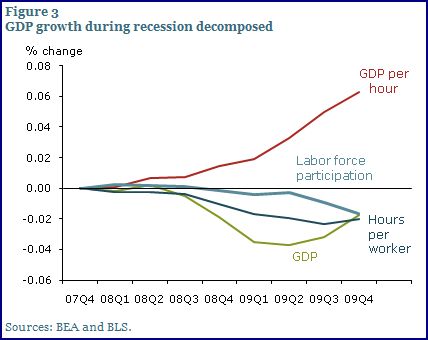
In 2009, strong growth in productivity allowed firms to lay off large numbers of workers while holding output relatively steady. This behavior threw a wrench into the long-standing relationship between changes in GDP and changes in the unemployment rate, known as Okun's law. If Okun's law had held in 2009, the unemployment rate would have risen by about half as much as it did over the course of the year. … Our results indicate that the main factor driving the unusual rise in unemployment relative to output was very rapid productivity growth, which allowed businesses to cut back sharply on labor while maintaining output levels.
… Anecdotal evidence suggests that efforts to contain costs and remain nimble in the face of uncertainty have become a fixture in business strategy. If productivity keeps on growing at an above-average pace, then unemployment forecasts based on Okun's law could continue to be overly optimistic.
Economists blindingly grapple with these issues
- "Is America facing an increase in structural unemployment?", brief answers from a range of economists, 23 July 2010
- "Identifying Cyclical vs. Structural Unemployment", Brad DeLong (Prof Economics, Berkeley), 24 August 2010
- "A curious unemployment picture gets more curious", Federal Reserve Bank of Atlanta, 16 July 2010
- "Labor Force Participation and the Future Path of Unemployment", Joyce Kwok et al, Federal Reserve Bank of San Francisco, 13 September 2010
Martin Ford has some answers to these questions
Ford wrote The Lights in the Tunnel: Automation, Accelerating Technology and the Economy of the Future (2009); the ebook is free.
- The Economic Implications of Intelligent Machines, 26 October 2009
- The Average Worker and the Average Machine, 1 July 2010
- Structural Unemployment: The Economists Just Don't Get It, 4 August 2010
- Econometrics and Technological Unemployment — Some Questions, 6 August 2010
- Outsourcing Jobs…that Can't be Outsourced, 27 August 2010
- Healthcare Robotics, 14 September 2010
Other posts about robots and automation
- 4GW: A solution of the first kind – Robots!, 8 April 2008
- The coming big increase in structural unemployment, 7 August 2010
- The coming Robotic Nation, 28 August 2010
- The coming of the robots, reshaping our society in ways difficult to foresee, 22 September 2010
Originally published at Fabius Maximus and reproduced here with the author's permission.
Opinions and comments on RGE EconoMonitors do not necessarily reflect the views of Roubini Global Economics, LLC, which encourages a free-ranging debate among its own analysts and our EconoMonitor community.
Etiquetas: 2010, ECONOMIA, INDUSTRIAL, INGENIERIA, nov10, SERVICIOS, TECNOLOGIA, USA
Cuando Nos Cruzamos de Brazos German Alarco
Germán Alarco Tosoni Son muchos los que creen que la mejor política económica para el Perú es dejar que el mercado resuelva todos los desajustes a nivel micro y macro. Aquí confluyen los economistas neoliberales y sus clientes políticos asociados al statu quo, que creen en conceptos tales como la tasa "natural" de desempleo. Todavía no entienden la dinámica económica y lo que ocurrió en los años treinta del siglo pasado y hace un par de años. Hay vertientes menos radicales que justifican alguna intervención estatal con las herramientas exclusivas, de los países avanzados, de la política monetaria y fiscal. Se olvidan que dejar operar libremente al mercado, o intervenir excepcionalmente, también nos puede conducir a crisis. Hay que analizar cómo operaría la economía "naturalmente". La inversión en los sectores primarios es el motor de crecimiento. Qué bueno que se reciba, pero es claramente intensiva en capital y poco empleadora. En Yanacocha se invirtieron US$ 3,000 millones y se generan menos de 3,000 empleos. En Las Bambas la inversión anunciada es de US$ 4,200 millones y se generarían 1,350 empleos permanentes. Hay problemas con las articulaciones productivas de estos sectores con el resto. Con esta dinámica no se podrían generar entre 250,000 y 280,000 empleos de calidad que se requieren anualmente. La contratación con base a las micro empresas tiene límites. Asimismo, el funcionamiento "eficiente" del mercado externo está incubando la denominada "enfermedad holandesa" que afectaría, por la apreciación del sol a los otros sectores de exportación no tradicional y a la manufactura. El portafolio tradicional del Banco Central es insuficiente para enfrentarla. También lo es para promover una reducción drástica de las tasas de interés activas reales, elemento clave que afecta nuestra competitividad. En otros temas, ¿se puede mantener la política actual de no ajustar la remuneración mínima vital, omitiendo las mejoras en la productividad?. ¿Cuáles serían los efectos de preservar el nivel de gasto público y la presión tributaria actual? Mantener sin ajuste alguno el actual modelo económico es cruzarse de brazos. Ese camino no es recomendable para el país, por razones económicas y sociales. Es poco probable que transitemos hacia una crisis cambiaria, una crisis fiscal o de balanza de pagos convencionales. Sin embargo, la desaceleración o implosión interna es igualmente peligrosa. Si a esta se agrega más desigualdad, pocos empleos de calidad y mayor heterogeneidad, estamos preparando un coctel inadecuado socialmente hablando (En: La Primera, 15/10/2010, p.10). |
ENTREVISTAS TV CRISIS GLOBAL
Etiquetas
- 1 MAYO
- 2
- 2002
- 2007
- 2008
- 2009
- 2010
- 2011
- 2012
- 2013
- 2014
- 2015
- 2016
- 2o11
- 2OO9
- a
- abr2015
- abril09
- abril10
- acc
- actualidadecono
- AFP
- AFPS
- AFRICA
- Ago11
- AGOS
- AGOST10
- agost12
- AGOSTO2008
- AGOSTO2009
- agosto2015
- AGRO
- AGROEXPORTACION
- AIG
- AL
- ALAGROEXPORTACION
- ALEMANIA
- ALIMENTOS
- amazonia
- AMERICALATINA
- ANDAHUAYLAS
- APEC
- ARCH MES
- ARGENTINA
- asarco
- ASIA
- ATTAC
- australia
- AUTOMOVIL
- AVAAZ
- b
- BAILOUT
- baltic
- BANCOS
- BC
- BCE
- BCRP
- benassy
- benedetti
- BERNANKE
- bernis
- BIELORUSIA
- BIS
- blanchard
- BOE
- BOJ
- BOLIVIA
- BOLSA
- BONUS
- BRASIL
- BRIC
- BUBBLE
- bundesbank
- C
- c rec
- CAFE
- CAMBIOCLIMATICO
- CAMERICAS
- CAN
- CANADA
- CANCION
- CAPITALISMO
- castro
- CDO
- cepij
- CHAVEZ
- cheque
- CHILE
- chimerica
- CHINA
- CHRYSLER
- CICLO
- CIE
- ciencia
- CIP
- COBRE
- COLOMBIA
- COMERCIO
- commodities
- COMPUTO
- CONSTRUCCION
- CONSUMO
- CONTAGIO
- control
- COPENHAGUE
- CORRUPCION
- coursera
- CRECIMIENTO
- CREDITO
- CRISIS
- CUBA
- CUMBREALCUE
- CUMBREALCUSA
- davos
- DEC08
- DEC11
- dec12
- DEC13
- dec15
- DEFICIT
- DEFLACION
- demanda
- DEPRESION
- DERIVADOS
- DEUDA
- developpement
- DIC09
- DIC10
- dic12
- DICIEMBRE
- do
- DOLAR
- doubledip
- dsk
- dubai
- duracion
- ec
- ecologo
- ECONOMIA
- ECUADOR
- EDUCA
- efectos
- EMPLEO
- EN11
- en16
- EN2016
- encuesta
- ene016
- energia
- ENERO
- ENERO09
- enero10
- EST
- eu
- EURO
- expansion
- EXPORTACION
- f
- fannie
- feb09
- feb10
- feb13
- feb15
- FED
- filo
- fin
- FINANZAS
- FINLANDIA
- fisica
- flu
- FMI
- FONDOS
- fr
- FRANCE
- frankfurt
- frontrunning
- fukushima
- G20
- G7
- GAS
- geab
- GEITHNER
- gini
- GLO
- global
- GM
- GONZALO GARCIA
- grece
- GREENSPAN
- GRENOBLE
- gripeporcina
- grupo mexico
- HAITI
- hambre
- HEDGE FUNDS
- HIPOTECA
- hist
- HOLLANDE
- HONDURAS
- IMPORTACION
- IMPUESTOS
- INDE
- INDIGNADOS
- INDUSTRIAL
- INFLACION
- INFORMALIDAD
- INFRAESTRUCTURA
- INGENIERIA
- INGENIEROS
- innova
- INTEGRACION
- INTERNACIONAL
- INVERSION
- IRAN
- IRLANDA
- ISLANDIA
- ismea
- ITALIA
- IZQ
- JAPON
- JUL11
- JULIO08
- JULIO09
- JULIO15
- JUN09
- jun10
- jun11
- JUN12
- jun13
- jun15
- JUNIO08
- keynes
- KRUGMAN
- lagarde
- LAREPUBLICA
- leap
- leverage
- liquidez
- LITIO
- lme
- LR
- macro
- MACROECONOMICS
- madera
- MADOFF
- MAMBIENTE
- MANGO
- MARS09
- mars10
- marx
- matematicas
- MATERIASPRIMAS
- MATUK
- MAY09
- MAY11
- MAY12
- MAY13
- may15
- may2015
- MAYO
- MBS
- me
- mef
- MERKEL
- METALES
- MEXICO
- miga
- MIGRA
- MINERIA
- MODELES
- MONDE
- MONEDA
- mourey
- MUJICA
- MUNDO
- musica clasica
- NACIONALIZACION
- neural
- niño
- nobel
- NOTASEMANAL
- NOV08
- nov09
- nov10
- NOV11
- NOV12
- nov15
- nuclear
- OBAMA
- OCDE
- oct09
- oct10
- OCT11
- oct12
- OCTUBRE08
- OFCE
- OIT
- OMC
- ORO
- paita
- PANAMA
- PAPA
- PARADIS
- PARAGUAY
- PAULSON
- pbi
- pe
- PEÑAFLOR
- PERU
- pesca
- PETROLEO
- piketty
- PLAN
- PMI
- POBLA
- POBREZA
- POL
- POLITICA
- porter
- portugal
- postcrisis
- PPT_CRISIS
- PRODUCCION
- PRODUCTIVIDAD
- profits
- prog
- PROTECCION
- QUIEBRA
- r
- RECESION
- REGULACION
- REMESAS
- REPEC
- REPRISE
- REPSOL
- RESERVAS
- RETAIL
- RGE
- RIESGOPAIS
- RMBS
- ROBOTICA
- RODRIK
- ROUBINI
- RUSIA
- SALARIOS
- SARKO
- school paris
- sep11
- SEP15
- SEQUIA
- SERVICIOS
- set09
- set10
- set11
- set12
- SET15
- SETIEMBRE08
- SINGAPUR
- SIRIA
- sismo
- soros
- southern
- SPAIN
- STANFORD
- STIGLITZ
- SUBPRIMES
- SUISSE
- SYRIZA
- TAIWAN
- TARIFAS
- TAS
- TCAMBIO
- TECNOLOGIA
- TERRITORIO
- TEXTIL
- TINTERES
- TLC
- TPP
- trabajo
- trentin
- TRICHET
- TROIKA
- tsunami
- TURISMO
- TV
- UBS
- UE
- UK
- UKRANIA
- UNASUR
- URUGUAY
- USA
- v
- VENEZUELA
- VIDEO
- vivienda
- WALL STREET
- WS
- wsj
- YEN
- young
- YUAN
- Zbasura
- zerohedge
Peru:crisis impacto regional arequipa,raul mauro
Temas CRISIS FINANCIERA GLOBAL
claves para pensar la crisis
-Tipo de cambio
- DIARIOS DE HOY
PRESS CLIPPINGS-RECORTES PRENSA-PRESSE..
canciones de GRACIAS A LA VIDA !
ETIQUETAS alfabetico
- 1 MAYO
- 2
- 2002
- 2007
- 2008
- 2009
- 2010
- 2011
- 2012
- 2013
- 2014
- 2015
- 2016
- 2o11
- 2OO9
- a
- abr2015
- abril09
- abril10
- acc
- actualidadecono
- AFP
- AFPS
- AFRICA
- Ago11
- AGOS
- AGOST10
- agost12
- AGOSTO2008
- AGOSTO2009
- agosto2015
- AGRO
- AGROEXPORTACION
- AIG
- AL
- ALAGROEXPORTACION
- ALEMANIA
- ALIMENTOS
- amazonia
- AMERICALATINA
- ANDAHUAYLAS
- APEC
- ARCH MES
- ARGENTINA
- asarco
- ASIA
- ATTAC
- australia
- AUTOMOVIL
- AVAAZ
- b
- BAILOUT
- baltic
- BANCOS
- BC
- BCE
- BCRP
- benassy
- benedetti
- BERNANKE
- bernis
- BIELORUSIA
- BIS
- blanchard
- BOE
- BOJ
- BOLIVIA
- BOLSA
- BONUS
- BRASIL
- BRIC
- BUBBLE
- bundesbank
- C
- c rec
- CAFE
- CAMBIOCLIMATICO
- CAMERICAS
- CAN
- CANADA
- CANCION
- CAPITALISMO
- castro
- CDO
- cepij
- CHAVEZ
- cheque
- CHILE
- chimerica
- CHINA
- CHRYSLER
- CICLO
- CIE
- ciencia
- CIP
- COBRE
- COLOMBIA
- COMERCIO
- commodities
- COMPUTO
- CONSTRUCCION
- CONSUMO
- CONTAGIO
- control
- COPENHAGUE
- CORRUPCION
- coursera
- CRECIMIENTO
- CREDITO
- CRISIS
- CUBA
- CUMBREALCUE
- CUMBREALCUSA
- davos
- DEC08
- DEC11
- dec12
- DEC13
- dec15
- DEFICIT
- DEFLACION
- demanda
- DEPRESION
- DERIVADOS
- DEUDA
- developpement
- DIC09
- DIC10
- dic12
- DICIEMBRE
- do
- DOLAR
- doubledip
- dsk
- dubai
- duracion
- ec
- ecologo
- ECONOMIA
- ECUADOR
- EDUCA
- efectos
- EMPLEO
- EN11
- en16
- EN2016
- encuesta
- ene016
- energia
- ENERO
- ENERO09
- enero10
- EST
- eu
- EURO
- expansion
- EXPORTACION
- f
- fannie
- feb09
- feb10
- feb13
- feb15
- FED
- filo
- fin
- FINANZAS
- FINLANDIA
- fisica
- flu
- FMI
- FONDOS
- fr
- FRANCE
- frankfurt
- frontrunning
- fukushima
- G20
- G7
- GAS
- geab
- GEITHNER
- gini
- GLO
- global
- GM
- GONZALO GARCIA
- grece
- GREENSPAN
- GRENOBLE
- gripeporcina
- grupo mexico
- HAITI
- hambre
- HEDGE FUNDS
- HIPOTECA
- hist
- HOLLANDE
- HONDURAS
- IMPORTACION
- IMPUESTOS
- INDE
- INDIGNADOS
- INDUSTRIAL
- INFLACION
- INFORMALIDAD
- INFRAESTRUCTURA
- INGENIERIA
- INGENIEROS
- innova
- INTEGRACION
- INTERNACIONAL
- INVERSION
- IRAN
- IRLANDA
- ISLANDIA
- ismea
- ITALIA
- IZQ
- JAPON
- JUL11
- JULIO08
- JULIO09
- JULIO15
- JUN09
- jun10
- jun11
- JUN12
- jun13
- jun15
- JUNIO08
- keynes
- KRUGMAN
- lagarde
- LAREPUBLICA
- leap
- leverage
- liquidez
- LITIO
- lme
- LR
- macro
- MACROECONOMICS
- madera
- MADOFF
- MAMBIENTE
- MANGO
- MARS09
- mars10
- marx
- matematicas
- MATERIASPRIMAS
- MATUK
- MAY09
- MAY11
- MAY12
- MAY13
- may15
- may2015
- MAYO
- MBS
- me
- mef
- MERKEL
- METALES
- MEXICO
- miga
- MIGRA
- MINERIA
- MODELES
- MONDE
- MONEDA
- mourey
- MUJICA
- MUNDO
- musica clasica
- NACIONALIZACION
- neural
- niño
- nobel
- NOTASEMANAL
- NOV08
- nov09
- nov10
- NOV11
- NOV12
- nov15
- nuclear
- OBAMA
- OCDE
- oct09
- oct10
- OCT11
- oct12
- OCTUBRE08
- OFCE
- OIT
- OMC
- ORO
- paita
- PANAMA
- PAPA
- PARADIS
- PARAGUAY
- PAULSON
- pbi
- pe
- PEÑAFLOR
- PERU
- pesca
- PETROLEO
- piketty
- PLAN
- PMI
- POBLA
- POBREZA
- POL
- POLITICA
- porter
- portugal
- postcrisis
- PPT_CRISIS
- PRODUCCION
- PRODUCTIVIDAD
- profits
- prog
- PROTECCION
- QUIEBRA
- r
- RECESION
- REGULACION
- REMESAS
- REPEC
- REPRISE
- REPSOL
- RESERVAS
- RETAIL
- RGE
- RIESGOPAIS
- RMBS
- ROBOTICA
- RODRIK
- ROUBINI
- RUSIA
- SALARIOS
- SARKO
- school paris
- sep11
- SEP15
- SEQUIA
- SERVICIOS
- set09
- set10
- set11
- set12
- SET15
- SETIEMBRE08
- SINGAPUR
- SIRIA
- sismo
- soros
- southern
- SPAIN
- STANFORD
- STIGLITZ
- SUBPRIMES
- SUISSE
- SYRIZA
- TAIWAN
- TARIFAS
- TAS
- TCAMBIO
- TECNOLOGIA
- TERRITORIO
- TEXTIL
- TINTERES
- TLC
- TPP
- trabajo
- trentin
- TRICHET
- TROIKA
- tsunami
- TURISMO
- TV
- UBS
- UE
- UK
- UKRANIA
- UNASUR
- URUGUAY
- USA
- v
- VENEZUELA
- VIDEO
- vivienda
- WALL STREET
- WS
- wsj
- YEN
- young
- YUAN
- Zbasura
- zerohedge