SECCION Crisis monetaria: US/EURO, dolar vs otras monedas

Gráfico del tipo de cambio del Dólar Americano al Euro - Desde dic 1, 2008 a dic 31, 2008

Evolucion del dolar contra el euro

US Dollar to Euro Exchange Rate Graph - Jan 7, 2004 to Jan 5, 2009

V. SECCION: M. PRIMAS

1. SECCION:materias primas en linea:precios


[Most Recent Quotes from www.kitco.com]


METALES A 30 DIAS click sobre la imagen
(click sur l´image)

3. PRIX DU CUIVRE

  Cobre a 30 d [Most Recent Quotes from www.kitco.com]

4. ARGENT/SILVER/PLATA

5. GOLD/OR/ORO

6. precio zinc

7. prix du plomb

8. nickel price

10. PRIX essence


petrole on line

Find out how to invest in energy stocks at EnergyAndCapital.com.

azucar

azucar
mercados,materias primas,azucar,precios y graficos azucar i otros
Mostrando entradas con la etiqueta AFRICA. Mostrar todas las entradas

10 ago 2012

Fwd: Macroperu Sequía en USA


Midwest Drought Sends Grain Prices Soaring And A Look At Other Commodities

July 9, 2012  | 3 comments  |  includes: CORN, DBC, SOYB, WEAT
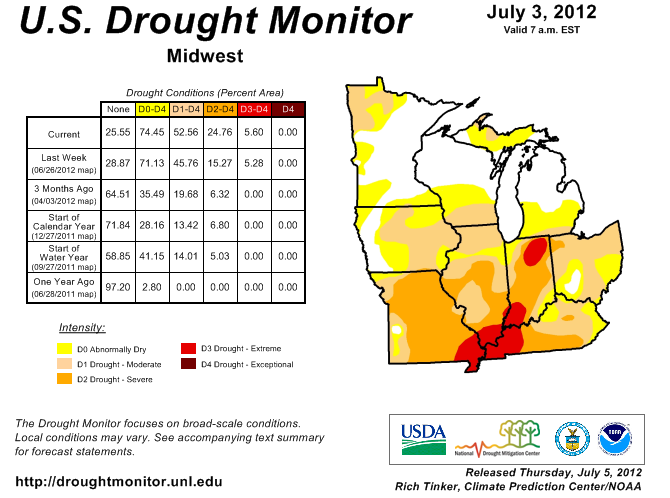
(click to enlarge)
Source: MRRCC Midwest Drought Information Center
The historical Midwest drought is gaining more and more market attention and threatens to challenge one of the worst U.S. grain disasters ever. It has not been since 1988, and perhaps even the dust bowl years of 1936, that it has been this dry and hot across the U.S. grain belt. Given the present weather pattern the next couple weeks at least, Steinback's "Grapes of Wrath" may unfortunately depict what is going to happen to some American farmers, though of course in a bit less relative scale to the Great Depression years of the mid 1930s.
The Dust Bowl days in Iowa in 1936 (top picture) and the recent Colorado Fires (bottom picture).
The incredible dry soils over the Plains to Indiana is only acting to feed a hot-dry hot pressure ridge, even in the face of El Nino conditions. Normally during early El Nino events this is not supposed to happen.
SOURCE: Wikipedia
Corn and Soybean Prices on a Tear
U.S. corn and soybean crop conditions continue to fall and may fall another 7-10% in this afternoon's USDA weekly crop report. This reality and the likelihood of further reductions in the next week or two means the percentage price move in corn and soybeans might even surpass that of 1988 (below)
(click to enlarge)
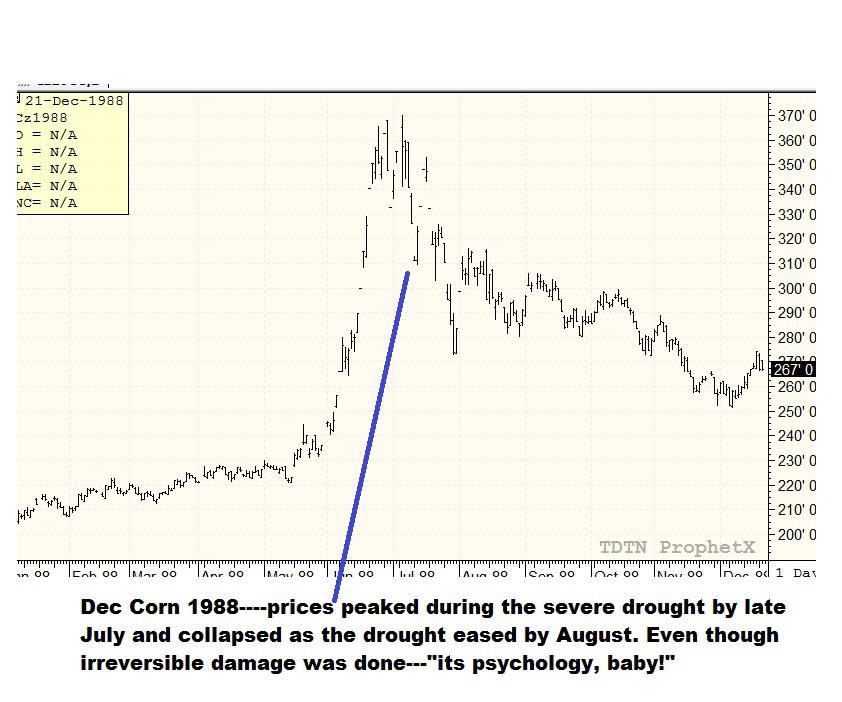
(click to enlarge)
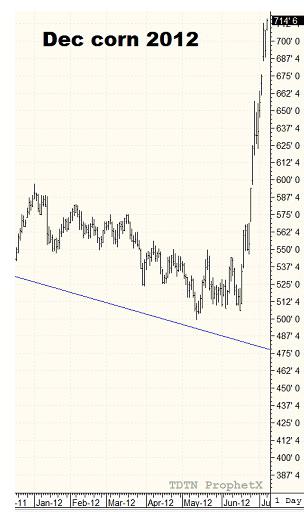
December corn following the same price pattern as 1988.
One possible big difference? The summer's drought eased in August, 1988 sending grain prices south, but this summer, there are NO signs of a general change in the weather pattern. This could mean higher grain prices still and also cause some adjustments to our national Ethanol program.
Source of charts--DTN/Prophet X
Commodities Affected by the Weather
The Corn ETF (CORN) continues to surge and still has another 5-10% in it the next few weeks given the U.S. drought that I expect to worsen. Other grain prices will follow. Wheat has rallied some 15% as well the last few weeks and worries over recent floods in Ukraine, following drought conditions earlier are adding to the woes in this market.Soybeans have a chance to challenge $17 later this summer if this drought continues another month or so. Given certain teleconnections I look at and global warming, I do not see this drought breaking any-time soon, so this is a real possibility.
World supplies of sugar are fairly robust but a very weak Indian Monsoon is going to threaten oilseed crops and at least 40% of the nation's sugar cane crop the next few weeks. With wet weather returning to Sao Paulo and Parana, Brazil, this could further impede the quality of the sugar crop. With India and Brazil being huge players in the world sugar market, these two weather scenarios are looking more and more like 2009, whensugar prices soared some 30% during the summer months. While I do not expect sugar prices to soar nearly as much, selling October $1900-$2000 puts may be a conservative safe play in this market, as prices will at least, not fall out of bed.

Coffee prices have staged a modest rally after falling to a year and a half low of $1.50/lb two weeks ago. The initial 40% collapse in coffee prices the last year, has been due, not only to worries over the European economy and weakened global demand but the onset of the largest Brazilian coffee crop ever. Most recently, heavy rains in N. Brazil have lowered the quality of the Brazil crop and hence, we have had a bit of a rally.
December cotton prices rallied off their 2-3 year of 67 cents/lb. due in part to the worsening U.S. cotton crop, the slow Indian Monsoon and oversold market and rebound in some outside markets. Excellent drought easing rains in China and an improvement this week for rainfall in Texas and the Delta were key reasons for the late week sell off last week. If it were not for the improved U.S. and China weather situation, I would think cotton would be a buy due to my expectations of further crop issues in India in the coming weeks.
Natural gas prices reached the highest point in months late last week ($3.06 basis the nearby August contract), but gave up those gains due to our forecasts of cooler weather this week in the eastern U.S. and rain cooled air in the deep south and Texas, following record breaking heat. I do not think prices will break below the $2.50 basis August contract, given a return of warmer weather again to many consuming areas in the eastern U.S. and Midwest this weekend and next week, but as far as forecasting a major bull move, I am not sure this is in the cards given the still huge supplies and the odds of an El Nino type "weak" second half of the hurricane season.
Disclosure: I have no positions in any stocks mentioned, and no plans to initiate any positions within the next 72 hours.
.

__,_._,___

13 sept 2011

Fwd: Macroperu Zimbabwe inicia plan para nacionalizar minas


 26 August 2011

Agreement Suspends Zimbabwe Shutdown Threat to Canadian-Operated Gold Mine

Canadian-based Caledonia Mining Corporation and the Indigenization Ministry issued a joint statement saying they had 'agreed on a process that will result in a revised indigenization implementation plan' for Blanket Mine
Gibbs Dube | Washington


Operations continued Wednesday at Blanket Mine in Gwanda, Zimbabwe, following an agrement between Caledonia Mining Corporation, the mine's Canadian owner, and Minister of Indigenization Saviour Kasukuwere on the indigenization process which the government intends should place a controlling stake in the venture in black Zimbabwean hands.
The Ministry of Indigenization and Caledonia Mining issued a joint statement Tuesday saying they had met and "agreed on a process that will result in the production of a revised indigenization implementation plan for Blanet Mine that is compliant with the Indigenization and Economic Empowerment Act." The statement said the plan will take into account "the independently verified intrinsic value of the mineral resources, plant and equipment."
Consequently, the statement said, "the Honorable Minister Savious Kasukuwere has agreed to suspend the cancellation of Blanket Mine's operating llicense pending the submission of a compliant indigenization implementation plan."
Kasukuwere earlier had sent a letter to the Ministry of Mines saying Blanket's license should be suspended for failure to submit an indigenization plan conforming with the legislation and regulations. Minister of Mines Obert Mpofu said the mine's license had not been suspended.
Caledonia Mining issued a statement late last week noting Kasukuwere's letter to the Mines Ministry. The company said it had submitted a "comprehensive indigenization proposal" to Kasukuwere on May 9, following which it had received no "formal notification that the proposal is deficient or that it should be revised" by any specific deadline.
The company said then that it believed Kasukuwere had "exceeded his legal powers both in terms of his assessment of Caledonia's proposal and his request to the Minister of Mines.
The statement said Caledonia was "seeking urgent clarification from the relevant ministers, and is also consulting with its legal advisers regarding appropriate legal action."
Gwanda residents expressed anger at the prospect of the mine ceasing operations, saying they suspect top officials of President Robert Mugabe's ZANU-PF party want to grab the mine under the cover of the indigenization or black empowerment process.

Mayor Lionel De Necker said residents will not allow the government to cut off the town's lifeblood. De Necker said Gwanda would become a ghost town if the mine were to close.
Youth In Mining Council member Buletsi Nyathi said Kasukuwere is unfairly targeting the mine. "We are worried the minister is targeting a mining firm based in the Matabeleland region as a test case for this skewed indigenization program," Nyathi said.
[

21 jun 2011

mining tax

More mining tax, royalty hikes 'inevitable' – Control Risks

TORONTO (miningweekly.com) – More governments in Africa and elsewhere, especially newly elected ones, will likely look at raising mining taxes and royalties amid historically high commodity prices, Control Risks senior analyst for Africa Thomas Wilson said in an interview.
"I think it's inevitable. And it's always been like that, it's always followed the mineral cycle, he said on the sidelines of a MineAfrica seminar in Toronto.
"Governments look at commodity prices and say 'we should be getting more out of this'."
The trend is also a product of the changes in governments, particularly when more democratic regimes replace what may have been "more autocratic" previous governments, he said.
"So they come in on a popular mandate where they have made the electorate promises to look at contracts that were signed in the past with other governments that were potentially, I suppose, less scrupulous when it came to negotiating with foreign investors."
Mining companies and investors are increasingly edgy about potential changes in government policy in the regions where they operate, as nations seek ways to benefit more from record commodity prices.
A trend towards resource nationalism around the world is probably the biggest risk facing mining companies, Xstrata CEO Mick Davis said in December.
Last year, then-Australian Prime Minister Kevin Rudd proposed a 40% resources super profits tax, and although the country backed off the plan it has now released draft laws for a 30% tax on coal and iron ore miners.
Also this week, reports emerged that the Tanzanian government is planning a windfall tax on the mining industry, sending shares in LSE-listed African Barrick Gold lower.
And Mining companies operating in Peru also declined sharply on Monday after left-leaning Ollanta Humala, a military officer who had talked about making sure Peruvians benefit more from the country's mineral wealth, was elected President.
Guinea, under new President Alpha Conde, has also said it will relook at the country's mining code, followed by a review of all existing mining contracts.
Reviews of outdated laws and a push by governments to be more active in their resources sectors are not necessarily a bad thing, Wilson commented.
"But they must resist the temptation to turn reviews of laws and contracts into a purely revenue generating exercise."
DEALS TO SURVIVE
Mining companies operating in higher-risk areas are also not helping themselves or their shareholders by squeezing all possible concessions out of governments when negotiating mining contracts and agreements, Webber Wentzel partner Nkikia Moshesh said at the same event.
Agreements that seem skewed in the foreign investor's favour might look good on paper but run the risk of coming under fire from future governments and their voters, she commented.
Regimes change, commodity prices rise, "and people end up saying 'we are not extracting enough value from this company'," Moshesh said.
"Mining projects are intended to be of a long term nature. You want to conclude agreements that are going to survive, and preferably will survive changes in government, changes in political thinking."
ALMIGHTY STINK
African Barrick Gold, the biggest producer in Tanzania, and South Africa's AngloGold Ashanti both insisted this week that their tax positions in the country are protected by existing mineral development agreements, and could not be affected by a new windfall tax.
But there few new mines coming onstream in Tanzania and there is relatively little exploration investment as well, commented Africa mining consultant with political risk consultancy Menas Associates Christopher Melville.
"If the government is serious about the windfall tax it can have no other targets than the producing mines operated by the big players," he said.
Although the tax reports could just be "smoke and mirrors" related to internal party politics, it is also possible that the government is trying to use the threat of an imposed tax to persuade mining companies to renegotiate contracts voluntarily, Melville suggested.
"Trying to push it through...would cause an almighty stink with the majors given the stabilisation clauses in their development agreements.
"The government surely has no stomach for such a stink and may rather hope that unsettling announcements will be enough to encourage the companies to renegotiate voluntarily."
Either way, this week's reports are clearly negative for investor interest in Tanzania, he said.
"The government cannot afford to kill the goose."
Edited by: Creamer Media Reporter

__._,_.___
.

__,_._,___

26 oct 2009

SENEGAL: Cadeau de 100 m E au Representant FMI

La forte somme d'argent remise par les autorités sénégalaises à l'ex-représentant du Fonds monétaire international (FMI) à la fin de septembre ne visait pas à le "corrompre" mais à l'aider à "acheter des cadeaux pour ses parents", a affirmé le premier ministre sénégalais à la presse, lundi 26 octobre.


Selon le FMI, son ancien représentant à Dakar, l'Espagnol Alex Segura, avait reçu au dernier jour de sa mission "un cadeau monétaire" d'une "valeur substantielle" qui avait été "rendu aux autorités sénégalaises" par la suite.
"Il ne s'agissait pas pour nous de le corrompre, ce n'était pas une corruption", a plaidé le chef du gouvernement, Souleymane Ndéné Ndiaye, dans une interview publiée par le journal sénégalais Kotch. "Mais ce qui s'est passé, c'est que nous avons cherché à aider quelqu'un à acheter des cadeaux pour ses parents parce qu'il venait de quitter le Sénégal après un séjour de trois ans", a-t-il assuré.
Pour la première fois, un représentant du gouvernement reconnaît ainsi explicitement qu'une somme d'argent a été donnée à M. Segura.
Mais M. Ndiaye explique ce geste par "une tradition en Afrique" : "Quand vous avez quelqu'un qui vient vous voir, vous lui offrez un cadeau à son départ." A l'objection "Un cadeau de 100 000 euros ne saurait être symbolique", le premier ministre répond : "Figurez-vous, 100 000 euros, c'est rien. Sans que je puisse même confirmer la somme, c'est quand même quelqu'un [Alex Segura, ndlr] qui est à l'étranger. (...) Avec cette somme, qu'est-ce que vous pouvez acheter en France ? Vous ne pouvez même pas vous payer un appartement."
L'affaire dite du "cadeau monétaire" – reçu par M. Segura après un dîner à la présidence de la République sénégalaise le 25 septembre puis restitué, plus tard, en Europe, aux autorités sénégalaises – fait scandale à Dakar.

30 jul 2009

FMI; aumentara recursos para PED

FMI planea un fuerte incremento de préstamos a países en desarrollo

11:25 | Se desembolsará fondos por US$17.000 mlls hasta 2014. El promedio de los préstamos concedidos entre 2006 y 2008 fue de US$1.000 mlls

Washington (DPA). El Fondo Monetario Internacional (FMI) planea un fuerte incremento de los créditos otorgados a los países en vías de desarrollo que están siendo más golpeados por la actual crisis financiera y económica mundial, informó hoy el organismo.

El FMI señaló que desembolsará fondos por 17.000 millones de dólares hasta 2014. En comparación, el promedio de los préstamos concedidos a países subdesarrollados entre 2006 y 2008 fue de 1.000 millones de dólares.

Gran parte de los fondos están destinados al África subsahariana. El plan del FMI prevé asimismo que unos 60 países endeudados con la entidad puedan aplazar el pago de sus cuotas hasta finales de 2011.

Se trata de un “incremento sin precendentes del apoyo del FMI para los países más pobres en África subsahariana y en el resto del mundo”, dijo al respecto el presidente del organismo, Dominique Strauss-Kahn.

El FMI ha incrementado con fuerza sus préstamos debido a los devastadores efectos de la crisis económica, que ha dejado a varios Estados con serios problemas presupuestarios.

Los líderes de los 20 principales países industrializados y emergentes del mundo (G20) prometieron durante una cumbre en abril incrementar las reservas de capital del FMI en unos 500.000 millones de dólares.

3 jun 2009

AFRICA:ERA 2009 Calls for stronger emphasis on agriculture


JOINT PRESS RELEASE

ERA 2009 Calls for stronger emphasis on agriculture

Addis Ababa, 29 May 2009 (ECA) - The Economic Report on Africa 2009 calls for African countries to pay special attention to the agriculture sector as a basis for long-term growth and development. Jointly published by the United Nations Economic Commission for Africa (ECA) and the African Union Commission (AUC), the Report was launched Thursday 28 May 2009 in Addis Ababa, Ethiopia; by Mr. Abdoulahi Mahamat, acting Director of Trade, Finance and Economic Development Division of ECA; Mr. Adam Elhiraika, chief of the macroeconomic analysis section of ECA; Mr. Maurice Tankou, chief of agricultural marketing section of ECA; and Mr. Abdallah Msa, head of the division of economic policies and research at the African Union Commission.

Speaking at the launching ceremony of the Economic Report on Africa, Mr. Elhiraika, said: "development does not happen by accident." Agriculture provides strong linkages to other sectors of the economy and through proper planning, can be the engine for growth.

He gave the example of buying processed foods in supermarkets across Africa. All the products are imported, yet when you go to the villages, you will find African farmers selling the same products in raw form. "We need to connect them to the value chains"' he said.

Mr. Abdallah on his part said this year's report on the theme: "Developing African Agriculture through Regional Value Chains" is the third edition of the Economic report jointly produced by the ECA and the AUC. He explained that the Report will serve as an instrument to help the decision makers, elaborate good policies for the economic sectors. "The Report provides key economic substance aimed at reinforcing the economic management capacity at national and regional levels, as well as enhancing the economic integration of the continent", he noted.

The report has two parts. Part one looks at recent developments in the global economy and its impacts on Africa. It says GDP growth in Africa is expected to decline from 5.1 percent in 2008 to 2% in 2009. Inflation in Africa, excluding Zimbabwe, was 10.7% in 2008, up from 6.4% in 2007, mainly due to high fuel and food prices.


ERA 2009 states that commodity prices have peaked and both demand and prices are now falling. In order to cut public spending and maintain fiscal stability, many countries will be forced to reduce spending on development projects and cut some services. This will threaten some recent development gains, such as rising primary school enrolment ratios, and progress towards attaining the MDGs.

It however finds a glimmer of hope with sustained economic reforms, exchange rate adjustment, easing of inflation and efforts to revive domestic demand, which could contribute to growth in Africa in 2009.

ERA 2009 notes that although Africa is heavily dependent on agriculture for providing employment, generating economic growth, foreign exchange earnings and tax revenue, the sector receives very little investments. It states that only 6% of arable land is irrigated, as opposed to 40% in Asia. Low fertiliser and tractor use, limited access to credit and insurance schemes, poor roads and marketing infrastructure, poorly funded agriculture related institutions of higher education, research and extension services.

To develop agricultural product value chains, Africa must enhance research and development, improve input markets, farm level production, product processing, storage, handling and transport, marketing and trade, financing, soil and water conservation, etc. This is a tall order for any one country to undertake, so ERA 2009 argues for the creation of regional value chains.

Background:

The Economic Report on Africa (ERA) is an annual publication of the African Union Commission and the United Nations Economic Commission for Africa (ECA). It provides a comprehensive analysis of developments in African economies over the preceding year, and makes predictions about the following year. The report also gives an overview of the global economy. Each year part two of ERA tackles a thematic area of importance to Africa. The theme of ERA 2009 is: "Developing African Agricultural through Regional Value Chains." The report can be downloaded from www.uneca.org/era and www.africa-union.org. For a print version, please contact either the Information and Communication Service of ECA or the AU Communication Team.

jointly issued by:
The ECA Information and Communication Service
PO Box 3001
Addis Ababa
Ethiopia

Tel: +251 11 551 5826
Fax: +251 11 551 0365
E-mail: ecainfo@uneca.org

Web: www.uneca.org

and

The African Union Communication and

Information Division (DCI)
PO Box 3243
Addis Ababa
Ethiopia

Tel: +251 11 551 77 00 Ext. 236
+251 11 551 45 55
Fax: +251 11 551 12 99
E-mail: dinfo@africa-union.org
Web: www.africa-union.org

--

Eduardo Daniel Peñaflor Rivas
Kenyan Address
Convent Road N40, Nairobi Kenya,
Home +254 4348400
Mobile +254 714222821


Sent from Nairobi, Nairobi Area, Kenya


18 abr 2009

G20:SOSTENER EL CRECIMIENTO EMERGENTE

Les pays en voie de développement seront soutenus

Cy. L.
03/04/2009 | Mise à jour : 09:06
| Ajouter à ma sélection
Une jeune costaricaine lave du linge dans un ruisseau, au sud de la capitale, San Jose.
Une jeune costaricaine lave du linge dans un ruisseau, au sud de la capitale, San Jose. Crédits photo : AP

6 milliards de dollars d'or vendus pour les pays les plus pauvres.

Ne pas laisser les pays les plus pauvres s'enfoncer dans la crise. La France avait fait de l'aide au développement l'un des thèmes phares de ce G20. Paris présidait d'ailleurs le groupe de travail chargé de plancher sur ces questions en vue de la préparation du sommet de Londres. Le communiqué final fait la part belle à ces questions.

Dans les trois prochaines années, les pays les plus pauvres se verront allouer quelque six milliards de dollars tirés des ventes d'or du Fonds monétaire international. Les modalités précises de ces opérations seront discutées lors du sommet de printemps du FMI qui se tiendra à Washington fin avril.

Par ailleurs, les banques multilatérales de développement recevront 100 milliards de dollars supplémentaires de facilités de prêts. Ceci devra leur permettre de continuer à investir dans l'éducation des populations les plus défavorisées, et à «mettre en place des stimulations fiscales pour construire des infrastructures solides, durables et faibles consommatrices d'énergie», dans les pays en développement.

«Nous avons conscience de la dimension humaine de cette crise», indiquent par ailleurs les chefs d'État du G20. «Nous nous engageons à mettre en place les ressources financières nécessaires pour garantir la protection sociale des plus défavorisés et poursuivre la mise en place de programmes alimentaires à long terme».

ENTREVISTAS TV CRISIS GLOBAL

NR.: Director, no presidente ---------------------------------------------- Bruno Seminario 1 ------------------------- Bruno Seminario 2 -------------------- FELIX JIMENEZ 1 FELIZ JIMENEZ 2 FELIX JIMENEZ 3, 28 MAYO OSCAR DANCOURT,ex presidente BCR ------------------- Waldo Mendoza, Decano PUCP economia ---------------------- Ingeniero Rafael Vasquez, parlamentario 24 set recordando la crisis, ver entrevista en diario

Etiquetas

Peru:crisis impacto regional arequipa,raul mauro

Temas CRISIS FINANCIERA GLOBAL

QUIEN SOY?
claves para pensar la crisis

MATERIAS PRIMAS
-Metales
-Cobre
- plata
- oro
- zinc
- plomo
- niquel
- petroleo

-Tipo de cambio

- LA CRISIS

- BOLSA VALORES
- BANCOS
- PBI PAISES
- USA: DEFICIT GEMELOS
- UE: RIEN NE VA PLUS

CONTAGIO: CANALES

- PERU: DIAGRAMA DE CONTAGIO
- PERU: IMPACTO EN BOLSA
- MEXICO: HAY CRISIS?

LA PRENSA
COMENTARIO DE HOY

- DIARIOS DE HOY
NLACES

Coyuntura
Bancos centrales
Paginas Recomendadas

BLOGS

economiques
Interes

VIDEO

- Economia videos
- Crisis financiera global

TRICONTINENTAL

- AFRICA: daniel
- EUROPA: helene
- ASIA:
- AMERICA

COLUMNAS AMIGAS

Chachi Sanseviero

ETIQUETAS
por frecuencia de temas
por alfabetico

EVENTOS

FOTOS DEL PERU

GONZALO EN LA RED

JOBS
VOZ ME CONVERTIDOR
CLIMA
SUDOKU
PICADURAS

LOGO

LIBRO de GONZALO

La exclusion en el Peru

-Presentacion

- introduccion

- contexo economico

- crisis de la politica

- excluidos de las urbes

- excluidos andinos

- contratapa

VIDEOS ECONOMICOS
Crisis Enero 2009
Krugman
Globalizacion 1
Globalizacion 2
Crisis Brasil
Crisis bancaire
Karl marx revient

TODOS LOS DERECHOS RESERVADOS

GOOGLE INFORMA


PRESS CLIPPINGS-RECORTES PRENSA-PRESSE..

ETIQUETAS alfabetico