un gráfico que les resume los ultimos 300 años de la historia económica del Per{u
17. TASAS DE INTERES Peru
16. tipo de cambio sol/dolar-consulta del dia
V. SECCION: M. PRIMAS
1. SECCION:materias primas en linea:precios
METALES A 30 DIAS click sobre la imagen
(click sur l´image)
2. PRECIOS MATERIAS PRIMAS
9. prix du petrole
10. PRIX essence
petrole on line
24 jun 2011
Perú: trescientos años del Modelo Primario Exportador
Etiquetas: 2011, CRECIMIENTO, ECONOMIA, PERU, SERVICIOS
21 jun 2011
What are the social implications of economic collapse?
by Simon Black · View CommentsNew York City
For the last few days, we've been having an important discussion about the magnitude of the economic challenges in the west; if you didn't read yesterday's letter, I really encourage you to do so before proceeding because it's important to understand why the west has truly passed the point of no return.
Simply put, the United States and much of Europe are borrowing an extraordinary amount of money now just to pay interest on the money they've already borrowed. They cannot even self-fund their mandatory entitlement programs without going into the hole, and their options are limited:
Option 1: Continue borrowing, keep the party going.
As long as the government CAN do this, they WILL do this. Regardless of their intentions, though, more debt only worsens the situation, creating higher borrowing costs in the long run, and even more debt. As this happens, the pool of buyers begins to dry up, especially from overseas.
Option 2: Inflation
The more buyers stop purchasing Treasury securities, the more the Federal Reserve will mop up the excess liquidity. In doing so, the Fed essentially conjures up money and loans it to the government.
No matter what the government monkey statistics say, this is inflationary, plain and simple. The more money they print, the greater the level of inflation in the long-term. Meanwhile, as foreigners simultaneously reduce their US dollar holdings, this inflation will become more acutely felt in the US.
Option 3: Austerity
There's going to come a time when the US government is forced to face its economic reality and make some incredibly deep cuts that would be felt across society, from Wall Street and the military industrial complex to project housing on the other side of the tracks.
Option 4: Default
Eventually, the debt burden is simply going to be too much, and the most obvious solution will be to default. Politicians will make China out to be the enemy and they will probably invent a war just to have an excuse to default on Chinese owned debt. Americans will wave the flag and celebrate defaulting on their enemies.
Option 5: Economic Cannibalism
In the best traditions of Atlas Shrugged, the government will continue its persecution of the productive class– professionals, investors, entrepreneurs, and skilled workers. Existing taxes will rise, new taxes will be created, trade barriers will be enacted, and a maze of cost prohibitive regulations will be passed.
The first option (keeping the party going) is what has been happening for years. Politicians make small concessions to show they're "serious" about fiscal discipline, cutting laughably small programs while dumping hundreds of billions of dollars into wars and entitlement programs.
The worse the debt situation becomes, though, the higher the borrowing costs become, and the worse the debt situation becomes. It's not an enviable position. Existing lenders will continue backing away from the US Treasury market, giving option 1 a half-life measured in months at best.
In the longer term, only options 2-5 remain: inflation, austerity, default, and cannibalism. Each of these remaining options will shake the financial system to its core. More importantly, each of these has the power to create widespread social upheaval.
When inflation eats away at a family's already meager standard of living, when austerity eliminates the benefits to which recipients have grown accustomed, when default vanquishes a retiree's savings, when high taxes make workers feel like they're just government serfs– this is when the real turmoil will begin:
* Rising crime: devoid of a job or means to support their families, people will turn to crime out of desperation
* Class warfare: with dividing lines drawn between have's vs. have-not's, it will become unpopular and even dangerous to be successful
* Corruption: low-level public service officials will look to supplement their income through bribery and kickbacks
* Black economy: An underground, cash-only (probably gold or foreign currency) economy will emerge with people getting paid in envelopes
* Censorship: Of course they'll blame it on national security, but the idea will be to prevent public disparaging of government policy
* War: The government will need another major event to distract people from the real problems
* Protests/Riots: This is when things turn bloody
* Police state conditions: The government will close ranks and send the cops out to show all the little people who's really in charge
There are a number of other manifestations, and many are already showing signs of emergence. The US and European police states are alive and well. Crime is on the rise.
In Europe, cops are doing battle in the streets with their citizens. Think it can't happen in the US? Remember tanks in the streets during the LA riots? Remember New Orleans? Remember any number of G8/G20 protests?
Here's the bottom line: all you have to do is glance at the headlines to see what happens when you strip people of their livelihood, of their ability to put food on the table for their families.
The US has been able to kick the can down the road with the most blunt social implications simply because the country benefits so much from a US-oriented financial system. This is coming to an end very, very quickly.
As a rule of thumb, the greater the economic distortion, the harder the collapse. The US economy has been in a fantasy world for so long, and when its dominant primacy is yanked away, the collapse will be at freefall speed.
Listen… I'm not talking about the end of the world here, I'm talking about difficult times ahead, and the things that go beyond economics. It's time to face facts and look at how society will change (and has already changed).
Tomorrow, I'd like to write more about what we can do now. Meanwhile, please tell me what you think about this– how do you see society changing from this reset of the financial system?
17 ene 2011
24 oct 2010
Economists Grapple With the First Stage of the Robot Revolution Fabius Maximus S
Economists Grapple With the First Stage of the Robot Revolution
Summary: The first signs of the robot revolution have appeared, automation moving from manufacturing into the service industries. Economists see the evidence but cannot understand. This post provides some explanations to this complex issue. Links to other chapters of this series appear at the end.
Automation will allow amazing productivity growth. This might be captured by our elites, or shared amongst the people. But what would we do with the extra time, a world with less work? A look at past societies:
The lives of ordinary people in the Middle Ages in Europe or in Ancient Greece or Rome may not have been easy, but they were certainly leisurely. In the fourth century the Roman Empire had 175 public festival days. In medieval England holidays added up to about 4 months a year; 5 months in Spain; 6 months in France. {Source}
But in our world automation increases productivity — boosting business profits (now at record levels despite the recession) and reduces employment. Especially as the automation wave moves from manufacturing into the far larger pool of service employment.
- Fire bank tellers; install ATMs.
- Fire workers in toll booths and parking lots; install automated payment systems (e.g., FasTrak).
- Fire cashiers; install automated check-out systems (e.g., gas stations and Home Depot).
- Fire teachers for simple continuing education course; install online learning systems
It's happening now, as the recession has sparked businesses to rationalize their business practices to fully utilize new technology. The results appear in economists' data, but they cannot see it because their dogma says it cannot happen. They extrapolate results from the first waves of industrialization into a natural law — ignoring the probably painful effects of the transition.
Excerpts from interesting articles about the problem
"Economic Growth Given Machine Intelligence", Robin Hanson (Asst Prof Economics, George Mason U), unpublished, date unknown:
"This suggests that the transition from human dominated labor to labor dominated by machine intelligence might rather rapid. … Then in just 4 years machines could go from doing 25% to 75% of the job types, if computer prices halved every 2 years, and per-human product grew an average of 22% per year over this period."
Economics Of The Singularity", Robin Hanson (Asst Prof Economics, George Mason U), IEEE Spectrum, June 2008:
Our global economy would stupefy a Roman merchant as much as the Roman economy would have confounded a caveman. But we would be similarly amazed to see the economy that awaits our grandchildren, for I expect it to follow a societal discontinuity more dramatic than those brought on by the agricultural and industrial revolutions. The key, of course, is technology. A revolutionary speedup in economic growth requires an unprecedented and remarkable enabling tool. Machine intelligence on a human level, if not higher, would do nicely. Its arrival could produce a singularity–an overwhelming departure from prior trends, with uneven and dizzyingly rapid change thereafter. A future shock to end future shocks.
"The Mythology of the Future Job Market", Martin Ford, Angry Bear, 18 November 2009 — See links to his other articles below. Excerpt:
{W}e are led to expect that, over time, the bulk of the workforce is going to migrate into jobs that require creativity or innovation, or jobs that depend on uniquely human traits or talents. Furthermore, these new jobs are going to require that any innovation, creativity or personal attention occur pretty much while actually holding onto your customer's hand—so that the job can't be offshored. Is that really a likely scenario?
The first thing to note is that the two sectors singled out as being promising—healthcare and education—are by no means exempt from automation. Specific healthcare tasks are likely to be automated, while decision making and patient monitoring may migrate increasingly into expert systems.
Automation is clearly going to be a major factor in specialized, vocational-type education and training. Today in California, you can get your real estate license completely online. You won't encounter an actual human being until you run into a proctor at the licensing exam. A similar thing has happened with the traffic school programs that drivers have to complete after getting a ticket. If training can be offered online, it will be. I see no reason why something similar won't eventually occur in college education, especially since new graduates have been seeing a lower financial return on their investment. It seems likely that if the credential is worth less, many people will gravitate toward less expensive, automated online learning.
… Historically, the job market has always looked like a pyramid in terms of worker skills and capabilities. At the top, a relatively small number of highly skilled professionals and entrepreneurs have been responsible for most creativity and innovation. The vast majority of the workforce has always been engaged in work that is fundamentally routine and repetitive. As various sectors have mechanized or automated, workers have transitioned from routine jobs in one sector to routine jobs in another. In many cases, skills have been upgraded, but the work has nonetheless remained routine in nature. So, historically, there has been a reasonable match between the types of work required by the economy and the capabilities of the available workforce.
Now, as it becomes clear that automation is going to ultimately consume the entire base of the job skills pyramid, the conventional wisdom is that we are going to somehow cram everyone into the very top. And even if we somehow manage to do that, the jobs will be highly susceptible to offshoring, so we also have to require that the jobs be somehow anchored locally. I think this is somewhat analogous to having the agricultural sector mechanize and then expecting that everyone will get a job driving a tractor. The numbers don't work. The problem with the conventional wisdom is that it underestimates the long-term impact of automation, and it expects too much in the way of occupational acrobatics from the average worker.
Yet another problem is that even if all these creative jobs materialize, the result would likely be far from optimal. Jobs that rely heavily on creativity, talent or unique personality traits (think authors, actors, musicians, commission sales people) very often have a power law income distribution. In other words, a few people do phenomenally well, while nearly everyone else struggles to survive.
"Okun's Law and the Unemployment Surprise of 2009", Mary Daly and Bart Hobijn, Federal Reserve Bank of San Francisco, 8 March 2010:
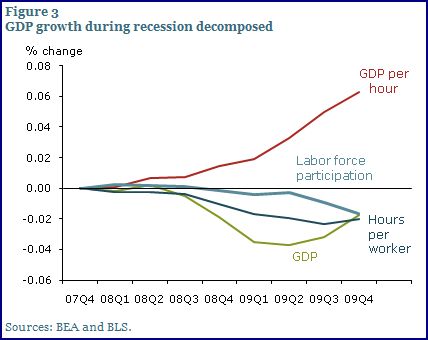
In 2009, strong growth in productivity allowed firms to lay off large numbers of workers while holding output relatively steady. This behavior threw a wrench into the long-standing relationship between changes in GDP and changes in the unemployment rate, known as Okun's law. If Okun's law had held in 2009, the unemployment rate would have risen by about half as much as it did over the course of the year. … Our results indicate that the main factor driving the unusual rise in unemployment relative to output was very rapid productivity growth, which allowed businesses to cut back sharply on labor while maintaining output levels.
… Anecdotal evidence suggests that efforts to contain costs and remain nimble in the face of uncertainty have become a fixture in business strategy. If productivity keeps on growing at an above-average pace, then unemployment forecasts based on Okun's law could continue to be overly optimistic.
Economists blindingly grapple with these issues
- "Is America facing an increase in structural unemployment?", brief answers from a range of economists, 23 July 2010
- "Identifying Cyclical vs. Structural Unemployment", Brad DeLong (Prof Economics, Berkeley), 24 August 2010
- "A curious unemployment picture gets more curious", Federal Reserve Bank of Atlanta, 16 July 2010
- "Labor Force Participation and the Future Path of Unemployment", Joyce Kwok et al, Federal Reserve Bank of San Francisco, 13 September 2010
Martin Ford has some answers to these questions
Ford wrote The Lights in the Tunnel: Automation, Accelerating Technology and the Economy of the Future (2009); the ebook is free.
- The Economic Implications of Intelligent Machines, 26 October 2009
- The Average Worker and the Average Machine, 1 July 2010
- Structural Unemployment: The Economists Just Don't Get It, 4 August 2010
- Econometrics and Technological Unemployment — Some Questions, 6 August 2010
- Outsourcing Jobs…that Can't be Outsourced, 27 August 2010
- Healthcare Robotics, 14 September 2010
Other posts about robots and automation
- 4GW: A solution of the first kind – Robots!, 8 April 2008
- The coming big increase in structural unemployment, 7 August 2010
- The coming Robotic Nation, 28 August 2010
- The coming of the robots, reshaping our society in ways difficult to foresee, 22 September 2010
Originally published at Fabius Maximus and reproduced here with the author's permission.
Opinions and comments on RGE EconoMonitors do not necessarily reflect the views of Roubini Global Economics, LLC, which encourages a free-ranging debate among its own analysts and our EconoMonitor community.
Etiquetas: 2010, ECONOMIA, INDUSTRIAL, INGENIERIA, nov10, SERVICIOS, TECNOLOGIA, USA
26 dic 2009
27 oct 2009
ING: LA FIN D´UN MODELE ET D´UN GEANT
ING, la fin d'un modèle …
et d'un géant
26/10/2009 | Mise à jour : 10:58 |
ANALYSE - Le cas ING illustre la fin d'une époque, celle de la domination des bancassureurs du Bénélux.
Ce mouvement majeur d'ING est dans l'air du temps. Après les banques américaines puis françaises (ces dernières occupant une position particulière dans le paysage européen), la course aux remboursements des aides publiques est lancée sur le vieux continent. Outre ING, le britannique Lloyds Banking Group s'attelle en ce moment-même à lever suffisamment de capitaux auprès de ses actionnaires pour s'émanciper de la tutelle de l'Etat.
Mais le cas ING illustre aussi la fin d'une époque, celle de la domination des bancassureurs du Bénélux. Après le démantèlement de Fortis, l'option stratégique prise aujourd'hui par ING enterre un modèle qui, au début de la décennie, en avait fait un champion. Le groupe a valu jusqu'à 80 milliards d'euros en Bourse, l'une des toutes premières du secteur financier.
Enfin, il convient de souligner le rôle de la Commission européenne dans les annonces faites aujourd'hui par ING. Soupçonnée par certains de favoritisme à l'égard de ses compatriotes, la commissaire néerlandaise à la Concurrence, Neelie Kroes, affiche au contraire son intransigeance à l'approche de la fin de son mandat. Cet été, la banque allemande Commerzbank avait dû, la première, consentir d'énormes sacrifices en contreparties des aides d'Etat reçues. La restructuration drastique à laquelle se plie ING annonce donc d'autres décisions douloureuses chez les banques qui attendent encore l'imprimatur de Bruxelles: Lloyds Banking Group et Royal Bank of Scotland outre-Manche, KBC en Belgique, mais aussi Dexia.
10 ago 2009
aig: despues de la crisis, que?
http://www.elpais.com/articulo/servicios/transformador/coladero/elpepueconeg/20090809elpnegser_3/Tes
aig: despues de la crisis, que?
http://www.elpais.com/articulo/servicios/transformador/coladero/elpepueconeg/20090809elpnegser_3/Tes
27 jul 2009
21 jul 2009
PERU:Promesa Incumplida: Analfabetismo al 8% en 2011
| http://29x55.wordpress.com/2009/07/22/analfabetismo-2006-11-2008-10-22-vii-09/ Analfabetismo 2006: 11% 2008: 10%
Son 6 meses para comenzar las primeras y más urgentes acciones, 2 años para madurar su resultado. Señor ministro, este podría ser el histórico quinquenio en que erradiquemos el analfabetismo. (Mensaje a la Nación, 28 de Julio de 2006)
Pero al mismo tiempo, debemos terminar con la injusticia de tener 2 millones 500 mil peruanos mayores de 15 años que no han sido alfabetizados. Ese es el horror de la exclusión. Y esperamos que al terminar el año esos dos departamentos (Ayacucho y Huancavelica) puedan quedar libres del analfabetismo bajo la supervisión internacional. Y entonces, déjenme confesárselo, como alumno de Haya de la Torre, mi vida por fin habrá alcanzado una meta, erradicar el analfabetismo del Perú. (Mensaje a la Nación, 28 de Julio de 2007)
En Noviembre tendremos un millón de peruanos y peruana alfabetizados. En cuanto a los sectores sociales, trabajamos para aumentar la calidad de la educación y erradicar el analfabetismo. Hasta ahora hemos alfabetizado efectivamente a 420,788 personas en 757 distritos. Este año estamos llegando a 979 distritos y 567,000 personas con lo que se completa un millón de alfabetizados con 189 millones de inversión. (Mensaje a la Nación, 28 de Julio de 2008)
La meta de "Analfabetismo Cero" fue parte del discurso de cierre de campaña de la segunda vuelta, así como también de los últimos tres mensajes a la nación, y debiera serlo del cuarto mensaje del próximo 28 de Julio.
Las bases de datos oficiales de la ENAHO (Encuesta Nacional de Hogares) permiten monitorear como ha evolucionado la variable de analfabetismo en personas de 15 años o más, a nivel nacional y en cada una de las 25 regiones. Así como también por sexo y por lengua materna. El programa de cómputo para elaborar las tablas con una precisión de 99.9% (equivalente a una probabilidad de 1 en 1000 de error) que se presentan a continuación esta disponible en www.29x55.com.
| 2006 | 2008 | 99.9% | |
| Hombre | 5.6% | 5.2% | Igual | |
| Mujer | 16.2% | 15.3% | Igual |
| Lengua Materna |
| 2006 | 2008 | 99.9% | |
| Lengua Originaria | 28.1% | 26.8% | Igual |
| Otra Lengua | 6.5% | 6.1% | Igual |
| Región |
| 2006 | 2008 | 99.9% | |
| Lima y Callao | 3.7% | 3.7% | Igual |
| Amazonas | 13.7% | 11.6% | Igual |
| Ancash | 20.4% | 16.6% | Reducción |
| Apurimac | 23.1% | 26.6% | Igual |
| Arequipa | 8.1% | 7.0% | Igual |
| Ayacucho | 29.0% | 21.5% | Reducción |
| Cajamarca | 20.0% | 21.0% | Igual |
| Cuzco | 20.0% | 18.0% | Igual |
| Huancavelica | 29.0% | 26.0% | Igual |
| Huánuco | 23.1% | 19.8% | Igual |
| Ica | 6.4% | 5.7% | Igual |
| Junín | 12.6% | 9.6% | Reducción |
| La Libertad | 13.2% | 10.4% | Reducción |
| Lambayeque | 8.2% | 10.0% | Igual |
| Lima Provincias | 7.8% | 10.9% | Igual |
| Loreto | 7.8% | 9.2% | Igual |
| Madre de Dios | 7.9% | 6.7% | Igual |
| Moquegua | 8.6% | 8.9% | Igual |
| Pasco | 12.1% | 13.4% | Igual |
| Piura | 13.6% | 11.7% | Igual |
| Puno | 18.2% | 19.6% | Igual |
| San Martín | 9.9% | 9.1% | Igual |
| Tacna | 7.3% | 4.2% | Igual |
| Tumbes | 6.0% | 4.6% | Igual |
Con estos resultados estadísticos es posible concluir con certeza que el analfabetismo no se redujo por sexo, y que el analfabetismo femenino es el triple del masculino. Al reagrupar la población por lengua materna, en un grupo están las lenguas originarias (quechua, aimaras y amazónicas), y en otro grupo las que no son originarias; el analfabetismo no se redujo en ninguno de los dos grupos y la desigualdad entre ambos tampoco se modificó. A nivel regional, si se encuentra reducción del analfabetismo en 4 de las 25, estas son Ancash, Ayacucho, Junín y La libertad, mientras que en las otras 21 el analfabetismo no ha sido reducido.
En síntesis, la meta presidencial de "Analfabetismo Cero" esta lejos de ser cumplida, y en el mejor de los casos, la tendencia presente permite pronosticar un 8% de analfabetismo en 2011.
2 jul 2009
Alzheimer : Johnson & Johnson investit plus d' 1 milliard de dollars
[ 02/07/09 - 14H25 - actualisé à 15:34:00 ]
Le géant américain de la pharmacie a signé un accord pour prendre une participation de 18,4% de la biotech irlandaise Elan, dans le cadre du rapprochement de leurs activités de recherche contre la maladie neurodégénérative.
Le groupe pharmaceutique américain Johnson & Johnson va prendre 18,4% de l'entreprise irlandaise de biotechnologies Elan, moyennant 1 milliard de dollars, dans le cadre d'un rapprochement de leurs activités dans la recherche contre la maladie d'Alzheimer.
L'opération, qui doit être finalisée au deuxième semestre 2009, devrait avoir un impact dilutif de 2 à 3 cents sur le bénéfice unitaire de l'exercice de Johnson & Johnson.
Une nouvelle société reprenant les activités d'Elan dans le traitement d'Alzheimer - qui sont actuellement rassemblées au sein du progamme AIP* mené en collaboration avec Wyeth -, sera créée, Johnson & Johnson en détenant 50,1% et Elan 49,9%.
Elan, basée à Dublin, est évalué à environ 2,7 milliards d'euros, selon de récentes estimations. En janvier dernier, elle avait mandaté Citigroup pour mener une revue stratégique et indiqué qu'elle pouvait théoriquement mener à une cession ou une fusion de l'entreprise avec un concurrent. L'opération annoncée aujourd'hui semble séduire les investisseurs : le titre gagnait plus de 28% sur le marché irlandais.
Johnson & Johnson a indiqué son intention de financer à hauteur de 500 millions de dollars le programme de recherche, dont les travaux portent sur une nouvelle molécule, le bapineuzumab. L'accord qui vient d'être signé prévoit que le groupe pourrait être amené à apporter des financements complémentaires.
Le bapineuzumab fait actuellement l'objet d'études de phase III (les derniers avant la demande d'autorisation de mise sur le marché), pour administration intraveineuse. Une formule pour injection sous-cutanée est actuellement testée en phase II. Un vaccin contre la maladie d'Alzheimer fait par ailleurs l'objet de recherches.
Selon l'Association des Alzheimer aux Etats-Unis, le pays compte compte actuellement 5,3 millions de personnes vivant avec la maladie, une situation qui occasionne au total plus de 148 milliards dollars de frais directs et indirects par an.
14 may 2009
AFP: SOBRE EL ALZA DE COMISIONES, KBURNEO
Cómo Ganar Mas de 3 Millones de Soles
Kurt Burneo
No, no necesita ganar la lotería sino solamente ser accionista de una AFP. El caso es que una de las cuatro AFP´s anunció para alegría de sus accionistas y mala suerte de sus afiliados que elevaría su comisión por administrar el fondo de sus afiliados de 1.98% a 2.3%: Entonces si tal como la propia AFP lo reconoce hasta el momento cuenta con 996,000 afiliados con un salario promedio de 1,000 nuevos soles, su decisión unilateral de aumento en la comisión, le reporta mayores ingresos por S/. 3´187,000 nuevos soles mensuales, curiosamente y por pura casualidad esta decisión de esta AFP surge a continuación de la ley recientemente promulgada que establece la no afectación de las gratificaciones para efectos de aportes al sistema pensionario.
Muy al margen que la decisión de esta AFP implica directamente la reducción del salario real de sus afiliados, el caso es que no hay mucho margen de reacción para estos últimos, dado que la posibilidad de traslado a otra AFP no se efectiviza en lo inmediato; es así que si un trabajador afiliado a esta AFP no quisiera seguir recibiendo estas atípicas expresiones de afecto y presentase sus solicitud de traslado hoy a otra AFP (dado que todas las otras cobran comisiones mas bajas) la generación de aportes y comisiones en la nueva administradora recién se efectivizaría en el mes de julio tal como la aplicación de nuestra normatividad vigente lo establece.
Téngase en cuenta que el gerente de esta administradora, para justificar la decisión señalaba que: “Los afiliados están alcanzando una rentabilidad de 13% de su inversión, entonces no hay un equilibrio” …(el rendimiento para los accionistas de esta AFP es de “sólo US$ 33 millones”), ¿Usted cree amigo lector que si realmente hubiera competencia en el mercado de administración de fondos previsionales sería posible sin mayor problema como ocurre hoy, el que una AFP incremente el precio del servicio para aumentar el rendimiento de la inversión de los dueños? Claro cuando en lo inmediato la demanda por servicios de administración de fondos de pensiones es (por arreglo institucional) perfectamente inelástica, ello sí es factible.
Otro interesante argumento de esta AFP engreidora de sus afiliados, para justificar el alza en la comisión, según su gerente general es porque:….”lo mas importante es mantener el servicio que venimos dando a nuestros afiliados” Veamos, si le tomamos la palabra a este funcionario el mejor servicio que espera el afiliado de su AFP o de cualquiera, está asociado con el rendimiento neto que logre. El caso es que dado que la rentabilidad se calcula sobre el monto de la cuenta individual de capitalización (el ahorro del afiliado) y las comisiones sobre las remuneraciones; se necesita calcular una comisión que convierte lo que un afiliado desembolsa actualmente durante todo su periodo de ahorro (tiempo de vida laboral útil alrededor de 30 años) en una comisión que se estime sobre su cuenta individual de capitalización, a esto se denomina Comisión Equivalente. Entonces si descontamos a la rentabilidad del fondo pensionario de un afiliado la comisión equivalente, se tiene una versión ajustada de la rentabilidad neta y según cálculos de la propia SBS, paradójicamente, la AFP que subió su comisión para mantener “el servicio a sus afiliados” en los últimos 10 años (dado que el análisis debe hacerse con una perspectiva de largo plazo) presenta una rentabilidad neta de 7.12%, la mas baja respecto a las otras. ¿Mejor servicio?
Adicionalmente, este tipo de decisiones unilaterales van a contrasentido del objetivo macroeconómico de las recientes medidas dictadas, para exonerar las gratificaciones al pago de aportes previsionales y liberalización de las CTS, las cuales buscan propulsar el ingreso disponible, el consumo y la demanda…... Excepto que se suponga que los accionistas de esta AFP tienen tantas necesidades insatisfechas que su propensión a consumir (y por tanto el efecto sobre el consumo y demanda en la economía) es mucho mayor que la que tienen sus afiliados. Al final 3 millones de soles adicionales al mes para los accionistas de esta AFP, los obtienen no por jugar a la loteria, ni por racionalizar sus costos como cualquier otra empresa, sino gracias a una privilegiada posición en un mercado cautivo.
12 may 2009
PERU: MINERA TIA MARIA 2TRIM 2011, RETRASO
Tía María operaría desde el segundo trimestre del 2011
17:55El proyecto cuprífero sufriría un retraso de casi seis meses en sus operaciones, estimó la productora Southern Copper.
Southern Copper, uno de los mayores productores mundiales de cobre, dijo el lunes que podría reiniciar a fines de este año o inicios del 2010 las operaciones en su mina Cananea en México, que aportaba al menos un 20 por ciento de la producción total de la compañía.
El presidente ejecutivo de la empresa, Oscar González, agregó en el Foro de Inversión de Reuters sobre América Latina que su proyecto cuprífero peruano Tía María sufriría un retraso de casi seis meses y comenzaría a operar en el segundo trimestre del 2011.
Southern Copper, controlada por Grupo México, opera en Perú las minas Toquepala y Cuajone y su fundición de Ilo, y en México los yacimientos La Caridad y Cananea, este último cerrado actualmente por fuerza mayor tras casi dos años de huelga de sus trabajadores.
“Cananea puede comenzar para fin de año o para principio del año 2010. Estamos confiados en que el año que entra podamos tener una producción normal, las posibilidades son bastante grandes (...) yo diría que un 99%”, dijo González.
“Con nuevo sindicato y nuevos trabajadores que hay que capacitar”, agregó, en declaraciones que reproduce la agencia Reuters.
Grupo México fue autorizado por el Gobierno de su país a despedir y compensar a los trabajadores en huelga en Cananea, cuya capacidad de producción asciende a entre 140,000 y 150,000 toneladas anuales de cobre.
Cananea, el segundo mayor yacimiento cuprífero de la compañía, alimenta a la fundición La Caridad, que actualmente opera a la mitad de su capacidad.
González afirmó que antes de retomar la producción en Cananea la empresa reparará los daños sufridos en la mina, lo que podría tomar entre tres y cuatro meses.
“Hay daños en las instalaciones de Cananea (...) que requiere inclusive una inversión superior a más de 50 millones de dólares”, precisó el ejecutivo.
“En el caso de México estamos esperando que se reanude Cananea para hacer las inversiones que había previstas, las más importantes estaban en Cananea”, añadió.
PROYECTOS EN PERÚ
Para este año, González estimó que la producción de cobre de Southern Copper se mantendría estable, en entre 470,000 y 480,000 toneladas de cobre, sin incluir lo que produciría Cananea a fines de este año.
Perú es el segundo productor mundial de cobre, después de Chile.
González dijo que Southern Copper decidió continuar con el proyecto de cobre Tía María en Perú, con inversiones de 950 millones de dólares, y que actualmente evalúa si pueden reactivar la expansión de Toquepala, que implica otros 600 millones de dólares.
El proyecto Tía María “ya está aprobado, no está financiado, lo vamos a hacer con recursos propios y por eso es que nos vamos hasta el 2011, porque vamos a ir manejando nuestra caja que ahorita está muy baja. Vamos a ir invirtiendo a medida que vayamos teniendo ingresos”, afirmó.
Tía María, ubicado en la región andina de Arequipa, en el sur de Perú, podría producir unas 120,000 toneladas métricas de cobre anuales, según la empresa.
“Antes teníamos pronosticado Tía María para el cuarto trimestre del 2010, ahora lo tenemos en el segundo trimestre del 2011, casi seis meses más”, explicó el ejecutivo.
“Toquepala se podría decidir en una reunión de directorio en julio (...) Hablamos de una inversión de 600 millones de dólares para aumentar en 40.000 toneladas más la producción, frente a las 60.000 que produce actualmente”, agregó González.
1 may 2009
PREMIER MAI: UNITAIRE, HUMA
Premier mai : la force de l'unité
160 000 manifestants à paris, plus d’un million dans toute la France. La journée d’histoire comptera pour la suite du mouvement.
Reportage à Marseille : Josette, Jean, Robert et Sylvie ont défilé ensemble. Pour deux d’entre eux, c’était une première.
Marseille (Bouches-du-Rhône), correspondant régional.
Ils sont éparpillés tout au long de l’imposant cortège marseillais de ce 1er Mai. « Même avec les portables, on n’a pas réussi à se retrouver. » Mais ces quatre-là sont restés ensemble, en début de cortège, où la sono et les pétards couvrent les slogans comme les sonneries.
Il y a Josette, ancienne salariée dans le nettoyage industriel, « virée à cinquante ans ». Des années de petits boulots ensuite, puis désormais l’allocation de solidarité. Josette n’est pas forcément de toutes les manifs. Mais, aujourd’hui, elle voulait en être : « Il y a tellement de choses à dire, tellement de trucs qui ne vont pas… sauf pour les patrons qui n’ont pas trop à se plaindre. Enfin, je parle des gros, pas des petits. »
À ses côtés se trouve son frère, Jean. Technicien informatique, il a perdu son emploi le 1er novembre 2008 : « Depuis un an, on sentait les choses venir. Le but du jeu, pour la direction, c’est de rogner sur la masse salariale pour payer les dividendes des actionnaires. » Son ancien salaire : le SMIC, « et encore annualisé », sans parler des heures supplémentaires pas payées. Issu d’une famille de communistes depuis plusieurs générations - « j’ai distribué l’HD quand j’étais petit » -, Jean ne rate pas un défilé : « Je manifeste pour montrer ma détermination à ne pas me laisser faire et pour dire que là où certains parlent de meilleure répartition des richesses, moi, je veux une répartition totalement différente des richesses. Ce n’est pas pareil. » Il affirme « ne rien attendre de ce gouvernement ». Simplement, ça le « regonfle de voir que (je) ne suis pas seul dans (mon) coin », dit-il en jetant un coup d’œil au plus important défilé du 1er Mai que Marseille ait connu depuis bien des années. Avec lui, son compagnon, Robert, bat le pavé marseillais pour la première fois. De nationalité belge, il est arrivé de sa Flandre natale à Marseille en 2005. Programmeur informatique. En Belgique non plus, il n’avait jamais manifesté. Il résume ainsi le sens de ce pas franchi : « Contre la politique qui n’aide que les patrons et ne fait rien les salariés. »
Première également pour Sylvie, la belle-fille de Josette. Femme de ménage à temps plein depuis quatre ans, elle touche le salaire minimum. La crise la frappe directement au porte-monnaie. « On ne peut pas réduire le logement ou le chauffage, alors on serre le budget nourriture. Je peux vous dire que cet été, on ne sera pas nombreux sur les plages. » Cette mère de deux enfants (treize et onze ans) formule également son inquiétude quant à l’avenir de l’éducation. En quelques mots comme en cent, elle lâche : « Y en a marre de leurs conneries qui nous retombent dessus. Il faut que le gouvernement prenne conscience que c’est le peuple qui l’a élu et que ce peuple a des attentes. » La sono crache la chanson des Zebda, Motivés.
Christophe Deroubaix
1 MAYO 2009: MATICES INTERSINDICALES
Et après ? Pour la troisième fois en quatre mois, les syndicats mettront vendredi dans la rue un nombre impressionnant de salariés. Avec 283 cortèges dans toute la France et une manifestation parisienne qui devrait battre des records, le succès de cette troisième journée d’action ne fait guère de doute. Pourtant, cette mobilisation croissante complique un peu plus la stratégie des organisations syndicales, qui jouent l’union sacrée face à la crise économique, mais sont de plus en plus tiraillées entre réalistes et radicaux.
Trotskistes. Lundi, les huit de l’intersyndicale (CGT, CFDT, FO, CFTC, CFE-CGC, Unsa, Solidaires, FSU) se sont retrouvés au siège de Force ouvrière pour définir les revendications communes. Sur ce chapitre, pas de surprise : ce sont l’emploi, le pouvoir d’achat et la relance économique. Mais pour la suite des événements, le scénario est plus complexe. Aussi les huit organisations syndicales ont-elles décidé… de se revoir le 4 mai «pour débattre des objectifs, des modalités et du calendrier des prochaines initiatives».
Dans le camp des radicaux, on trouve Solidaires, la FSU et Force ouvrière, qui verraient bien un appel à la grève générale avant l’été. Une stratégie inspirée par les militants trotskistes du Nouveau Parti anticapitaliste d’Olivier Besancenot (nombreux à Solidaires, dans les syndicats SUD), de Lutte ouvrière et du Parti ouvrier indépendant, l’ancien Parti des travailleurs (à FO et parfois à la CGT), mais aussi du PCF et du Parti de gauche de Jean-Luc Mélenchon, influents à la FSU.
Cette résurgence du vieux mythe de la grève générale a le don d’exaspérer les leaders du bloc «réaliste» au sein de l’intersyndicale, rassemblé derrière un front CGT-CFDT plus uni que jamais. Le fait que Force ouvrière s’accroche au mot d’ordre de grève générale les irrite particulièrement. «Même en mai 1968, rappelle un responsable CGT, on n’a pas appelé à la grève générale. Et sur le terrain, dans les boîtes, on aimerait bien les voir un peu plus les gars de FO. Là où ils sont encore présents, c’est pas des foudres de guerre.» Confidences «off», bien entendu. L’heure est à l’unité syndicale.
Maladresse calculée. De leur côté, les militants «radicaux» critiquent de plus en plus ouvertement la CGT et la CFDT, dont le gouvernement souligne avec une maladresse calculée «le sens des responsabilités», en l’opposant aux débordements réels ou supposés observés dans les conflits locaux, qu’il s’agisse des séquestrations de dirigeants ou des dégradations de la sous-préfecture de Compiègne.
«Chacun en réalité sait très bien que le premier qui quitte l’intersyndicale apparaîtra comme un briseur de l’unité d’action», observe un responsable de l’Unsa : «On est donc condamnés à s’entendre.» La seule fenêtre de lancement pour une prochaine action commune est la deuxième quinzaine de juin. A la mi-mai, en effet, ont lieu les quatre grandes manifestations européennes auxquelles les quatre syndicats membres de la Confédération européenne des syndicats (CGT, CFDT, FO et Unsa) se doivent de participer activement. Le 7 juin ont lieu les élections européennes. Reste trois semaines avant les vacances d’été.
Quant à la nature de la mobilisation, elle pose aussi problème. Le record que ce 1er Mai devrait constituer sera difficile à battre. «Il nous faut trouver une forme d’action qui ne permette pas la comparaison», confiait un dirigeant de la CFDT. Une équation difficile à résoudre alors que le bloc des «radicaux» pourra continuer à réclamer un appel à grève générale.
27 abr 2009
4 mar 2009
UE:DEGRADATION DU TERTIAIRE
| Tous droits réservés - Les Echos |
ENTREVISTAS TV CRISIS GLOBAL
Etiquetas
- 1 MAYO
- 2
- 2002
- 2007
- 2008
- 2009
- 2010
- 2011
- 2012
- 2013
- 2014
- 2015
- 2016
- 2o11
- 2OO9
- a
- abr2015
- abril09
- abril10
- acc
- actualidadecono
- AFP
- AFPS
- AFRICA
- Ago11
- AGOS
- AGOST10
- agost12
- AGOSTO2008
- AGOSTO2009
- agosto2015
- AGRO
- AGROEXPORTACION
- AIG
- AL
- ALAGROEXPORTACION
- ALEMANIA
- ALIMENTOS
- amazonia
- AMERICALATINA
- ANDAHUAYLAS
- APEC
- ARCH MES
- ARGENTINA
- asarco
- ASIA
- ATTAC
- australia
- AUTOMOVIL
- AVAAZ
- b
- BAILOUT
- baltic
- BANCOS
- BC
- BCE
- BCRP
- benassy
- benedetti
- BERNANKE
- bernis
- BIELORUSIA
- BIS
- blanchard
- BOE
- BOJ
- BOLIVIA
- BOLSA
- BONUS
- BRASIL
- BRIC
- BUBBLE
- bundesbank
- C
- c rec
- CAFE
- CAMBIOCLIMATICO
- CAMERICAS
- CAN
- CANADA
- CANCION
- CAPITALISMO
- castro
- CDO
- cepij
- CHAVEZ
- cheque
- CHILE
- chimerica
- CHINA
- CHRYSLER
- CICLO
- CIE
- ciencia
- CIP
- COBRE
- COLOMBIA
- COMERCIO
- commodities
- COMPUTO
- CONSTRUCCION
- CONSUMO
- CONTAGIO
- control
- COPENHAGUE
- CORRUPCION
- coursera
- CRECIMIENTO
- CREDITO
- CRISIS
- CUBA
- CUMBREALCUE
- CUMBREALCUSA
- davos
- DEC08
- DEC11
- dec12
- DEC13
- dec15
- DEFICIT
- DEFLACION
- demanda
- DEPRESION
- DERIVADOS
- DEUDA
- developpement
- DIC09
- DIC10
- dic12
- DICIEMBRE
- do
- DOLAR
- doubledip
- dsk
- dubai
- duracion
- ec
- ecologo
- ECONOMIA
- ECUADOR
- EDUCA
- efectos
- EMPLEO
- EN11
- en16
- EN2016
- encuesta
- ene016
- energia
- ENERO
- ENERO09
- enero10
- EST
- eu
- EURO
- expansion
- EXPORTACION
- f
- fannie
- feb09
- feb10
- feb13
- feb15
- FED
- filo
- fin
- FINANZAS
- FINLANDIA
- fisica
- flu
- FMI
- FONDOS
- fr
- FRANCE
- frankfurt
- frontrunning
- fukushima
- G20
- G7
- GAS
- geab
- GEITHNER
- gini
- GLO
- global
- GM
- GONZALO GARCIA
- grece
- GREENSPAN
- GRENOBLE
- gripeporcina
- grupo mexico
- HAITI
- hambre
- HEDGE FUNDS
- HIPOTECA
- hist
- HOLLANDE
- HONDURAS
- IMPORTACION
- IMPUESTOS
- INDE
- INDIGNADOS
- INDUSTRIAL
- INFLACION
- INFORMALIDAD
- INFRAESTRUCTURA
- INGENIERIA
- INGENIEROS
- innova
- INTEGRACION
- INTERNACIONAL
- INVERSION
- IRAN
- IRLANDA
- ISLANDIA
- ismea
- ITALIA
- IZQ
- JAPON
- JUL11
- JULIO08
- JULIO09
- JULIO15
- JUN09
- jun10
- jun11
- JUN12
- jun13
- jun15
- JUNIO08
- keynes
- KRUGMAN
- lagarde
- LAREPUBLICA
- leap
- leverage
- liquidez
- LITIO
- lme
- LR
- macro
- MACROECONOMICS
- madera
- MADOFF
- MAMBIENTE
- MANGO
- MARS09
- mars10
- marx
- matematicas
- MATERIASPRIMAS
- MATUK
- MAY09
- MAY11
- MAY12
- MAY13
- may15
- may2015
- MAYO
- MBS
- me
- mef
- MERKEL
- METALES
- MEXICO
- miga
- MIGRA
- MINERIA
- MODELES
- MONDE
- MONEDA
- mourey
- MUJICA
- MUNDO
- musica clasica
- NACIONALIZACION
- neural
- niño
- nobel
- NOTASEMANAL
- NOV08
- nov09
- nov10
- NOV11
- NOV12
- nov15
- nuclear
- OBAMA
- OCDE
- oct09
- oct10
- OCT11
- oct12
- OCTUBRE08
- OFCE
- OIT
- OMC
- ORO
- paita
- PANAMA
- PAPA
- PARADIS
- PARAGUAY
- PAULSON
- pbi
- pe
- PEÑAFLOR
- PERU
- pesca
- PETROLEO
- piketty
- PLAN
- PMI
- POBLA
- POBREZA
- POL
- POLITICA
- porter
- portugal
- postcrisis
- PPT_CRISIS
- PRODUCCION
- PRODUCTIVIDAD
- profits
- prog
- PROTECCION
- QUIEBRA
- r
- RECESION
- REGULACION
- REMESAS
- REPEC
- REPRISE
- REPSOL
- RESERVAS
- RETAIL
- RGE
- RIESGOPAIS
- RMBS
- ROBOTICA
- RODRIK
- ROUBINI
- RUSIA
- SALARIOS
- SARKO
- school paris
- sep11
- SEP15
- SEQUIA
- SERVICIOS
- set09
- set10
- set11
- set12
- SET15
- SETIEMBRE08
- SINGAPUR
- SIRIA
- sismo
- soros
- southern
- SPAIN
- STANFORD
- STIGLITZ
- SUBPRIMES
- SUISSE
- SYRIZA
- TAIWAN
- TARIFAS
- TAS
- TCAMBIO
- TECNOLOGIA
- TERRITORIO
- TEXTIL
- TINTERES
- TLC
- TPP
- trabajo
- trentin
- TRICHET
- TROIKA
- tsunami
- TURISMO
- TV
- UBS
- UE
- UK
- UKRANIA
- UNASUR
- URUGUAY
- USA
- v
- VENEZUELA
- VIDEO
- vivienda
- WALL STREET
- WS
- wsj
- YEN
- young
- YUAN
- Zbasura
- zerohedge
Peru:crisis impacto regional arequipa,raul mauro
Temas CRISIS FINANCIERA GLOBAL
claves para pensar la crisis
-Tipo de cambio
- DIARIOS DE HOY
PRESS CLIPPINGS-RECORTES PRENSA-PRESSE..
canciones de GRACIAS A LA VIDA !
ETIQUETAS alfabetico
- 1 MAYO
- 2
- 2002
- 2007
- 2008
- 2009
- 2010
- 2011
- 2012
- 2013
- 2014
- 2015
- 2016
- 2o11
- 2OO9
- a
- abr2015
- abril09
- abril10
- acc
- actualidadecono
- AFP
- AFPS
- AFRICA
- Ago11
- AGOS
- AGOST10
- agost12
- AGOSTO2008
- AGOSTO2009
- agosto2015
- AGRO
- AGROEXPORTACION
- AIG
- AL
- ALAGROEXPORTACION
- ALEMANIA
- ALIMENTOS
- amazonia
- AMERICALATINA
- ANDAHUAYLAS
- APEC
- ARCH MES
- ARGENTINA
- asarco
- ASIA
- ATTAC
- australia
- AUTOMOVIL
- AVAAZ
- b
- BAILOUT
- baltic
- BANCOS
- BC
- BCE
- BCRP
- benassy
- benedetti
- BERNANKE
- bernis
- BIELORUSIA
- BIS
- blanchard
- BOE
- BOJ
- BOLIVIA
- BOLSA
- BONUS
- BRASIL
- BRIC
- BUBBLE
- bundesbank
- C
- c rec
- CAFE
- CAMBIOCLIMATICO
- CAMERICAS
- CAN
- CANADA
- CANCION
- CAPITALISMO
- castro
- CDO
- cepij
- CHAVEZ
- cheque
- CHILE
- chimerica
- CHINA
- CHRYSLER
- CICLO
- CIE
- ciencia
- CIP
- COBRE
- COLOMBIA
- COMERCIO
- commodities
- COMPUTO
- CONSTRUCCION
- CONSUMO
- CONTAGIO
- control
- COPENHAGUE
- CORRUPCION
- coursera
- CRECIMIENTO
- CREDITO
- CRISIS
- CUBA
- CUMBREALCUE
- CUMBREALCUSA
- davos
- DEC08
- DEC11
- dec12
- DEC13
- dec15
- DEFICIT
- DEFLACION
- demanda
- DEPRESION
- DERIVADOS
- DEUDA
- developpement
- DIC09
- DIC10
- dic12
- DICIEMBRE
- do
- DOLAR
- doubledip
- dsk
- dubai
- duracion
- ec
- ecologo
- ECONOMIA
- ECUADOR
- EDUCA
- efectos
- EMPLEO
- EN11
- en16
- EN2016
- encuesta
- ene016
- energia
- ENERO
- ENERO09
- enero10
- EST
- eu
- EURO
- expansion
- EXPORTACION
- f
- fannie
- feb09
- feb10
- feb13
- feb15
- FED
- filo
- fin
- FINANZAS
- FINLANDIA
- fisica
- flu
- FMI
- FONDOS
- fr
- FRANCE
- frankfurt
- frontrunning
- fukushima
- G20
- G7
- GAS
- geab
- GEITHNER
- gini
- GLO
- global
- GM
- GONZALO GARCIA
- grece
- GREENSPAN
- GRENOBLE
- gripeporcina
- grupo mexico
- HAITI
- hambre
- HEDGE FUNDS
- HIPOTECA
- hist
- HOLLANDE
- HONDURAS
- IMPORTACION
- IMPUESTOS
- INDE
- INDIGNADOS
- INDUSTRIAL
- INFLACION
- INFORMALIDAD
- INFRAESTRUCTURA
- INGENIERIA
- INGENIEROS
- innova
- INTEGRACION
- INTERNACIONAL
- INVERSION
- IRAN
- IRLANDA
- ISLANDIA
- ismea
- ITALIA
- IZQ
- JAPON
- JUL11
- JULIO08
- JULIO09
- JULIO15
- JUN09
- jun10
- jun11
- JUN12
- jun13
- jun15
- JUNIO08
- keynes
- KRUGMAN
- lagarde
- LAREPUBLICA
- leap
- leverage
- liquidez
- LITIO
- lme
- LR
- macro
- MACROECONOMICS
- madera
- MADOFF
- MAMBIENTE
- MANGO
- MARS09
- mars10
- marx
- matematicas
- MATERIASPRIMAS
- MATUK
- MAY09
- MAY11
- MAY12
- MAY13
- may15
- may2015
- MAYO
- MBS
- me
- mef
- MERKEL
- METALES
- MEXICO
- miga
- MIGRA
- MINERIA
- MODELES
- MONDE
- MONEDA
- mourey
- MUJICA
- MUNDO
- musica clasica
- NACIONALIZACION
- neural
- niño
- nobel
- NOTASEMANAL
- NOV08
- nov09
- nov10
- NOV11
- NOV12
- nov15
- nuclear
- OBAMA
- OCDE
- oct09
- oct10
- OCT11
- oct12
- OCTUBRE08
- OFCE
- OIT
- OMC
- ORO
- paita
- PANAMA
- PAPA
- PARADIS
- PARAGUAY
- PAULSON
- pbi
- pe
- PEÑAFLOR
- PERU
- pesca
- PETROLEO
- piketty
- PLAN
- PMI
- POBLA
- POBREZA
- POL
- POLITICA
- porter
- portugal
- postcrisis
- PPT_CRISIS
- PRODUCCION
- PRODUCTIVIDAD
- profits
- prog
- PROTECCION
- QUIEBRA
- r
- RECESION
- REGULACION
- REMESAS
- REPEC
- REPRISE
- REPSOL
- RESERVAS
- RETAIL
- RGE
- RIESGOPAIS
- RMBS
- ROBOTICA
- RODRIK
- ROUBINI
- RUSIA
- SALARIOS
- SARKO
- school paris
- sep11
- SEP15
- SEQUIA
- SERVICIOS
- set09
- set10
- set11
- set12
- SET15
- SETIEMBRE08
- SINGAPUR
- SIRIA
- sismo
- soros
- southern
- SPAIN
- STANFORD
- STIGLITZ
- SUBPRIMES
- SUISSE
- SYRIZA
- TAIWAN
- TARIFAS
- TAS
- TCAMBIO
- TECNOLOGIA
- TERRITORIO
- TEXTIL
- TINTERES
- TLC
- TPP
- trabajo
- trentin
- TRICHET
- TROIKA
- tsunami
- TURISMO
- TV
- UBS
- UE
- UK
- UKRANIA
- UNASUR
- URUGUAY
- USA
- v
- VENEZUELA
- VIDEO
- vivienda
- WALL STREET
- WS
- wsj
- YEN
- young
- YUAN
- Zbasura
- zerohedge