Mirada schumpeteriana de la crisis
http://www.project-syndicate.org/commentary/technological-stagnation-and-advanced-countries--slow-growth-by-kenneth-rogoff/spanish
17. TASAS DE INTERES Peru
16. tipo de cambio sol/dolar-consulta del dia
V. SECCION: M. PRIMAS
1. SECCION:materias primas en linea:precios
METALES A 30 DIAS click sobre la imagen
(click sur l´image)
2. PRECIOS MATERIAS PRIMAS
9. prix du petrole
10. PRIX essence
petrole on line
4 dic 2012
CRISIS,CIENCIA,TECNOLOGIA,INNOVACION
Etiquetas: 2012, ciencia, dic12, ECONOMIA, EURO, innova, JAPON, MACROECONOMICS, TECNOLOGIA, USA
20 jun 2012
Fwd: Macroperu Flujos de Inversión Directa extranjera en LA
.
From: Bruno <lbseminario@yahoo.com>
Date: 2012/6/18
Subject: Macroperu Flujos de Inversión Directa extranjera en LA
¿Por q}e Brasil reciben un flujo de ineversi{on que excede a su partiación en el PBI? Probablemnte porque las multinacionales pinesan usr estos paises como plataformas exportadoras hacia otros paises como plataforma exportadora a otros paises de al region: son las dos unicas economias de la region con un aparto industrial digno de consideraci}on. La manufactura en Sudamerica se reduce al procesamineto de alimentos, produccion de materiales de construccion , y procesamiento de materias primas, es dcir, a sectores donde la investigaci{on y desarrollo no tiene la mayor importancia . En estos sectores la investigacion y el desarrollo tine escasa relevancia pues los productos no ambia de forma. Despues de todo, uno no necesita cambiar la forma de las gaseoasas, loslos platos, o los ladrillos de las casas . El valor agregado directo de estos productos es 30 por ciento del costo total. Tambien es reducido el ipacto del mismo sobre estos sectores de la econom{ia.
Es posible, por ejemplo, que un dolara de textil exportado genra menos valor garegado que un dolara de harian de pescad y probablemnte igual cantidad de empleo. La exportacion de textiles con algodon importado corta la conexi{on del sector con la agricltura y hace desaprecer casi todo el impacto indirecto del sector. El mismo fecto reduce el valor agregado generado en el sector.
Foreign Direct Investment in Latin America Hit Record Highs in 2011
Author: Shannon Oneil · June 18th, 2012 · Comments (0)
Share This Print 0 0
Last year foreign direct investment (FDI) in Latin America continued its surge, topping $150 billion, an all time high for the region. According to the Economic Commission for Latin America and the Caribbean's report "Foreign Direct Investment in Latin America and the Caribbean," the inflows climbed 31 percent—the most of any region and three times Asia's growth rate—and now represent just over 10 percent of total global investment (breaking into the double digits for the first time as well).
While nearly all countries gained, the largest recipient, unsurprisingly, was Brazil. There, investments rose by 37 percent, and in a change from the past, flowed mostly into the manufacturing and service sectors (the largest single investment coming from the German conglomerate ThyssenKrupp's construction of a $7 billion steel exporting plant). Inflows to Mexico and Central America were also led by manufacturing and services (including tourism, banking, and the automotive sectors). Only in South America (excluding Brazil), did most of the investment remain in commodities and natural resources.
Despite tough times at home, Europe led with some $35 billion in investment. Anecdotes suggest that the profitability of Latin American subsidiaries and operations have helped keep some European companies afloat (for instance the Spanish banks Santander and BBVA). Following in total inflows was the United States, and, if taken in the aggregate, other Latin American states (which invested nearly $23 billion). Interestingly, these countries, Japan, and Canada all outpaced China's involvement.
The report also touches on the quality of FDI flows, and its potential to transform Latin America's economies for the better through job creation, technology transfers, capacity building, and the like. Here the story is better than in the past, but still cautionary. More investment (now over one-third) went into what can be considered medium-high tech sectors, such as chemicals, autos, and machinery. Most of this uptick occurred in Latin America's largest economies, Brazil and Mexico. The study also shows that investment in high end technology and research and development remains small (less than 5 percent) and concentrated in Brazil.
Foreign direct investment is a useful gauge of investor confidence and, indirectly, potential economic growth. Here Latin America's decade of macroeconomic stability, natural resource endowments, and expanding domestic markets (due to a growing regional middle class) have drawn increased attention and dollars. The challenge for the region is to funnel the growing investment to benefit its citizens alongside these international companies and investors, creating jobs, enhancing learning, and increasing productivity in ways that will let Latin America compete globally in the long term.
Published in conjunction with Latin America's Moment at the Council on Foreign Relations.
This post originally appeared at LatIntelligence and is posted with permissio
Etiquetas: 2012, AMERICALATINA, ciencia, INGENIERIA, INTERNACIONAL, INVERSION, JUN12, PRODUCCION, PRODUCTIVIDAD, TECNOLOGIA
13 sept 2011
Fwd: ARGENPRESS.info - Envío especial: Clases, estados e ideologías imperiales
Por: Claudio Katz (especial para ARGENPRESS.info)
http://www.argenpress.info/2011/08/clases-estados-e-ideologias-imperiales.html
¿Imperialismo versus economía de mercado?
Claudio Katz (especial para ARGENPRESS.info)
http://www.argenpress.info/2011/08/imperialismo-versus-economia-de-mercado.html
¿Un imperio trasnacional?
Claudio Katz (especial para ARGENPRESS.info)
http://www.argenpress.info/2011/08/un-imperio-trasnacional.html
Teorías de la sucesión hegemónica
Por: Claudio Katz (especial para ARGENPRESS.info)
http://www.argenpress.info/2011/08/teorias-de-la-sucesion-hegemonica.html
Discusiones sobre el declive de Estados Unidos
Por: Claudio Katz (especial para ARGENPRESS.info)
http://www.argenpress.info/2011/07/discusiones-sobre-el-declive-de-estados.html
Los cambios en la rivalidad interimperial
Por: Claudio Katz (especial para ARGENPRESS.info)
http://www.argenpress.info/2011/07/los-cambios-en-la-rivalidad.html
¿Etapa final o temprana del imperialismo?
Por: Claudio Katz (especial para ARGENPRESS.info)
http://www.argenpress.info/2011/07/etapa-final-o-temprana-del-imperialismo.html
Replanteos marxistas del imperialismo
Por: Claudio Katz (especial para ARGENPRESS.info)
http://www.argenpress.info/2011/07/replanteos-marxistas-del-imperialismo.html
Interpretaciones convencionales del imperio
Por: Claudio Katz (especial para ARGENPRESS.info)
http://www.argenpress.info/2011/07/interpretaciones-convencionales-del.html
Las áreas estratégicas del imperio
Por: Claudio Katz (especial para ARGENPRESS.info)
http://www.argenpress.info/2011/06/las-areas-estrategicas-del-imperio.html
Adversarios y aliados del imperio
Por: Claudio Katz (especial para ARGENPRESS.info)
http://www.argenpress.info/2011/06/adversarios-y-aliados-del-imperio.html
Gestión colectiva y asociación económica imperial
Por: Claudio Katz (especial para ARGENPRESS.info)
http://www.argenpress.info/2011/06/gestion-colectiva-y-asociacion.html
El papel imperial de Estados Unidos
Por: Claudio Katz (especial para ARGENPRESS.info)
http://www.argenpress.info/2011/06/el-papel-imperial-de-estados-unidos.html
El imperialismo contemporáneo
Por: Claudio Katz (especial para ARGENPRESS.info)
http://www.argenpress.info/2011/05/el-imperialismo-contemporaneo.html
"El imperialismo del siglo XXI" (Capítulo I – Parte IV): La teoría
clásica del imperialismo
Por: Claudio Katz (especial para ARGENPRESS.info)
http://www.argenpress.info/2011/05/el-imperialismo-del-siglo-xxi-capitulo_20.html
Etiquetas: 2011, ARGENTINA, ECONOMIA, EMPLEO, MACROECONOMICS, set11, TECNOLOGIA
18 ene 2011
GERARD DESTANNE DE BERNIS in memoriam, WILKIPEDIA
http://fr.wikipedia.org/wiki/G%C3%A9rard_Destanne_de_Bernis#Affiliation_th.C3.A9orique
Un resume de la vie de Gerard Destanne De Bernis, in memoriam
Etiquetas: 2011, AL, ASIA, bernis, CHINA, CRECIMIENTO, ECONOMIA, EN11, FRANCE, GAS, INDUSTRIAL, JAPON, MACROECONOMICS, TECNOLOGIA
DE BERNIS IN MEMORIAM: THEOTONIO DOS SANTOS
http://theotoniodossantos.blogspot.com/
Gerard De Bernis in memoriam, par Theotonio Dos Santos
Etiquetas: 2011, AL, bernis, BRASIL, CRECIMIENTO, ECONOMIA, EN11, FRANCE, MACROECONOMICS, TECNOLOGIA
http://www.ceim.uqam.ca/spip.php?article713
Gérard De Bernis (1928-2010)
In memoriam
Gérard De Bernis (1928-2010)
Arturo Guillén y Gregorio Vidal
Departamento de Economía Universidad Autónoma Metropolitana, Unidad Iztapalapa, en México.
Un gran corazón y una mente lúcida dejaron de existir en la Nochebuena del 2010. Después de una penosa enfermedad que lo arrancó de su fructífera vida intelectual de muchas décadas, el economista francés Gérard Destanne De Bernis murió víctima de un ataque cardíaco inesperado. Gérard de Bernis es sin duda, uno de los economistas franceses más importantes del siglo XX. Alumno de Maurice Byé y de François Perroux otro gigante del pensamiento económico francés de ese siglo -, marxista y comunista por convicción, De Bernis fue un pensador fecundo, pero también, en su ámbito, un hombre de acción. Estudiante universitario en Francia a finales de los años cuarenta, fue Presidente de la Unión Nacional de Estudiantes y director del diario estudiantil La Quinzaine. Nombrado como Profesor Agregado a los 25 años, fue asignado a desempeñarse en Túnez, donde participó en las luchas por la independencia de esta ex-colonia francesa, lo que le valió ser sancionado por el gobierno francés y regresado a su país por la fuerza. A diferencia de muchos intelectuales franceses y de los países desarrollados incluidos marxistas que se deleitan en el eurocentrismo, Gérard fue siempre un tercermundista, un auténtico internacionalista. Fue asesor de varios gobiernos africanos que accedieron a la independencia. Trabajó de manera muy cercana con el gobierno revolucionario de Boumediene en Argelia, en cuya estrategia económica influyó de manera importante[1]. Mantuvo lazos, entre otros, con gobiernos y sindicatos de Vietnam, Mozambique, Congo- Brazza, Marruecos e Irak. Dio su apoyo para la creación del centro de investigación independiente, ARCIS, en plena dictadura de Pinochet. Fue profesor emérito de la Universidad de Grenoble y Presidente del Instituto de Ciencias Matemáticas y Economía Aplicada (ISMEA) de París, donde sucedió a su fundador François Perroux en 1982, hasta que su enfermedad lo alejó de ese cargo. Su obra es muy vasta y rica, aunque poco difundida, aún en su natal Francia. Entre sus principales libros y artículos se encuentran, con Maurice Byé, Relations Économiques Internationales (1987)[2], dos tomos firmados colectivamente por el Groupe de Recherche sur la Régulation de la Économie Capitaliste (GRREC) intitulados Crise et Régulation [3] y varios artículos en la serie Théories de la régulation en la revista Économies et sociétés publicada por el ISMEA.[4] En México, se publicó su único libro en español, El capitalismo contemporáneo (1988). El libro Relations Économiques Internacionales corresponde a la quinta edición de un texto creado por Maurice Byé. El documento fue totalmente reescrito por De Bernis, pero como destacó él mismo en el prefacio de la obra, en acuerdo con la viuda de Byé, se mantuvo su nombre como un reconocimiento a la deuda intelectual que tenía con su maestro. La edición sumó 1336 páginas, en las que plantea el cuadro de las relaciones económicas internacionales. Se presentan la grandes referencias teóricas y se expone la teoría del equilibrio económico general aplicada a las relaciones económicas internacionales. Por tanto, se discute la teoría pura del comercio internacional y algunas de sus variantes o desarrollos y la teoría monetaria internacional. Sólo después se procede a desarrollar una construcción alternativa : la teoría de la regulación aplicada a las relaciones económicas internacionales. En esta parte del texto, una vez que se han dado las bases históricas, se propone la contribución teórica sobre las relaciones económicas internacionales. Los conceptos centrales son regulación, sistema productivo, crisis y estabilidad en el proceso de acumulación. Los dos volúmenes intitulados Crise et Regulation son el resultado de la discusión y el trabajo colectivo de un grupo investigación creado por De Bernis a finales de los años setenta en la Universidad de Grenoble. Los textos que se recogen en esos dos volumes dan cuenta de resultados de la investigación sobre temas sustanciales de la teoría ecónomica. Hay un sistemático debate con las propuestas fundamentales de la teoría ortodoxa. Algunos de los productos del trabajo de investigación de ese grupo se recogen en la serie sobre la teoría de la regulación de la revista Economía y Sociedad, publicada por el ISMEA. En el libro sobre el capitalismo contemporáneo publicado en México incluye un texto en el que propone una guía de lectura para comprender la regulación de la economías capitalistas hasta el punto en que se encuentran los desarrollos teóricos sobre el tema [6]. Otro de los capítulos es sobre la propuesta teórica de la regulación. Discute la teoría del equilibrio económico general y propone como hipótesis alternativa la regulación [7]. De Bernis fue uno de los fundadores de la llamada escuela francesa de la regulación, a la cual se asocian los nombres de Michel Aglietta y Robert Boyer. Surgida la teoría de la regulación de una lectura creativa de la crisis de los años setenta, es uno de los aportes más originales para la comprensión de las grandes crisis del capitalismo, junto con el poskeynesianismo financiero y la teoría de las ondas largas. A diferencia de Aglietta y Boyer que destacaban el papel de la creación y adaptación de las instituciones en la regulación del capitalismo frente a sus contradicciones, De Bernis sin desconocer la importancia de aquellas en la evolución de largo plazo de este sistema, ponía el acento en la contradicciones objetivas del modo de producción capitalista, y en las formas concretas que estás asumían con su desarrollo y en cada una de sus fases. En particular, ponía en el centro de su teorización en las dos leyes de la ganancia estudiadas por K. Marx, que son el motor de la acumulación capitalista, a saber : la ley de la tendencia decreciente de la tasa de ganancia y la perecuación de la tasa de ganancia, o la tendencia a la formación de una ganancia media. Para él y a riesgo de simplificar en extremo en esta breve nota un pensamiento tan rico -, la regulación puede entenderse como la articulación eficaz de estas dos leyes de la ganancia, que aunque distintas y expuestas por Marx en forma separada en El Capital, obedecían a un solo proceso regido por la ley de maximización de los beneficios. Cuando la articulación de estas leyes era eficaz, es decir, cuando las contratendencias a la baja de la tasa de ganancia y a la formación de la ganancia media operaban de manera adecuada, el sistema, según De Bernis, estaba regulado y la reproducción de capital fluía de manera estable. Por el contrario, cuando la eficacia de esas contratendencias se agotaba, la tasa media de ganancia bajaba, y se abría una feroz competencia entre los capitalistas, lo que rompía el sistema de reparto de la plusvalía en función de la ganancia media. En ese momento el modo de regulación dejaba de funcionar y se desplegaba una ³gran crisis², un proceso de duración y salida incierta, que implicaba la destrucción y restructuración de los sistemas productivos vigentes. Debemos a De Bernis la propuesta de que las grandes crisis, independientemente de sus diferencias específicas, atraviesan por dos grandes fases : una primera inflacionista y en la que predominan las tendencias de los sistemas productivos nacionales a volcarse hacia el exterior ; y, una segunda deflacionaria y proteccionista, donde los embates de la crisis empujan a los estados nacionales a replegarse hacia dentro[8]
México, Distrito Federal, diciembre de 2010.
[1] Véase al respecto G. de Bernis « Industries industrialisantes et contenu d¹une politique d¹intégration régionale » en Économie Appliquée. T. XIX, N. 3-4, Paris, 1966, ISMEA.
[2] M. Byé et G. Destanne de Bernis. Relations économiques internationales. Paris, 1987, Dalloz, 5a. édition.
[3] GRREC. Crise et régulation. Recueil de textes, 1979-1983. Grenoble, 1983, Universidad Pierre Mendes France y GRREC. Crise et Régulation. Recueil de textes 1983-1989. Grenoble, 1991, Universidad Pierre Mendes France.
[4] G. De Bernis. Sur quelques concepts nécessaires à la théorie de la régulation, Économies et Sociétés, Série Théories de la régulation, T. XIX, n. 1, Grenoble, 1985 (janvier), ISMEA, y G. De Bernis. ³Les contradictions des relations financières internationales dans la crise², Économies et Sociétés, Série Théories de la régulation, T. XX, n. 3, Grenoble, 1988 (mayo), ISMEA.
[5] G. de Bernis. El capitalismo contemporáneo. México, 1988, Editorial Nuestro Tiempo.
[6] G. De Bernis. Guía de lectura, en El Capitalismo Contemporáneo, México, 1988, Editorial Nuestro Tiempo, pp. 17-80
[7] El texto lo presentó De Bernis en una primera versión en el Instituto de Economía de la Academia de Ciencias de Hungría en enero de 1977. En 1977 se publica G. De Bernis. Régulation ou équilibre dans l¹analyse économique, in L’idée de régulation dans les sciences, sous la direction de G. Gadoffre, A. Lichnerowicz et F. Perroux, Paris, 1977, Maloine, pp. 85-101. El libro es resultado de exposiciones realizadas en el Colegio de Francia (Collège de France).
[8] G. de Bernis. Guía de lectura en El capitalismo contemporáneo. Ob. Cit. p. 232.
[9] G. de Bernis. « De l’urgence de abandonner la dette de périphéries » Économies et Sociétés N. 37, Paris, 2000, ISMEA. Existe traducción al español en Gregorio Vidal y Arturo Guillén. ³De la urgencia a abandonar las deudas de las periferias en Repensar la teoría del desarrollo en un contexto de globalización. Homenaje a Celso Furtado. Buenos Aires, 2007, CLACSO
[10] G. de Bernis. Guía de lectura. Ob. cit. p. 262.
[11] G. de Bernis y M. Byé. Relations Économiques Internationales Ob cit. p. 1199.
[12] A. Aguilar, P. Boccara y G. de Bernis et al. Naturaleza de la actual crisis. México, 1986 y G. de Bernis, B. Fine, A. Guillén et al. La fase actual del capitalismo, México, 1985, Editorial Nuestro Tiempo.
[13] El texto se volvio a publicar recientemente en : G. De Bernis. Por una política alternativa : Trabajo para todos en todas partes del Mundo, en Ola Financiera, Sección Clásicos, núm. 4. México, 2009, Instituto de Investigaciones Económicas y Facultad de Economía, UNAM, pp. 191-206.
[14] G. De Bernis, Desarrollo durable y acumulación : ¿Son concluyentes las experiencias del sur ?, en Iztapalapa, Revista de Ciencias Sociales y Humanidades, año 16, núm. 38, México, 1996, Universidad Autónoma Metropolitana Iztapalapa, pp. 91-128.
[15] G. De Bernis. ¿Se puede pensar en una periodización del pensamiento económico ?, Revista Problemas del Desarrollo, vol. 28, núm. 110, México, 1997 (julio-septiembre), Instituto de Investigaciones Económicas, UNAM, pp. 43-85.
Etiquetas: 2011, AMERICALATINA, COMERCIO, CRECIMIENTO, ECONOMIA, EN11, energia, FINANZAS, FONDOS, FRANCE, G20, G7, GAS, INFRAESTRUCTURA, INTEGRACION, MACROECONOMICS, PRODUCCION, PRODUCTIVIDAD, TECNOLOGIA
24 oct 2010
Economists Grapple With the First Stage of the Robot Revolution Fabius Maximus S
Economists Grapple With the First Stage of the Robot Revolution
Summary: The first signs of the robot revolution have appeared, automation moving from manufacturing into the service industries. Economists see the evidence but cannot understand. This post provides some explanations to this complex issue. Links to other chapters of this series appear at the end.
Automation will allow amazing productivity growth. This might be captured by our elites, or shared amongst the people. But what would we do with the extra time, a world with less work? A look at past societies:
The lives of ordinary people in the Middle Ages in Europe or in Ancient Greece or Rome may not have been easy, but they were certainly leisurely. In the fourth century the Roman Empire had 175 public festival days. In medieval England holidays added up to about 4 months a year; 5 months in Spain; 6 months in France. {Source}
But in our world automation increases productivity — boosting business profits (now at record levels despite the recession) and reduces employment. Especially as the automation wave moves from manufacturing into the far larger pool of service employment.
- Fire bank tellers; install ATMs.
- Fire workers in toll booths and parking lots; install automated payment systems (e.g., FasTrak).
- Fire cashiers; install automated check-out systems (e.g., gas stations and Home Depot).
- Fire teachers for simple continuing education course; install online learning systems
It's happening now, as the recession has sparked businesses to rationalize their business practices to fully utilize new technology. The results appear in economists' data, but they cannot see it because their dogma says it cannot happen. They extrapolate results from the first waves of industrialization into a natural law — ignoring the probably painful effects of the transition.
Excerpts from interesting articles about the problem
"Economic Growth Given Machine Intelligence", Robin Hanson (Asst Prof Economics, George Mason U), unpublished, date unknown:
"This suggests that the transition from human dominated labor to labor dominated by machine intelligence might rather rapid. … Then in just 4 years machines could go from doing 25% to 75% of the job types, if computer prices halved every 2 years, and per-human product grew an average of 22% per year over this period."
Economics Of The Singularity", Robin Hanson (Asst Prof Economics, George Mason U), IEEE Spectrum, June 2008:
Our global economy would stupefy a Roman merchant as much as the Roman economy would have confounded a caveman. But we would be similarly amazed to see the economy that awaits our grandchildren, for I expect it to follow a societal discontinuity more dramatic than those brought on by the agricultural and industrial revolutions. The key, of course, is technology. A revolutionary speedup in economic growth requires an unprecedented and remarkable enabling tool. Machine intelligence on a human level, if not higher, would do nicely. Its arrival could produce a singularity–an overwhelming departure from prior trends, with uneven and dizzyingly rapid change thereafter. A future shock to end future shocks.
"The Mythology of the Future Job Market", Martin Ford, Angry Bear, 18 November 2009 — See links to his other articles below. Excerpt:
{W}e are led to expect that, over time, the bulk of the workforce is going to migrate into jobs that require creativity or innovation, or jobs that depend on uniquely human traits or talents. Furthermore, these new jobs are going to require that any innovation, creativity or personal attention occur pretty much while actually holding onto your customer's hand—so that the job can't be offshored. Is that really a likely scenario?
The first thing to note is that the two sectors singled out as being promising—healthcare and education—are by no means exempt from automation. Specific healthcare tasks are likely to be automated, while decision making and patient monitoring may migrate increasingly into expert systems.
Automation is clearly going to be a major factor in specialized, vocational-type education and training. Today in California, you can get your real estate license completely online. You won't encounter an actual human being until you run into a proctor at the licensing exam. A similar thing has happened with the traffic school programs that drivers have to complete after getting a ticket. If training can be offered online, it will be. I see no reason why something similar won't eventually occur in college education, especially since new graduates have been seeing a lower financial return on their investment. It seems likely that if the credential is worth less, many people will gravitate toward less expensive, automated online learning.
… Historically, the job market has always looked like a pyramid in terms of worker skills and capabilities. At the top, a relatively small number of highly skilled professionals and entrepreneurs have been responsible for most creativity and innovation. The vast majority of the workforce has always been engaged in work that is fundamentally routine and repetitive. As various sectors have mechanized or automated, workers have transitioned from routine jobs in one sector to routine jobs in another. In many cases, skills have been upgraded, but the work has nonetheless remained routine in nature. So, historically, there has been a reasonable match between the types of work required by the economy and the capabilities of the available workforce.
Now, as it becomes clear that automation is going to ultimately consume the entire base of the job skills pyramid, the conventional wisdom is that we are going to somehow cram everyone into the very top. And even if we somehow manage to do that, the jobs will be highly susceptible to offshoring, so we also have to require that the jobs be somehow anchored locally. I think this is somewhat analogous to having the agricultural sector mechanize and then expecting that everyone will get a job driving a tractor. The numbers don't work. The problem with the conventional wisdom is that it underestimates the long-term impact of automation, and it expects too much in the way of occupational acrobatics from the average worker.
Yet another problem is that even if all these creative jobs materialize, the result would likely be far from optimal. Jobs that rely heavily on creativity, talent or unique personality traits (think authors, actors, musicians, commission sales people) very often have a power law income distribution. In other words, a few people do phenomenally well, while nearly everyone else struggles to survive.
"Okun's Law and the Unemployment Surprise of 2009", Mary Daly and Bart Hobijn, Federal Reserve Bank of San Francisco, 8 March 2010:
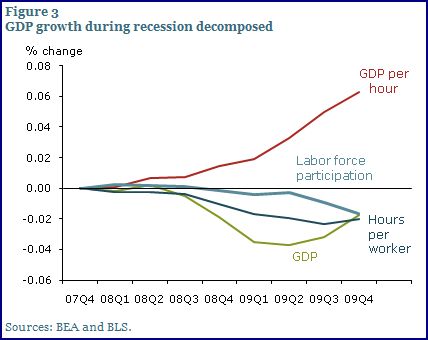
In 2009, strong growth in productivity allowed firms to lay off large numbers of workers while holding output relatively steady. This behavior threw a wrench into the long-standing relationship between changes in GDP and changes in the unemployment rate, known as Okun's law. If Okun's law had held in 2009, the unemployment rate would have risen by about half as much as it did over the course of the year. … Our results indicate that the main factor driving the unusual rise in unemployment relative to output was very rapid productivity growth, which allowed businesses to cut back sharply on labor while maintaining output levels.
… Anecdotal evidence suggests that efforts to contain costs and remain nimble in the face of uncertainty have become a fixture in business strategy. If productivity keeps on growing at an above-average pace, then unemployment forecasts based on Okun's law could continue to be overly optimistic.
Economists blindingly grapple with these issues
- "Is America facing an increase in structural unemployment?", brief answers from a range of economists, 23 July 2010
- "Identifying Cyclical vs. Structural Unemployment", Brad DeLong (Prof Economics, Berkeley), 24 August 2010
- "A curious unemployment picture gets more curious", Federal Reserve Bank of Atlanta, 16 July 2010
- "Labor Force Participation and the Future Path of Unemployment", Joyce Kwok et al, Federal Reserve Bank of San Francisco, 13 September 2010
Martin Ford has some answers to these questions
Ford wrote The Lights in the Tunnel: Automation, Accelerating Technology and the Economy of the Future (2009); the ebook is free.
- The Economic Implications of Intelligent Machines, 26 October 2009
- The Average Worker and the Average Machine, 1 July 2010
- Structural Unemployment: The Economists Just Don't Get It, 4 August 2010
- Econometrics and Technological Unemployment — Some Questions, 6 August 2010
- Outsourcing Jobs…that Can't be Outsourced, 27 August 2010
- Healthcare Robotics, 14 September 2010
Other posts about robots and automation
- 4GW: A solution of the first kind – Robots!, 8 April 2008
- The coming big increase in structural unemployment, 7 August 2010
- The coming Robotic Nation, 28 August 2010
- The coming of the robots, reshaping our society in ways difficult to foresee, 22 September 2010
Originally published at Fabius Maximus and reproduced here with the author's permission.
Opinions and comments on RGE EconoMonitors do not necessarily reflect the views of Roubini Global Economics, LLC, which encourages a free-ranging debate among its own analysts and our EconoMonitor community.
Etiquetas: 2010, ECONOMIA, INDUSTRIAL, INGENIERIA, nov10, SERVICIOS, TECNOLOGIA, USA
4 sept 2010
God did not create universe: Hawking
Friday, 3 September 2010
AFP
God no longer has any place in theories on the creation of the universe due to a series of developments in physics, according to a new book by Stephen Hawking.
In a hardening of the more accommodating position on religion that he took in his 1988 international best-seller A Brief History of Time, Hawking says the Big Bang was merely the consequence of the law of gravity.
"Because there is a law such as gravity, the Universe can and will create itself from nothing. Spontaneous creation is the reason there is something rather than nothing, why the Universe exists, why we exist," he writes in The Grand Design.
"It is not necessary to invoke God to light the blue touch paper and set the universe going," he adds.
Hawking has achieved worldwide fame for his research, writing and television documentaries despite suffering from motor neurone disease since the age of 21, which has left him disabled and dependent on a voice synthesiser.
'Turning point'
In A Brief History of Time, Hawking had suggested that the idea of God or a divine being was not necessarily incompatible with a scientific understanding of the universe.
But in his latest work, Hawking cites the 1992 discovery of a planet orbiting a star outside our own Solar System as a turning point against Isaac Newton's belief that the universe could not have arisen out of chaos.
"That makes the coincidences of our planetary conditions - the single Sun, the lucky combination of Earth-Sun distance and solar mass - far less remarkable, and far less compelling as evidence that the Earth was carefully designed just to please us human beings," he writes.
Hawking argued earlier this year that humankind's only chance of long-term survival lies in colonising space, as humans drain Earth of resources and face a terrifying array of new threats.
He also warns in a recent television series that humans should avoid contact with aliens at all costs, as the consequences could be devastating..
Etiquetas: 2010, ciencia, set10, TECNOLOGIA, TERRITORIO
24 mar 2010
Macroperu (ECONOMIA) Creaciones destructivas enviado por OBLanco
| The Creative Destruction of G8 Economics A plan to shift the theoretical foundations of our global system. The most important thing that the global financial crisis has done for economic theory is to show that neoclassical economics is not only wrong – it's dangerous. Neoclassical economics has contributed directly to the crisis by promoting a faith in the innate stability of a market economy, a false faith that has actually increased the financial system's tendency to instability. Touting the dubious claim that all instability in the system can be traced to market interventions rather than the market itself, neoclassical economics championed the deregulation of finance and the dramatic increase in income inequality. Its equilibrium vision of the functioning of finance markets has led to the development of the very products that are now threatening the existence of capitalism itself. At the same time, neoclassical economics was distracting economists from the obvious signs of an impending crisis: the asset market bubbles and the mounting private debt that was financing them. Paradoxically, as capitalism's "perfect storm" began to gather, neoclassical macroeconomists were absorbed in smug self-congratulation over their apparent success in taming inflation and the trade cycle, a feat they like to call the "Great Moderation." In 2004 Ben Bernanke, now the Chairman of the Federal Reserve, said: "The low-inflation era of the past two decades has seen not only significant improvements in economic growth and productivity but also a marked reduction in economic volatility, … a phenomenon that has been dubbed the 'Great Moderation.' Recessions have become less frequent and milder, and … volatility in output and employment has declined significantly … The sources of the Great Moderation remain somewhat controversial, but … there is evidence for the view that improved control of inflation has contributed in important measure to this welcome change in the economy …" It is all very well to have economic theory dominated by an innate faith in the stability of markets when those markets are forever gaining – either by growth in the physical economy or rising prices in the asset markets. In those circumstances, neoclassical dissenters who align themselves with the post-autistic economics movement (paecon) can rail about the logical inconsistencies in mainstream economics all they want. During the good times, the government, business community and most of the public ignore their concerns because they don't appear to matter. Dissenters are, in fact, often dismissed as critics of capitalism or proponents of socialism because it seems to neoclassical economists – and to those outside academia – that they are attacking capitalism itself and not economic theory. "You think markets are unstable? Shame on you!" The story is entirely different when asset markets crash beneath a mountain of debt, and the ensuing fallout threatens to take the physical economy with it. Now, in light of the global financial crisis, it should be possible to appreciate the critics of neoclassical economics for what we really are: critics of a fundamentally false theory and tentative developers of a new, realistic analysis of the nature of capitalism – warts and all. Changing Pedagogy Given the present severity of the crisis, the urgent need to reform economic theory and education should be obvious. But though the "irresistible force" of the global financial crisis is indeed immense, so is the inertia of the "immovable object" of economic belief. Despite the ways in which the crisis has affected our everyday world, academic neoclassical economists will continue to teach from the same textbooks in 2009 and 2010 that they used in 2008 and earlier (laziness will be as much a factor here as ideological commitment). Rebel economists will be emboldened enough to proclaim, "I told you so" in their non-core subjects, but in the core micro, macro and finance units it will be business as usual. Many undergraduate economics students in the coming years will sit gobsmacked as their lecturers recite textbook theory as if nothing extraordinarily different is taking place in the real economy. The same will happen in the academic journals. The editors of the American Economic Review and the Economic Journal are unlikely to convert to post-Keynesian economics, evolutionary economics or econophysics anytime soon, let alone be replaced by editors who are already practitioners of such unorthodox thought. The battle against entrenched neoclassical economic orthodoxy within academia promises to be long and hard, even though the discipline's failure is glaringly obvious to those in the outside world. It will be a difficult struggle mainly because neoclassical economists are genuinely naive about their role in causing the crisis. Instead they will attribute any failures to poor regulation and government intervention in the markets. Any aspects of the crisis that cannot be solely attributed to these causes will be covered by embellishing basic neoclassical theory. The subprimes scam, for example, will be easily explained by the theory of asymmetric information. Neoclassical economists seriously believe that far from the crisis calling for the abolition of their discipline, it actually calls for the theory to be more widely propagated. The idea that this financial crisis could require any change in what they do, let alone necessitate the rejection of neoclassical theory altogether, will strike them as completely incredible. In this sense, they are like the Maxwellian physicists about whom Max Planck remarked, "A new scientific truth does not triumph by convincing its opponents and making them see the light, but rather because its opponents eventually die, and a new generation grows up that is familiar with it." But physics is charmed in comparison to economics, since it is inherently an empirical discipline. Planck's confidence that a new generation would take the place of the old was therefore well founded. But in economics, the neoclassical old guard will not only resist change, they may – if economic circumstances stabilize – give rise to a new generation that faithfully accepts their interpretation of the crisis. That's exactly how the Keynesian counterrevolution came about, and it's the reason we are facing this crisis with an even more rabid neoclassicism than that which confronted Keynes in the 1930s. It is crucial that this crisis galvanizes student protest against the lack of debate within academic economics. Dissident academic economists will be unable to effect change without student bodies exerting massive pressure on the old guard. I was one of many students who protested against neoclassical economics in the early 1970s at Sydney University and campaigned for the establishment of a Political Economy Department. Were it not for student protests, the non-neoclassical staff at Sydney University would have had no chance at all of changing that department. And though we won that battle at Sydney University, we lost the war. The economic downturn of the mid-1970s allowed for the defeat of what Joan Robinson aptly called "Bastard Keynesianism" and ushered in its replacement: Friedman's "monetarism." Our protests were also wrongly characterized as being essentially anti-capitalist. Though there were indeed many anti-capitalists within the political economy movement, the real target of student protest was a poor theory of how capitalism operates, not capitalism itself. Similar observations can be made about the paecon movement, which began when student dissatisfaction with neoclassical economics in France spilled and ignited a worldwide movement. Though the movement's initial impact was substantial, neoclassical dominance of economic pedagogy continued unabated. paecon persisted, but its relevance to the real economy wasn't appreciated because that economy appeared to be booming. Now that the global economy is in crisis, students need to regroup and pounce – they need to apply massive pressure in order to ensure that real change to economic pedagogy occurs. Pressure from business groups is also essential. To some degree, these groups naively believe that those who herald the virtues of the market system and argue on the side of business in disputes over income distribution are their allies while market critics are their enemies. I hope that this financial catastrophe will convince the business community that its true friends in the academy are those who understand the market system, whether they criticize or praise it. As much as we need students to revolt over the teaching of economics, we need business to bring pressure on academic economics departments to revise their curricula. Changing Economics The pedagogic pressure from students and the wider community has to be matched by the accelerated development of alternatives to neoclassical economics. Though we know much more today about the innate flaws in neoclassical thought than was known at the time of the Great Depression, the development of an alternative is still a long way off. There are multiple alternative schools of thought extant – from post-Keynesian economics to evolutionary economics to behavioral economics to econophysics – but they're not yet developed to the point of providing a fully fledged alternative to neoclassical economics. But the fact that we do not yet have a viable alternative shouldn't dissuade us from dispensing completely with the neoclassical approach. We have to accept a period of turmoil and uncertainty in order to overcome flawed theory. Hanging on to parts of a failed paradigm simply because it has components that other schools lack would be a tragic mistake. It is from precisely such relics that a neoclassical vision could once again rise when (or if) the market economy emerges from this crisis. We need a rejection of neoclassical microeconomics in its entirety. An all-encompassing rejection was precisely what Keynes's revolution was missing. While Keynes tried to overthrow macroeconomic shibboleths like Say's Law, he continued to accept microeconomic concepts (such as perfect competition) and their unjustified projection into macroeconomic areas. He believed, for example, that the marginal productivity theory of income distribution, which is fundamentally a micro concept, applied at the macro level of wage determination. From this failure to expunge the microeconomic foundations of neoclassical economics from post-Great Depression theory arose the "microfoundations of macroeconomics" debate, which ultimately led to a model in which the economy is viewed as a single utility-maximizing individual blessed with perfect knowledge of the future. Fortunately, behavioral economics provides the beginnings of an alternative vision of how individuals operate in a market environment, while multi-agent modeling and network theory give us foundations for understanding group dynamics in a complex society. These approaches explicitly emphasize what neoclassical economics has evaded: that aggregation of heterogeneous individuals results in emergent properties of the group, which cannot be reduced to the behavior of any "representative individual." These approaches should replace neoclassical microeconomics completely. The changes to economic theory beyond the micro level involve a complete recanting of the neoclassical vision. The vital first step here is to abandon the obsession with equilibrium. The fallacy that dynamic processes must be modeled as if the system is in continuous equilibrium is probably the most important reason for the intellectual failure of neoclassical economics. Mathematics, science and engineering developed tools long ago to model outside of equilibrium processes. This dynamic approach to thinking about the economy should become second nature to economists. An essential pedagogic step here is to relegate the teaching of mathematical methods in economics to mathematics departments. Any mathematical training in economics, if it occurs at all, should come after students have at the very least completed course work in basic calculus, algebra and differential equations (the last being one about which most economists are woefully ignorant). This simultaneously explains why neoclassical economists obsess too much about proofs and why non-neoclassical economists, like those in the Circuit School, experience such difficulties in translating excellent verbal ideas about credit creation into coherent dynamic models of a monetary production economy. Neoclassical economics has effectively insulated itself from the great advances made in science and engineering over the last 40 years. This self-imposed isolation must come to an end. For while the concepts of neoclassical economics appear difficult, they are actually quaint in comparison to the sophistication evident in today's mathematics, engineering, computing, evolutionary biology and physics. In order to advance, economics must humbly submit to learning from disciplines that it has studiously ignored for so long. Some researchers in outside fields have called for the wholesale replacement of standard economics curricula, using at least the building blocks of modern thought inherent in other disciplines. In light of the catastrophe economists have visited upon the real world, those calls carry substantial weight. In response to a paper critical of trends in econophysics, for example, physicist Joe McCauley responded that, though some of the objections were valid, the problems in economics proper were far worse. He suggested that: "… the economists revise their curriculum and require that the following topics be taught: calculus through the advanced level, ordinary differential equations (including advanced), partial differential equations (including Green functions), classical mechanics through modern nonlinear dynamics, statistical physics, stochastic processes (including solving Smoluchowski and Fokker-Planck equations), computer programming (C, Pascal, etc.) and, for complexity, cell biology. Time for such classes can be obtained in part by eliminating microeconomics and macroeconomics classes from the curriculum. The students will then face a much harder curriculum and those who survive will come out ahead. So might society as a whole." The economic theory that should eventually emerge from the rejection of neoclassical economics and the basic adoption of dynamic methods will come much closer to meeting Alfred Marshall's dictum that "the Mecca of the economist lies in economic biology rather than in economic dynamics." As Thorstein Veblen correctly surmised over a century ago, the failure of economics to become an evolutionary science is the product of the optimizing framework of the underlying paradigm, which is inherently antithetical to the process of evolutionary change. This is the primary reason why the neoclassical mantra that the economy must be perceived as the outcome of the decisions of utility-maximizing individuals must be squarely rejected. Economics also has to become a fundamentally monetary discipline – from the consideration of how individuals make market decisions through to our understanding of macroeconomics. The myth of "the money illusion" (which can only be true in a world without debt) has to be immediately dispelled, while our macroeconomics have to reflect a monetary economy in which nominal magnitudes matter, precisely because they are the link between the value of current output and the financing of accumulated debt. The dangers of excessive debt and deflation simply cannot be comprehended from a neoclassical perspective. The discipline must also become fundamentally empirical, in contrast to the faux empiricism of econometrics. By this I mean basing itself on the economic and financial data first and foremost – the collection and interpretation of which has been the hallmark of contributions by econophysicists – and by respecting economic history, a topic that has been systematically expunged from economics departments around the world. It, along with a non-Whig approach to the history of economic thought, should be restored to the economics curriculum. Important names that are conspicuously absent from modern economics courses – Karl Marx, Thorstein Veblen, John Maynard Keynes, Irving Fisher, Michal Kalecki, Joseph Schumpeter, Hyman Minsky, Piero Sraffa and Richard Goodwin – should echo throughout the halls of universities around the world. Steve Keen is the Associate Professor of Economics and Finance at the University of Western Sydney and the author of Debunking Economics. Check out his blogs at debunkingeconomics.com and debtdeflation.com/blogs. |
Etiquetas: 2010, CRISIS, ECONOMIA, FINANZAS, MACROECONOMICS, mars10, TECNOLOGIA, USA
2 feb 2010
Macroperu Sobre la Importancia de las TICs en la EconomÃa del conocimiento.
The Importance of ICT for the Knowledge Economy: A Total Factor
Productivity Analysis for Selected OECD Countries
Ä smail Seki
Ege University, Turkey
Abstract
Science, technology and innovation have become key factors contributing to economic
growth in both advanced and developing economies. In the knowledge economy,
information circulates at the international level through trade in goods and services,
direct investment and technology flows, and the movement of people. Information and
communication technologies (ICT) have been at the heart of economic changes for more
than a decade. ICT sector plays an important role, notably by contributing to rapid
technological progress and productivity growth. Firms use ICTs to organize
transnational networks in response to international competition and the increasing need
for strategic interaction. As a result, multinational firms are a primary vehicle of the
everspreading process of globalization. New technologies and their implementation in
productive activities are changing the economic structure and contributing to
productivity increases in OECD economies.
Economic competitiveness depends on productivity level and in the knowledge
economy, ICT sectors determine the productivity level. As a result , we can say that the
power of economic competitiveness of a country depends on the productivity of its ICT
sector.
There are two ways to improve the TFP of ICT and to improve the power of
competitiveness. First of all, if the selected countries solve their inefficiency problem by
reallocation of resources, they can improve their TFP of the ICT sector and as a result
they can be more competitive. Secondly, the technological improvement in these
countries creates an expectation about increasing TFP of ICT sector for future. If there
will be a sustainable technological improvement by innovation, it will cause a
sustainable increase in the TFP of ICT sector and as a result it will cause a sustainable
increase in competitiveness.
--
http://www.betaggarcian.blogspot.com/
Etiquetas: 2010, feb10, PRODUCCION, PRODUCTIVIDAD, TECNOLOGIA
23 sept 2009
6 sept 2009
BRASIL:FRANCE ACUERDO AVION RAFALE
PARIS (Reuters) - Brasil está haciendo avances en conversaciones con Francia sobre la posible compra de aviones de combate Rafale, dijo el domingo el presidente brasileño, Luiz Inacio Lula da Silva, horas antes de una visita del presidente francés Nicolas Sarkozy a su país.
Lula destacó que las discusiones están muy avanzadas, pero se abstuvo de decir que una decisión se anunciaría durante la visita de Sarkozy.
"Las discusiones con el presidente Sarkozy están progresando rápidamente. Estamos en el camino correcto y tenemos una relación de confianza", dijo Lula en una entrevista con tres medios franceses, TV5 Monde, RFI radio y el diario Le Monde.
Brasil planea comprar 36 aviones de combate para renovar parcialmente su fuerza aérea. El contrato es por un valor cercano a 5.700 millones de dólares, según fuentes francesas.
Los aviones considerados son el francés Rafale, fabricado por Dassault Aviation; el estadounidense F18, de Boeing; y el Gripen, construido por la sueca Saab.
Las posibilidades son altas para Francia, que ha estado intentando exportar el Rafale durante años sin éxito.
"Todos saben que uno de los requerimientos de Brasil es la transferencia de tecnología. No podemos comprar un avión de combate si no tenemos la tecnología", dijo Lula en la entrevista.
Previamente había dicho que los franceses estaban bien ubicados en términos de transferencia de tecnología.
Sin embargo, Lula no dijo si Sarkozy podría esperar cerrar un acuerdo durante su visita a Brasil.
"No sé. Es un asunto muy delicado. Un acuerdo de tal escala implica mucho dinero, transferencia de tecnología, otros competidores. Todo lo que puedo decir es que estamos en un momento crucial de las conversaciones con Francia", destacó el mandatario sudamericano.
El Rafale, un proyecto iniciado en 1988, ha estado operativo en la fuerza aérea francesa desde el 2006. Sin embargo, tiene aún que hallar compradores extranjeros, para frustración de Sarkozy.
El líder francés está en negociación con los Emiratos Arabes Unidos por la posible venta de 60 aviones.
Durante una visita a Brasil en diciembre del 2008, Sarkozy firmó contratos de defensa con Lula por valor de miles de millones de dólares. Estos incluyeron la venta de cuatro submarinos convencionales y 50 helicópteros militares de transporte.
(Reporte de Estelle Shirbon e Yann Le Guernigou; Editado en español por Javier Leira)
3 sept 2009
CAEN ventas de servidores computacionales
10:49Los ingresos fabriles entre enero y junio retrocedieron un 30.1%, a 9,800 millones de dólares.
Las ventas de servidores computacionales en el mundo se hundieron en el segundo trimestre hasta niveles no vistos en años, informó la firma de estudios de mercado IDC.
No obstante, detalla la agencia Reuters, el organismo sostuvo que han comenzado a aparecer señales de estabilidad en un segmento que los analistas consideran un referente de la industria de tecnologías de la información.
Los ingresos fabriles en el mercado mundial de servidores se desplomaron un 30.1%, a 9,800 millones de dólares, en el período entre abril y junio, la cifra más baja desde que la IDC comenzó a seguir al mercado de manera trimestral en 1996.
Los envíos unitarios de servidores cayeron un 30.4%, la mayor baja trimestral interanual, indicó la IDC.
“Sentimos que esto es el fondo, que el primer y segundo trimestres son el fondo. Pensamos que la tendencia sería en forma de V, pero creo que tiene más forma de U en el fondo”, explicó Jed Scaramella, analista de IDC.
“Vemos señales de vida en el tercer trimestre. Seguimos pensando que será una lenta recuperación, pero creemos que el segundo trimestre fue el peor”, agregó.
Todos los mayores vendedores de servidores registraron profundas caídas interanuales en ventas en el segundo trimestre.
IBM se mantuvo en el primer lugar del mercado con una participación del 34.5%. Sus ingresos cayeron un 26.3% -la menor baja entre los cinco principales vendedores- pero la compañía recuperó 1.8 puntos de participación de mercado respecto del año pasado.
Hewlett-Packard se ubicó en segundo lugar con una participación del 28.5%. Sus ventas retrocedieron un 30.4% y cedió una pequeña porción de mercado, según la IDC.
Los ingresos de Dell, el tercero, bajaron un 26.8% y los del cuarto, Sun Microsystems, un 37.2%.
Etiquetas: 2009, COMPUTO, INTERNACIONAL, MUNDO, set09, TECNOLOGIA
CAEN ventas de servidores computacionales
10:49Los ingresos fabriles entre enero y junio retrocedieron un 30.1%, a 9,800 millones de dólares.
Las ventas de servidores computacionales en el mundo se hundieron en el segundo trimestre hasta niveles no vistos en años, informó la firma de estudios de mercado IDC.
No obstante, detalla la agencia Reuters, el organismo sostuvo que han comenzado a aparecer señales de estabilidad en un segmento que los analistas consideran un referente de la industria de tecnologías de la información.
Los ingresos fabriles en el mercado mundial de servidores se desplomaron un 30.1%, a 9,800 millones de dólares, en el período entre abril y junio, la cifra más baja desde que la IDC comenzó a seguir al mercado de manera trimestral en 1996.
Los envíos unitarios de servidores cayeron un 30.4%, la mayor baja trimestral interanual, indicó la IDC.
“Sentimos que esto es el fondo, que el primer y segundo trimestres son el fondo. Pensamos que la tendencia sería en forma de V, pero creo que tiene más forma de U en el fondo”, explicó Jed Scaramella, analista de IDC.
“Vemos señales de vida en el tercer trimestre. Seguimos pensando que será una lenta recuperación, pero creemos que el segundo trimestre fue el peor”, agregó.
Todos los mayores vendedores de servidores registraron profundas caídas interanuales en ventas en el segundo trimestre.
IBM se mantuvo en el primer lugar del mercado con una participación del 34.5%. Sus ingresos cayeron un 26.3% -la menor baja entre los cinco principales vendedores- pero la compañía recuperó 1.8 puntos de participación de mercado respecto del año pasado.
Hewlett-Packard se ubicó en segundo lugar con una participación del 28.5%. Sus ventas retrocedieron un 30.4% y cedió una pequeña porción de mercado, según la IDC.
Los ingresos de Dell, el tercero, bajaron un 26.8% y los del cuarto, Sun Microsystems, un 37.2%.
Etiquetas: 2009, COMPUTO, INTERNACIONAL, MUNDO, set09, TECNOLOGIA
5 ago 2009
USA: Ganancias Cisco - 46%
Cisco Systems Inc. registró una ganancia neta de US$1.110 millones, o 19 centavos por acción, durante el cuarto trimestre de su año fiscal, una disminución del 46% frente al beneficio de US$2.010 millones, o 33 centavos por acción, del mismo período del año anterior.
La compañía atribuyó los resultados al descenso de los ingresos, márgenes sin cambios y un cargo tributario. Sin embargo, la mayor fabricante de equipos de conexión de redes destacó algunas mejoras en las tendencias de pedidos de trimestre a trimestre.
De excluir los costos de compensación basada en acciones y un cargo tributario de US$174 millones por una mejora en los beneficios de jubilación anticipada, las ganancias cayeron a 31 centavos frente a los 40 centavos previos. Los analistas encuestados por Thomson Reuters esperaban ganancias de 29 centavos por acción.
Los ingresos de la compañía retrocedieron el 18% a US$8.540 millones. En mayo, la compañía proyectó ganancias de entre US$8.300 millones y US$8.600 millones, un descenso inferior al que habían esperado los analistas de Wall Street.
El margen bruto no registró cambios en el 64%, en línea con la proyección que la compañía emitió en mayo.
Las ventas de productos cayeron un 22% mientras que las ventas de servicios aumentaron un 4,8%.
Cisco, estrechamente ligada al mundo empresarial, es una referencial del sector tecnológico, porque sus productos de redes son cruciales para los componentes de cualquier estructura corporativa. Los resultados más recientes, que estuvieron esencialmente en línea con las expectativas, son una señal de que los gastos en tecnología no están mostrando un crecimiento significativo.
El titular y presidente ejecutivo, John Chambers, dijo el miércoles que Cisco observó un buen número de señales positivas este trimestre, especialmente en las comparación de tendencias secuenciales. "Si continuamos viendo estas positivas tendencias de pedidos en los próximos uno o dos trimestres, existe una buena probabilidad de que el punto de cambio ocurrió en nuestra compañía" en el cuarto trimestre.
Las acciones de Cisco se negociaban tras el cierre con un una pérdida del 2,7% a US$21,57.
Etiquetas: 2009, AGOSTO2009, BOLSA, CRECIMIENTO, CRISIS, ECONOMIA, FINANZAS, TECNOLOGIA, USA
13 jul 2009
crise: livres indispensables selon enquete LES ECHOS
http://www.lesechos.fr/diaporamas/index.php?id_diap=DIAP300609446_AB65F4
Etiquetas: 2009, chimerica, CRISIS, ECONOMIA, EMPLEO, FINANZAS, JULIO09, PRODUCCION, TECNOLOGIA
1 jun 2009
USA:CRISE KRUGMAN,SOROS,ROUBINI,BRADLEY,MEKS,FERGUSON..
The Crisis and How to Deal with It
By Bill Bradley, Niall Ferguson, Paul Krugman, Nouriel Roubini, George Soros, Robin Wells et al.Following are excerpts from a symposium on the economic crisis presented by The New York Review of Books and PEN World Voices at the Metropolitan Museum of Art on April 30. The participants were former senator Bill Bradley, Niall Ferguson, Paul Krugman, Nouriel Roubini, George Soros, and Robin Wells, with Jeff Madrick as moderator.
—The Editors
Jeff Madrick: It was six months ago now that the Lehman debacle occurred, that AIG was rescued, that Bank of America bought Merrill Lynch; it was about six months ago that the TARP funds started being distributed. The economy was doing fairly poorly in much of 2008, and then fell off a cliff in the last quarter of 2008 and into 2009, shrinking at a 6 percent annual rate—an extraordinary drop in our national income. It is now by some very important measures the worst economic recession in the post–World War II era. Employment has dropped faster than ever before in this space of time.
We have a three-front problem: a housing market that went crazy as the housing bubble burst; a credit crisis, the most severe we've known since the early 1930s; and now a sharp drop in demand for goods and services and capital investment, leading to a severe recession. What gives us the jitters is that all of these are related. We have seen some deceleration in the rate of economic decline, and many people are saying that "green shoots" are showing. What is the actual state of the economy, and do we need a serious mid-course correction on the part of the Obama administration?
Bill Bradley: How far are we along in a recovery? When the market price of Citicorp drops from 60 to 1, and then comes back to 3, I don't think that's a recovery. Warren Buffett buys Goldman Sachs, and after he buys, the price drops 45 to 50 percent, and if he's going to break even on the investment he's got to earn 9 percent for the next twelve years, I don't think that's a recovery. The administration has put in place measures that, if they were to work, could offer some hope.
What I'd like to suggest is that if they don't work, there's an alternative. The national government has now made about $12.7 trillion in guarantees and commitments to the US financial sector, and we've already spent a little over $4 trillion in this crisis. Some institutions such as Citicorp, for example, received about $60 billion in direct assistance, and $340 billion in guarantees. So US taxpayers are into Citicorp for around $400 billion. If we look out to June, July, and if we see that the PPIP [Public-Private Investment Program, created by Treasury Secretary Timothy Geithner] is not succeeding, that the bank assets aren't being bought at levels that they should be bought from the books of banks, then there is an alternative.
Think back to Citicorp. I looked at the ticker today: the market capitalization of Citicorp is $17 billion. So the government could buy Citicorp for a fraction of what we've already obligated the taxpayer for. And in buying Citicorp, as an example—there could be one or two others—the government would announce in four to six months that it is going to sell the good assets of the bank back to the public. If the government bought Citicorp for, let's say, $20 billion, what would it be worth if the government sold the good assets back to the public? Surely, several times what it paid for it.
I don't mean selling these assets to hedge funds, although they can participate; but I would propose offering them to any American who wants to invest in this good bank the opportunity to do so.
The prospect of that happening would bring very strong, positive influence on the development of the whole economy. And what would the government then be left with? The bad bank—that is, the bad assets that we're going through hoops now to try to get off the bank books. Instead the government would have those assets and it could take fifteen to twenty years to clean them up. So I say I would like to see the existing program work. But if it doesn't work, there is an alternative, and it's an alternative in the long run in which the average guy in America could participate.
Niall Ferguson: This is the end of the age of leverage, which began, I guess, in the late 1970s, and saw an explosive rise in the ratio of debt to gross domestic product, not only in this country, but in many, many other countries. Once you end up with public and private debts in excess of three and a half times the size of your annual output, you are Argentina. You know, it's funny that people refer all the time back to the collapse of Lehman last September. Let's remember that this crisis actually began in June 2007. It fully became clear in August of 2007 that major financial institutions were almost certainly on the brink of insolvency to anybody who bothered to think about the impact of subprime mortgage defaults on their balance sheets.
But we were in denial. And we stayed in denial until September, more than a year later, of last year. Then we had the breakdown. Notice how psychological terms are very helpful when economics fails as a discipline. After the breakdown, we came out of denial and we realized that probably more than one major bank was insolvent. Then in September and October the world went into shock. It was deeply traumatic.
Now we're in the therapy phase. And what therapy are we using? Well, it's very interesting because we're using two quite contradictory courses of therapy. One is the prescription of Dr. Friedman—Milton Friedman, that is —which is being administered by the Federal Reserve: massive injections of liquidity to avert the kind of banking crisis that caused the Great Depression of the early 1930s. I'm fine with that. That's the right thing to do. But there is another course of therapy that is simultaneously being administered, which is the therapy prescribed by Dr. Keynes—John Maynard Keynes—and that therapy involves the running of massive fiscal deficits in excess of 12 percent of gross domestic product this year, and the issuance therefore of vast quantities of freshly minted bonds.
There is a clear contradiction between these two policies, and we're trying to have it both ways. You can't be a monetarist and a Keynesian simultaneously—at least I can't see how you can, because if the aim of the monetarist policy is to keep interest rates down, to keep liquidity high, the effect of the Keynesian policy must be to drive interest rates up.
After all, $1.75 trillion is an awful lot of freshly minted treasuries to land on the bond market at a time of recession, and I still don't quite know who is going to buy them. It's certainly not going to be the Chinese. That worked fine in the good times, but what I call "Chimerica," the marriage between China and America, is coming to an end. Maybe it's going to end in a messy divorce.
No, the problem is that only the Fed can buy these freshly minted treasuries, and there is going to be, I predict, in the weeks and months ahead, a very painful tug-of-war between our monetary policy and our fiscal policy as the markets realize just what a vast quantity of bonds are going to have to be absorbed by the financial system this year. That will tend to drive the price of the bonds down, and drive up interest rates, which will also have an effect on mortgage rates—the precise opposite of what Ben Bernanke is trying to achieve at the Fed.
One final thought: Let's not think of this as a purely American phenomenon. This is a crisis of the global economy. I'd go so far as to say it's a crisis of globalization itself. The US economy is not going to contract the most this year, even if the worst projections at the International Monetary Fund turn out to be right; a 2.6 percent contraction is far, far less than the shock already being inflicted on Japan, on South Korea, on Taiwan, to say nothing of the shock being inflicted on Europe. Germany is contracting at something close to 5 or 6 percent. So we are faced not just with a problem to be dealt with by American policy, we are faced with a crisis of global proportions, and it's far from clear to me that the prescriptions of Dr. Friedman and Dr. Keynes together can solve that massive global crisis.
Paul Krugman: Let me respond to that a bit. Let's think about what is actually happening to the global economy right now. On the one side there has been an abrupt realization by many people that they have too much debt, that they are not as rich as they thought. US households have seen their net worth decline abruptly by $13 trillion, and there are similar blows occurring around the world. So the people, individual households, want to save again. The United States has gone from approximately a zero savings rate two years ago up to about 4 percent right now, which is still below historical norms; but suddenly saving is occurring.
That saving ought to be translated into investment, but the investment demand is not there. Housing is flat on its back because it was overbuilt; housing bubbles collapsed not only in the United States, but across much of Europe. Many businesses cannot get access to capital because of the breakdown of the financial system. But even those that do have access to capital don't want to invest because consumer demand is not there. Between the housing bust and the sudden decision of consumers to save, after all, we have a world with lots of excess capacity. The GDP report that just came out says that business-fixed investment, non-residential fixed investment, essentially business investment, is falling at a 40 percent annual rate.
This causes a problem. There are lots of people who want to save, creating a vast increase in savings, not only in the US but around the world, combined with a sharp decline in the amount that the private sector is willing to invest, even at a zero interest rate, or rather even at a zero interest rate for US government debt, which is what the Federal Reserve has the most direct impact on.
One way to think about the global crisis is a vast excess of desired savings over willing investment. We have a global savings glut. Another way to say it is we have a global shortage of demand. Those are equivalent ways of saying the same thing. So we have this global savings glut, which is why there is, in fact, no upward pressure on interest rates. There are more savings than we know what to do with. If we ask the question "Where will the savings come from to finance the large US government deficits?," the answer is "From ourselves." The Chinese are not contributing at all.
Those extra savings are, in effect, the savings that America has wanted to make anyway, but that US business is not willing to invest under current conditions. That is the way Keynesian policy works in the short run. It takes excess desired savings and translates them into some kind of spending. If the private sector won't do it, the government will. There is actually no contradiction between the Federal Reserve's actions and the actions of the US government with a fiscal stimulus. It's very much necessary to do both. By buying a lot of private securities, the Federal Reserve is essentially going out there and playing the role that the private banking system is no longer playing properly; by engaging in investment, the federal government is playing the role that businesses are not now willing to play. All that debt-financed spending on infrastructure by the Obama administration is basically filling the hole left by the collapse in business investment in the United States. There is not an excess demand for savings that is going to drive up interest rates. The only thing that might drive up interest rates—and this is a real concern—is that people may grow dubious about the financial solvency of governments.
Now, the great concern I have is that although we understand these things fairly well, there are thirty-eight Republican senators who say that the answer for the crisis is another round of Bush-style tax cuts that will reduce revenues by $3 trillion over the next decade.
This crisis has been so large and the political process has been so sluggish that the difficulties have been greater than expected. And yes, there are some green shoots. Things are getting worse more slowly, but we have not managed to head off a crisis that could turn out to be self-reinforcing, and leave us in this trap for many, many years.
Nouriel Roubini: It's pretty clear by now that this is the worst financial crisis, economic crisis and recession since the Great Depression. A number of us were worrying about it a while ago. At this point it's becoming conventional wisdom.
The good news is probably that six months ago there was a risk of a near depression, but we have seen very aggressive actions by US policymakers, and around the world. I think the policymakers finally looked into the abyss: they saw that the economy was contracting at a rate of 6 percent–plus in the US and around the world, and decided to use almost all of the weapons in their arsenals. Because of that I think that the risk of a near depression has been somewhat reduced. I don't think that there is zero probability, but most likely we are not going to end up in a near depression.
However, the consensus is now becoming optimistic again and says that we are going to go from minus 6 percent growth to positive growth in the second half of this year, meaning that the recession is going to be over by June. By the fourth quarter of 2009, the consensus estimates that growth is going to be positive, by 2 percent, and next year more than 2 percent. Now, compared to that new consensus among macro forecasters, who got it wrong in the past, my views are much more bearish.
I would agree that the rate of economic contraction is slowing down. But we're still contracting at a pretty fast rate. I see the economy contracting all the way through the end of the year, going from minus 6 to minus 2, not plus 2. And next year the growth of the economy is going to be very slow, 0.5 percent as opposed to the 2 percent–plus predicted by the consensus. Also, the unemployment rate this year is going to be above 10 percent, and is likely to be close to 11 percent next year. Thus, next year is still going to feel like a recession, even if we're technically out of the recession.
The outlook for Europe and Japan, both this year and next year, is even worse. Most of the advanced economies are going to do worse than the United States for a number of reasons, including structural factors in Japan and weak policy response in the case of the Euro zone.
The problems of the financial system are severe. Many banks are still insolvent. If you don't want to end up like Japan with zombie banks, it's better, as Bill Bradley suggested, to do what Sweden did: take over the insolvent banks, clean them up, separate good and bad assets, and sell them back in short order to the private sector.
Now, on the question of policy responses, there is no inconsistency between monetary easing and fiscal easing. Both of them should be stimulating demand, and the monetary easing should be leading also to restoration of credit. Of course, in a situation in which the economy is suffering not just from a lack of liquidity but also problems of solvency and a lack of credit, traditional monetary policy doesn't work as well. You also have to take unconventional monetary actions, and you have to fix the banks. And we need a fiscal stimulus because every component of our economy is sharply falling: consumption, residential investment, nonresidential construction, capital spending, inventories, exports. The only thing that can go up and sustain the economy for the time being is the fiscal spending of the government.
However, fiscal policy cannot resolve problems of credit, and it is not without cost. Over the next few years it's going to add about $9 trillion to the US public debt. Niall Ferguson said it's the end of the age of leverage. It's not really. There is not deleveraging. We have all the liabilities of the household sector, of the banks and financial institutions, of the corporate sectors; and now we've decided to socialize these bad debts and to put them on the balance sheet of the government. That's why the public debt is rising. Instead, when you have an excessive debt problem, you have to convert such debt into equity. That's what you do with corporate restructuring—it converts unsecured debt into equity. That's what you should do with the banks: induce the unsecured creditors to convert their claims into equity. You could do the same thing with the housing market. But we're not doing the debt-into-equity conversion. What we're doing is piling public debt on top of private debt to socialize the losses; and at some point the back of some governments' balance sheet is going to break, and if that happens, it's going to be a disaster. So we need fiscal stimulus in the short run, but we have to worry about the long-run fiscal sustainability, too.
George Soros: There are two features that I think deserve to be pointed out. One is that the financial system as we know it actually collapsed. After the bankruptcy of Lehman Brothers on September 15, the financial system really ceased to function. It had to be put on artificial life support. At the same time, the financial shock had a tremendous effect on the real economy, and the real economy went into a free fall, and that was global.
The other feature is that the financial system collapsed of its own weight. That contradicted the prevailing view about financial markets, namely that they tend toward equilibrium, and that equilibrium is disturbed by extraneous forces, outside shocks. Those disturbances were supposed to occur in a random fashion. Markets were seen basically as self-correcting. That paradigm has proven to be false. So we are dealing not only with the collapse of a financial system, but also with the collapse of a worldview.
That's the situation that President Obama inherited. He's faced with two objectives. One, he must arrest the collapse and, if possible, reverse it. Second, he has to reconstruct the financial system because it cannot be restored to what it was. This is a new situation. When people see this crisis as being the same as previous financial crises, they're making a mistake.
The interesting thing is that what needs to be done in the short term is almost exactly the opposite of what needs to be done in the long term. Obviously the problem was excessive leverage. But when you have a collapse of credit there's only one source of credit that is still credible, and that's the state: the Federal Reserve and the Treasury. Then you have actually to inject a lot more leverage and money into the economy; you have to print money as fast as you can, expand the balance sheet of the Federal Reserve, increase the national debt. And that is, in fact, what has been done, which is the right thing to do. But then once this policy is successful, you have to rein in the money supply as fast as you can.
I would say that policy has generally lagged behind events. We were behind the curve. Now that the free fall is moderating, and the collapse has more or less occurred, I think there is hope that policy will, in fact, catch up with events. The outcome of the stress test of the banks will be important, because that's basically where the policy has been lagging behind—in recapitalizing the banks. And that's where most of the confusion comes from.
Robin Wells: I want to go back to what Paul said about the global savings glut. The global savings glut is what drove interest rates down to historically low levels. Housing is very sensitive to the interest rate, and therefore a housing bubble was practically foreordained by an extended period of low interest rates. But you'll also notice that the bubble in housing hasn't occurred just in the United States, it's also occurred in Spain, Eastern Europe, and the UK; it's been in Ireland, it's been in Iceland. In order to prevent us from reexperiencing this catastrophe in another, say, ten years, we need to look at the origins of the global savings glut. Yes, there are some differences in how the bubbles were actually manifested in the different countries, and those manifestations are important; but let's look for a moment at the global savings glut in its entirety.
I think this story starts really in the Eighties. During the Reagan years, we experienced chronic fiscal deficits, and we began to abdicate our responsibility to raise tax revenue that could sustainably finance government. In order to do that, we had to borrow, and who did we borrow from? We borrowed from countries that were running persistent trade surpluses. And as we continued to run these deficits with these countries, there grew to be a symbiotic relationship, as Niall Ferguson says, this Chimerica.
But it was on several different fronts. There were the net exporters, such as China, Japan, and Germany, and the net importers of capital, the largest, of course, being the United States. This import of capital allowed us to consistently live beyond our means, first by running fiscal deficits, not raising enough tax revenue to finance the government, and then also through, ultimately, the leverage that we used in housing, and in commercial real estate, and in leverage buyouts. And this continued; it grew because there was no point anywhere along the line at which anyone would say "halt."
The persistent imbalances led us to pretend that we could keep borrowing without having sufficient tax revenue to pay for the government. And if your house prices are rising, if the stock market is going up—which of course is going to happen if you have cheap money—it puffs up the value of the assets, and disguises a lot of other structural problems such as rising inequality and corruption.
With this inflow of capital from abroad, the financial sector in the United States also became larger and larger relative to the rest of the economy, with GDP tilted disproportionately toward the financial sector.
How do we start to get out of this? In many ways we're almost adverse to bringing up the situation in which we find ourselves with the net exporting countries. I thought it was quite interesting a few weeks ago when many Chinese officials were saying that it was proper, and it was good economically, that the US continue to run persistent trade imbalances with China, that the Chinese yuan did not need to be appreciated, that we should continue doing the things we always have, and that the US should make sure that the value of Chinese assets were not diminished by any change in the value of the dollar. It should have been clear that this was not a sustainable relationship, but no one was willing to say that.
So I think we're going to have to address these chronic global trade imbalances. You might very well see a shift toward more protectionism. We're going to have to actually do something about raising taxes so that we can sustain government from our own resources rather than depending upon borrowing abroad. And we're going to have to start stepping back into our former role, one that we abdicated, as managers and guardians in the global economy.
J.M.: I think most people think the US government did what it had to in adopting a serious stimulus, despite the debt. Niall, why don't you respond to the comments, and then we'll have a little discussion on that.
N.F.: Well, if you listened carefully to what Paul Krugman said, he actually agreed with me. Because what he said was that everything is just fine as long as the financial credibility of the United States isn't called into question, but my point is that it will be called into question. Of course it will. According to the administration's crazily optimistic forecast for a recovery, it's going to be a 3 percent growth rate next year, 4 percent the year after that, 4.6 percent the year after that. If you believe those numbers, you'll believe absolutely anything, but they are there in the administration's budget document. Even if those numbers turn out to be true, the federal debt will rise over the next five to ten years to around 100 percent of gross domestic product.
But since those numbers are clearly wrong, and the trend growth rate of the US will be much closer to 1 percent than to 4, it seems reasonable to anticipate a much more rapid explosion of federal debt to somewhere in the region of 140 or 150 percent of gross domestic product. Even if the private savings rate rebounded to its highest point in the postwar period, it would still account for no more than 5 percent of gross domestic product. But this year's deficit, as I said earlier, is likely to be north of 12 percent of gross domestic product. So it doesn't quite add up.
The Fed has committed itself to buying $300 billion worth of treasuries this year, but clearly it will have to buy a great many more than that. Remember, $1.7 trillion or so are coming onto the market. And you assume that the credibility of the United States in the eyes of Americans, as well as foreign investors, is going to withstand this? At some point the United States does start to look like a Latin American economy, not only to people abroad but maybe to people at home. If the Fed's balance sheet explodes to up to $3 or $4 trillion, who knows how big it could get. At what point do people stop believing in the US dollar as a reserve currency, or even as a store of value for their own savings?
J.M.: Let's allow Paul and others to respond.
P.K.: The essence of this kind of recession is precisely that the amount that collectively we want to save is greater than the amount that collectively we want to invest. That is the problem. You can't get around that.
There is a very different question, which is the long-run solvency of the US government, and I do worry about that. I would disagree very much with Niall about those numbers, but this is a factor that should be taken into account. We are currently in debt about 60 percent of GDP. We have in the past been as high as 100 percent of GDP at the end of World War II without having a crisis, but your ability to go that high does depend upon people's belief that you will behave responsibly, and that is somewhat in question. I hope it is less in question than it was in the past, now that we've had some regime changes, but it is a problem.
N.R.: I think that the debate here is about what needs to be done in the short term versus the long term. The lesson of the Great Depression is pretty clear: it started with the stock market crash of 1929, and it actually became the Great Depression by 1933 for four reasons. One, we didn't believe in a counter-cyclical monetary policy. The money supply contracted rather than being eased. Interest rates were not falling, and that made the credit crunch worse. Two, nobody believed in counter-cyclical fiscal policy. The general theory of Keynes was written only in 1936; in the early 1930s, the government was raising taxes and cutting spending in order to maintain a balanced budget. That made the recession even more severe.
Three, there was a belief that banks should be allowed to collapse. Thousands of them collapsed, the credit crunch became even worse. And four, by 1933, 75 percent of households had defaulted on their mortgages; they couldn't pay them. So a stock market crash became a Great Depression. Then you add currency wars internationally, trade wars, protectionism, and capital controls; then you had default by countries and the rise of totalitarian regimens in Germany and in Italy, in Japan, and Spain, and we ended up in World War II. So those are the consequences of not taking the right policy actions in the short run.
I agree, however, that we have to worry about the long run. If we're going to finance budget deficits by printing money, we may have high inflation, even risk of hyperinflation in some countries. That's what happened in Germany in the 1920s during the Weimar Republic. We are having large budget deficits and increasing the public debt, we don't know whether it's going to be $5 trillion or $10 trillion of more debt. But there are only a few ways of resolving that debt problem: either you default on it as countries like Argentina did; or you use the inflation tax to wipe out the real value of the debt; or you have to raise taxes and cut government spending. And given the size of the deficits, over time that's going to be a painful political choice to make. So we need the stimulus in the short run, but we need to restore medium-term fiscal sustainability.
G.S.: Let's face it, for twenty-five years we have been consuming more than we have been producing. This living beyond our means accumulated mainly in the housing sector and the financial sector, and now those liabilities are being nationalized. It's a bit unfortunate that so far we have only nationalized the liabilities of the banks, and not their assets. I think it's right that we are extending a government credit to replace the collapsing credit, and we are currently in a deflationary situation. When the flow of credit restarts, suddenly there will be a flip-flop where the fear of deflation will be replaced by the fear of inflation. The pressure for interest rates to rise will be very, very strong, and the rise in interest rates could choke off the recovery. And so we are facing a period of stop-go, or stagflation similar to but more severe than what we faced in the Seventies. But that is a favorable outcome compared to what would have happened if we hadn't done what we are doing.
About regulation, we have to start by recognizing that the prevailing view is false, that markets actually are bubble-prone. They create bubbles. Therefore, they have to be regulated. The authorities have to accept responsibility for preventing asset bubbles from growing too big. They've expressly rejected that, saying that if the markets don't know, how can the regulators know? And, of course, they can't. They're bound to be wrong, but they get feedback from the market, and then they can make adjustments. Now, it is not enough to regulate the money supply. You have to regulate credit. And that means using tools that have largely fallen into disuse. Of course you have margin requirements, minimum capital requirements; but you actually have to vary them to counteract the prevailing mood of the market, because markets do have moods. It should be recognized that exuberance actually is quite rational. When I see a bubble beginning, forming, I jump on it because that's how I make money. So it's perfectly rational.
It's the job of the regulators to regulate. However, we should try not to go overboard. While markets are imperfect, regulators are even more imperfect: not only are they human, they're also bureaucratic and subject to political influences. So we want to keep regulation to a minimum, but we have to recognize that markets are inherently unstable.
N.R.: On this question of regulation, of course, we go into cycles, you know. We had the Great Depression, and then we imposed many actually useful regulations, both on the financial system and on the real economy. Some of them became excessive, and even before Reagan and Thatcher, Jimmy Carter started deregulating some parts of the economy. Eventually policy makers started believing that self-regulation is best; but that means no regulation. We believed in market discipline; but there is no discipline when there is irrational exuberance. We relied on internal risk management models; but nobody listened to risk managers when the risk takers were making all the profits in the banks; and we relied on rating agencies which had massive conflicts of interest since they were being paid by those that they were supposed to be rating. So the entire model of self-regulation and market discipline now has collapsed.
We have to go to a world where there is greater prudential regulation and supervision of the financial system. I think the challenge for the US economy is, can we grow without excessive credit and leverage? Can we grow in a more sustainable way? And what are going to be the sectors of the economy that give us sustainable, long-term growth? I think that's an open question.
P.K.: I think there are two big structural changes that we'd want to see. One is we need to reduce the role of the financial sector in the economy. We went from an economy in which about 4 percent of GDP came from the financial sector to an economy in which 8 percent of GDP come from the financial sector, and in which at its peak 41 percent of profits were being earned by the financial sector. And there is no reason to believe that anything productive happened as a result of all of that. These extremely highly compensated bankers were essentially just finding new ways to offload risks on to other people.
As I've written, we need a boring banking sector again. All of this high finance has turned out to be just destructive, and that's partly a matter of regulation. But in the political economy there was also a vicious circle. Because as the financial sector got increasingly bloated its political clout also grew. So, in fact, deregulation bred bloated finance, which bred more deregulation, which bred this monster that ate the world economy.
The other thing not to miss is the importance of a strong social safety net. By most accounts, most projections say that the European Union is going to have a somewhat deeper recession this year than the United States. So in terms of macromanagement, they're actually doing a poor job, and there are various reasons for that: the European Central Bank is too conservative, Europeans have been too slow to do fiscal stimulus. But the human suffering is going to be much greater on this side of the Atlantic because Europeans don't lose their health care when they lose their jobs. They don't find themselves with essentially no support once their trivial unemployment check has fallen off. We have nothing underneath. When Americans lose their jobs, they fall into the abyss. That does not happen in other advanced countries, it does not happen, I want to say, in civilized countries.
And there are people who say we should not be worrying about things like universal health care in the crisis, we need to solve the crisis. But this is exactly the time when the importance of having a decent social safety net is driven home to everybody, which makes it a very good time to actually move ahead on these other things.
N.F.: Well, I tell you what, I feel depressed after what I've heard tonight. We are now contemplating a massive expansion of the state to substitute for the private sector because that's the only thing Paul thinks will deliver growth. We're going to reregulate the markets, we're going to go back to those good old days. Where were you in the 1970s when all these wonderful regulations were in place? I don't remember that going too smoothly. But what else are we going to do? We're going to print money. Almost limitlessly we'll print money. That's going to be fine, too. And when we're done with that, we're going to raise taxes. What a fabulous package we have in store for us. You know, back in late 2007, I was asked what my big concern was, and I said, "My concern is that we're going to get the 1970s for fear of the 1930s." It's very easy to forget, in your iron indignation at the failure of the market, where the true mainsprings of economic growth lie. The lesson of economic history is very clear. Economic growth does not come from state-led infrastructure investment. It comes from technological innovation, and gains in productivity, and these things come from the private sector, not from the state.
B.B.: As we look at the future, we also have to look at the mistakes policymakers made in the last ten years. It's not news that people are greedy. But we made conscious decisions not to put limits on that natural human impulse. What were the mistakes? In 1999, we allowed investment banks, banks, insurance companies to combine: we eliminated the Glass-Steagall Act, which prohibited commercial banks from operating as investment banks. Why was Glass-Steagall put into law? Because the last time we didn't limit greed we got into trouble, the Great Depression.
The second mistake was in 1999, the explicit decision by the Clinton administration and Congress not to regulate derivatives, in particular credit default swaps. In 2002 they were worth $1 trillion and today they're worth $33 trillion, and that decision not to regulate derivatives created the following sequence: you have mortgages; then a thousand mortgages are packaged and sold as a mortgage-backed security; a thousand mortgage-backed securities are packaged and sold as a collateral debt obligation [CDOs]; then a thousand collateral debt obligations are packaged and sold as a CDO squared; and insuring each one of those bundles are credit default swaps, which are a part of that $33 trillion. And our government deliberately decided not to regulate this chain of investments.
One result was that the 374 people in the London office of AIG who were responsible for AIG derivatives destroyed a company that had 116,000 employees in 120 countries. Why? Because there was no regulation at all.
The third decision was in 2004. The SEC allowed banks to go from 10 to 1 leverage to 30 to 1 leverage. And guess what? Once they were allowed to do it, they did it. So if we're going to look at the future, we might think of undoing those three mistakes.
Finally, we might want to remember that the chairman of the Federal Reserve is supposed to remove the punch bowl from the party when the party gets out of control. And that did not happen in the Greenspan years. The opposite happened.
ENTREVISTAS TV CRISIS GLOBAL
Etiquetas
- 1 MAYO
- 2
- 2002
- 2007
- 2008
- 2009
- 2010
- 2011
- 2012
- 2013
- 2014
- 2015
- 2016
- 2o11
- 2OO9
- a
- abr2015
- abril09
- abril10
- acc
- actualidadecono
- AFP
- AFPS
- AFRICA
- Ago11
- AGOS
- AGOST10
- agost12
- AGOSTO2008
- AGOSTO2009
- agosto2015
- AGRO
- AGROEXPORTACION
- AIG
- AL
- ALAGROEXPORTACION
- ALEMANIA
- ALIMENTOS
- amazonia
- AMERICALATINA
- ANDAHUAYLAS
- APEC
- ARCH MES
- ARGENTINA
- asarco
- ASIA
- ATTAC
- australia
- AUTOMOVIL
- AVAAZ
- b
- BAILOUT
- baltic
- BANCOS
- BC
- BCE
- BCRP
- benassy
- benedetti
- BERNANKE
- bernis
- BIELORUSIA
- BIS
- blanchard
- BOE
- BOJ
- BOLIVIA
- BOLSA
- BONUS
- BRASIL
- BRIC
- BUBBLE
- bundesbank
- C
- c rec
- CAFE
- CAMBIOCLIMATICO
- CAMERICAS
- CAN
- CANADA
- CANCION
- CAPITALISMO
- castro
- CDO
- cepij
- CHAVEZ
- cheque
- CHILE
- chimerica
- CHINA
- CHRYSLER
- CICLO
- CIE
- ciencia
- CIP
- COBRE
- COLOMBIA
- COMERCIO
- commodities
- COMPUTO
- CONSTRUCCION
- CONSUMO
- CONTAGIO
- control
- COPENHAGUE
- CORRUPCION
- coursera
- CRECIMIENTO
- CREDITO
- CRISIS
- CUBA
- CUMBREALCUE
- CUMBREALCUSA
- davos
- DEC08
- DEC11
- dec12
- DEC13
- dec15
- DEFICIT
- DEFLACION
- demanda
- DEPRESION
- DERIVADOS
- DEUDA
- developpement
- DIC09
- DIC10
- dic12
- DICIEMBRE
- do
- DOLAR
- doubledip
- dsk
- dubai
- duracion
- ec
- ecologo
- ECONOMIA
- ECUADOR
- EDUCA
- efectos
- EMPLEO
- EN11
- en16
- EN2016
- encuesta
- ene016
- energia
- ENERO
- ENERO09
- enero10
- EST
- eu
- EURO
- expansion
- EXPORTACION
- f
- fannie
- feb09
- feb10
- feb13
- feb15
- FED
- filo
- fin
- FINANZAS
- FINLANDIA
- fisica
- flu
- FMI
- FONDOS
- fr
- FRANCE
- frankfurt
- frontrunning
- fukushima
- G20
- G7
- GAS
- geab
- GEITHNER
- gini
- GLO
- global
- GM
- GONZALO GARCIA
- grece
- GREENSPAN
- GRENOBLE
- gripeporcina
- grupo mexico
- HAITI
- hambre
- HEDGE FUNDS
- HIPOTECA
- hist
- HOLLANDE
- HONDURAS
- IMPORTACION
- IMPUESTOS
- INDE
- INDIGNADOS
- INDUSTRIAL
- INFLACION
- INFORMALIDAD
- INFRAESTRUCTURA
- INGENIERIA
- INGENIEROS
- innova
- INTEGRACION
- INTERNACIONAL
- INVERSION
- IRAN
- IRLANDA
- ISLANDIA
- ismea
- ITALIA
- IZQ
- JAPON
- JUL11
- JULIO08
- JULIO09
- JULIO15
- JUN09
- jun10
- jun11
- JUN12
- jun13
- jun15
- JUNIO08
- keynes
- KRUGMAN
- lagarde
- LAREPUBLICA
- leap
- leverage
- liquidez
- LITIO
- lme
- LR
- macro
- MACROECONOMICS
- madera
- MADOFF
- MAMBIENTE
- MANGO
- MARS09
- mars10
- marx
- matematicas
- MATERIASPRIMAS
- MATUK
- MAY09
- MAY11
- MAY12
- MAY13
- may15
- may2015
- MAYO
- MBS
- me
- mef
- MERKEL
- METALES
- MEXICO
- miga
- MIGRA
- MINERIA
- MODELES
- MONDE
- MONEDA
- mourey
- MUJICA
- MUNDO
- musica clasica
- NACIONALIZACION
- neural
- niño
- nobel
- NOTASEMANAL
- NOV08
- nov09
- nov10
- NOV11
- NOV12
- nov15
- nuclear
- OBAMA
- OCDE
- oct09
- oct10
- OCT11
- oct12
- OCTUBRE08
- OFCE
- OIT
- OMC
- ORO
- paita
- PANAMA
- PAPA
- PARADIS
- PARAGUAY
- PAULSON
- pbi
- pe
- PEÑAFLOR
- PERU
- pesca
- PETROLEO
- piketty
- PLAN
- PMI
- POBLA
- POBREZA
- POL
- POLITICA
- porter
- portugal
- postcrisis
- PPT_CRISIS
- PRODUCCION
- PRODUCTIVIDAD
- profits
- prog
- PROTECCION
- QUIEBRA
- r
- RECESION
- REGULACION
- REMESAS
- REPEC
- REPRISE
- REPSOL
- RESERVAS
- RETAIL
- RGE
- RIESGOPAIS
- RMBS
- ROBOTICA
- RODRIK
- ROUBINI
- RUSIA
- SALARIOS
- SARKO
- school paris
- sep11
- SEP15
- SEQUIA
- SERVICIOS
- set09
- set10
- set11
- set12
- SET15
- SETIEMBRE08
- SINGAPUR
- SIRIA
- sismo
- soros
- southern
- SPAIN
- STANFORD
- STIGLITZ
- SUBPRIMES
- SUISSE
- SYRIZA
- TAIWAN
- TARIFAS
- TAS
- TCAMBIO
- TECNOLOGIA
- TERRITORIO
- TEXTIL
- TINTERES
- TLC
- TPP
- trabajo
- trentin
- TRICHET
- TROIKA
- tsunami
- TURISMO
- TV
- UBS
- UE
- UK
- UKRANIA
- UNASUR
- URUGUAY
- USA
- v
- VENEZUELA
- VIDEO
- vivienda
- WALL STREET
- WS
- wsj
- YEN
- young
- YUAN
- Zbasura
- zerohedge
Peru:crisis impacto regional arequipa,raul mauro
Temas CRISIS FINANCIERA GLOBAL
claves para pensar la crisis
-Tipo de cambio
- DIARIOS DE HOY
PRESS CLIPPINGS-RECORTES PRENSA-PRESSE..
canciones de GRACIAS A LA VIDA !
ETIQUETAS alfabetico
- 1 MAYO
- 2
- 2002
- 2007
- 2008
- 2009
- 2010
- 2011
- 2012
- 2013
- 2014
- 2015
- 2016
- 2o11
- 2OO9
- a
- abr2015
- abril09
- abril10
- acc
- actualidadecono
- AFP
- AFPS
- AFRICA
- Ago11
- AGOS
- AGOST10
- agost12
- AGOSTO2008
- AGOSTO2009
- agosto2015
- AGRO
- AGROEXPORTACION
- AIG
- AL
- ALAGROEXPORTACION
- ALEMANIA
- ALIMENTOS
- amazonia
- AMERICALATINA
- ANDAHUAYLAS
- APEC
- ARCH MES
- ARGENTINA
- asarco
- ASIA
- ATTAC
- australia
- AUTOMOVIL
- AVAAZ
- b
- BAILOUT
- baltic
- BANCOS
- BC
- BCE
- BCRP
- benassy
- benedetti
- BERNANKE
- bernis
- BIELORUSIA
- BIS
- blanchard
- BOE
- BOJ
- BOLIVIA
- BOLSA
- BONUS
- BRASIL
- BRIC
- BUBBLE
- bundesbank
- C
- c rec
- CAFE
- CAMBIOCLIMATICO
- CAMERICAS
- CAN
- CANADA
- CANCION
- CAPITALISMO
- castro
- CDO
- cepij
- CHAVEZ
- cheque
- CHILE
- chimerica
- CHINA
- CHRYSLER
- CICLO
- CIE
- ciencia
- CIP
- COBRE
- COLOMBIA
- COMERCIO
- commodities
- COMPUTO
- CONSTRUCCION
- CONSUMO
- CONTAGIO
- control
- COPENHAGUE
- CORRUPCION
- coursera
- CRECIMIENTO
- CREDITO
- CRISIS
- CUBA
- CUMBREALCUE
- CUMBREALCUSA
- davos
- DEC08
- DEC11
- dec12
- DEC13
- dec15
- DEFICIT
- DEFLACION
- demanda
- DEPRESION
- DERIVADOS
- DEUDA
- developpement
- DIC09
- DIC10
- dic12
- DICIEMBRE
- do
- DOLAR
- doubledip
- dsk
- dubai
- duracion
- ec
- ecologo
- ECONOMIA
- ECUADOR
- EDUCA
- efectos
- EMPLEO
- EN11
- en16
- EN2016
- encuesta
- ene016
- energia
- ENERO
- ENERO09
- enero10
- EST
- eu
- EURO
- expansion
- EXPORTACION
- f
- fannie
- feb09
- feb10
- feb13
- feb15
- FED
- filo
- fin
- FINANZAS
- FINLANDIA
- fisica
- flu
- FMI
- FONDOS
- fr
- FRANCE
- frankfurt
- frontrunning
- fukushima
- G20
- G7
- GAS
- geab
- GEITHNER
- gini
- GLO
- global
- GM
- GONZALO GARCIA
- grece
- GREENSPAN
- GRENOBLE
- gripeporcina
- grupo mexico
- HAITI
- hambre
- HEDGE FUNDS
- HIPOTECA
- hist
- HOLLANDE
- HONDURAS
- IMPORTACION
- IMPUESTOS
- INDE
- INDIGNADOS
- INDUSTRIAL
- INFLACION
- INFORMALIDAD
- INFRAESTRUCTURA
- INGENIERIA
- INGENIEROS
- innova
- INTEGRACION
- INTERNACIONAL
- INVERSION
- IRAN
- IRLANDA
- ISLANDIA
- ismea
- ITALIA
- IZQ
- JAPON
- JUL11
- JULIO08
- JULIO09
- JULIO15
- JUN09
- jun10
- jun11
- JUN12
- jun13
- jun15
- JUNIO08
- keynes
- KRUGMAN
- lagarde
- LAREPUBLICA
- leap
- leverage
- liquidez
- LITIO
- lme
- LR
- macro
- MACROECONOMICS
- madera
- MADOFF
- MAMBIENTE
- MANGO
- MARS09
- mars10
- marx
- matematicas
- MATERIASPRIMAS
- MATUK
- MAY09
- MAY11
- MAY12
- MAY13
- may15
- may2015
- MAYO
- MBS
- me
- mef
- MERKEL
- METALES
- MEXICO
- miga
- MIGRA
- MINERIA
- MODELES
- MONDE
- MONEDA
- mourey
- MUJICA
- MUNDO
- musica clasica
- NACIONALIZACION
- neural
- niño
- nobel
- NOTASEMANAL
- NOV08
- nov09
- nov10
- NOV11
- NOV12
- nov15
- nuclear
- OBAMA
- OCDE
- oct09
- oct10
- OCT11
- oct12
- OCTUBRE08
- OFCE
- OIT
- OMC
- ORO
- paita
- PANAMA
- PAPA
- PARADIS
- PARAGUAY
- PAULSON
- pbi
- pe
- PEÑAFLOR
- PERU
- pesca
- PETROLEO
- piketty
- PLAN
- PMI
- POBLA
- POBREZA
- POL
- POLITICA
- porter
- portugal
- postcrisis
- PPT_CRISIS
- PRODUCCION
- PRODUCTIVIDAD
- profits
- prog
- PROTECCION
- QUIEBRA
- r
- RECESION
- REGULACION
- REMESAS
- REPEC
- REPRISE
- REPSOL
- RESERVAS
- RETAIL
- RGE
- RIESGOPAIS
- RMBS
- ROBOTICA
- RODRIK
- ROUBINI
- RUSIA
- SALARIOS
- SARKO
- school paris
- sep11
- SEP15
- SEQUIA
- SERVICIOS
- set09
- set10
- set11
- set12
- SET15
- SETIEMBRE08
- SINGAPUR
- SIRIA
- sismo
- soros
- southern
- SPAIN
- STANFORD
- STIGLITZ
- SUBPRIMES
- SUISSE
- SYRIZA
- TAIWAN
- TARIFAS
- TAS
- TCAMBIO
- TECNOLOGIA
- TERRITORIO
- TEXTIL
- TINTERES
- TLC
- TPP
- trabajo
- trentin
- TRICHET
- TROIKA
- tsunami
- TURISMO
- TV
- UBS
- UE
- UK
- UKRANIA
- UNASUR
- URUGUAY
- USA
- v
- VENEZUELA
- VIDEO
- vivienda
- WALL STREET
- WS
- wsj
- YEN
- young
- YUAN
- Zbasura
- zerohedge