SECCION Crisis monetaria: US/EURO, dolar vs otras monedas

Gráfico del tipo de cambio del Dólar Americano al Euro - Desde dic 1, 2008 a dic 31, 2008

Evolucion del dolar contra el euro

US Dollar to Euro Exchange Rate Graph - Jan 7, 2004 to Jan 5, 2009

V. SECCION: M. PRIMAS

1. SECCION:materias primas en linea:precios


[Most Recent Quotes from www.kitco.com]


METALES A 30 DIAS click sobre la imagen
(click sur l´image)

3. PRIX DU CUIVRE

  Cobre a 30 d [Most Recent Quotes from www.kitco.com]

4. ARGENT/SILVER/PLATA

5. GOLD/OR/ORO

6. precio zinc

7. prix du plomb

8. nickel price

10. PRIX essence


petrole on line

Find out how to invest in energy stocks at EnergyAndCapital.com.

azucar

azucar
mercados,materias primas,azucar,precios y graficos azucar i otros
Mostrando entradas con la etiqueta JUN12. Mostrar todas las entradas

28 ago 2012

Fwd: G20 rectifica, pero, quién paga ahora el cuantioso daño causado - un abrazo GS.


After two wasted years, the G20 pivots back towards fiscal sanity

The G-20 has come (almost) full circle. In April 2009 in London, the communique set out leaders' commitment to a massive coordinated fiscal stimulus:

            "We are undertaking an unprecedented and concerted fiscal expansion, which will save or create millions of jobs which would otherwise have been destroyed, and that           will, by the end of next year, amount to $5 trillion, raise output by 4 per cent, and      accelerate the transition to a green economy. We are committed to deliver the scale of sustained fiscal effort necessary to restore growth.
            While the degree of coordination was somewhat exaggerated, there was a genuine collective determination to do what was necessary to ensure the financial crisis did      not become a prolonged depression".

And it worked - perhaps too well. By June 2010, in Toronto, it appeared that recovery was indeed underway. The new priority was fiscal consolidation: the communique noted approvingly that:

            "Sound fiscal finances are essential to sustain recovery, provide flexibility to             respond to new shocks, ensure the capacity to meet the challenges of aging       populations, and avoid leaving future generations with a legacy of deficits and debt...    Advanced economies have committed to fiscal plans that will at least halve deficits     by 2013 "

For the UK government, this was a diplomatic triumph; not only did the G20 endorse the UK's approach to fiscal consolidation, it commended it to other countries:

            "I think the British budget has been noticed here in the G20 and has been      appreciated," finance minister George Osborne said. Citing the summit communique,             he said the group had formally recognized that "countries with serious fiscal       challenges need to accelerate the pace of dealing with them, and of course that is             exactly what the budget did."

Others were less positive; Paul Krugman's reaction:

            "The deficit hawks have taken over the G20. The right thing, overwhelmingly, is to do things that will reduce spending and/or raise revenue after the economy has recovered — specifically, wait until after the economy is strong enough that monetary policy can offset the contractionary effects of fiscal austerity.
            But no: the deficit hawks want their cuts while unemployment rates are still at near-record highs and monetary policy is still hard up against the zero bound. Utter folly posing as wisdom".
And indeed it is now clear this premature "pivot" to fiscal consolidation, as the IMF described it, was a huge mistake, both for the G20 as a whole and for the UK. The supposed commitment to halve deficits by 2013 has been quietly (and rightly) forgotten, derailed by weak growth. Indeed, in the UK, most of the deficit reduction so far has come through cutting public investment; belatedly, the government has recognised the folly of this approach, and is trying to think of ways to reverse it without admitting that it got it wrong, as I explain here.

Meanwhile, in the eurozone, matters are even worse. Austerity has proved self-defeating even in its own terms, with fiscal contraction leading to lower growth and higher unemployment, in turn exacerbating deficits and leading to further losses of credibility, both political and economic.

But the good news is that at this week's G20 in Los Cabos the message does seem finally to have got through to world leaders. Although most press attention has focused on the rather inconclusive discussion of the eurozone crisis, it is worth noting the communique text on fiscal policy:

            "All G20 members will take the necessary actions to strengthen global growth and restore confidence. Advanced economies will ensure that the pace of fiscal consolidation is appropriate to support the recovery, taking country-specific circumstances into account and, in line with the Toronto commitments, address concerns about medium term fiscal sustainability. Those advanced and emerging economies which have fiscal space will let the automatic fiscal stabilizers to operate taking into account national circumstances and current demand conditions. Should economic conditions deteriorate significantly further, those countries with sufficient fiscal space stand ready to coordinate and implement discretionary fiscal actions to support domestic demand, as appropriate. In many countries, higher investment in education, innovation and infrastructure can support the creation of jobs now while raising productivity and future growth prospects. Recognizing the need to pursue growth-oriented policies that support demand and recovery, the United States will calibrate the pace of its fiscal consolidation by ensuring that its public finances are placed on a sustainable long-run path so that a sharp fiscal contraction in 2013 is avoided".

As usual, there is something for everyone here. But the change of tone is marked. Instead of the mistaken and damaging view of 2010 that immediate fiscal consolidation was urgent to sustain recovery and boost confidence, there is a recognition that cutting deficits too fast could damage growth; that higher investment would boost both output and jobs now and productivity over the medium term; and that further stimulus may well be necessary, given the continued depressed state of much of the world economy. All this is welcome; it is a pity they didn't say this two years ago. Let us hope it translates into policy.

20 jun 2012

Fwd: Macroperu La Nueva Coyuntura Mundial: Tres Desarrollos Críticos

 La Nueva Coyuntura Mundial: Tres Desarrollos Críticos
To: MacroPeru@yahoogroups.com


Estimados Amigos,

                                     En una reciente entrevista de Roubini se mencionaran las tres fuerzas que regirán la dinámica muncial en el más inmediato futuro: (1) la escasez de energía y el dterioro de las condiciones ambientales de la producción ; (2) la crisis política en el mundo {arabe; (3) el colapso de euro  y de la UE; (4) el rproblema de la sobreacumulación d ecapital en China ; (5) la crisis  distrubutiva en Estados Unidos y la UE .  Les recomiendo escuhar la entrevista . 
__

Fwd: Macroperu Y, Hollande,, al apra


---------- Forwarded message ----------
From: Bruno <lbseminario@yahoo.com>
Date: 2012/5/6


Hollande arranca su mandato con la austeridad europea en su punto de mira


  • El nuevo presidente se ve como nueva referencia europea
  • En política interior proclama los valores clásicos republicanos frente a Sarkozy
  • Podría tomar posesion esta misma semana y nombrar un primer ministro

Enviar
RTVE.ES 06.05.2012 - 22:39h
"No somos cualquier país del mundo: somos Francia". Con estas palabras orgullosas y patrióticas a sus conciudadanos en la localidad de Tulle, en el departamento de Correze, François Hollande lanzaba un aviso a navegantes tras su victoria este 6 de mayo: ha llegado a la escena mundial para gobernar la quinta economía del planeta y quiere que su voz también se escuche.
En el exterior, para que sus socios europeos abandonen "la fatalidad" de la austeridad y apuesten por las políticas de crecimiento. En el interior, para recuperar los valores de libertad, (sobre todo) igualdad y fraternidad tras cinco años de hiperpresidencia de Nicolás Sarkozy.
"Esta noche solo hay una Francia, una sola nación reunida en un mismo destino", ha declarado de forma solemnetras detallar cuáles serán las prioridades de su mandato: La reducción del déficit, la preservación del modelo social para garantizar a todos el mismo acceso a los servicios públicos y la igualdad entre territorios.
"Nos sé capaces de superar los desafíos, de enderezarnos, siempre lo hemos hecho en nuestra historia", ha señalado el presidente electo, para quien este 6 de mayo debe ser igualmente "un nuevo punto de partida para Europa".
En una intervención de casi quince minutos, Hollande ha asegurado que su "misión"no es otra que "dar la construccioón europea una dimensión de crecimiento, de empleo, de prosperidad, de futuro" y ha advertido que eso se lo comunicará lo antes posible a sus socios europeos "y en primer lugar a Alemania".

Contra la fatalidad

Más aún, el nuevo presidente francés se ha mostrado consciente de que en muchos países de Europa se le está mirando con atención para enarbolar una bandera distinta a las políticas de austeridad y recortes y, en cierta medida, ha recogido el aguante.
"Estoy seguro de que en muchos países europeos (su victoria) ha sido un alivio, una esperanza" porque "la austeridad no podía ser una fatalidad", ha recalcado en referencia sobre todo a los países periféricos del euro, que se han convertido en tema de la campaña electoral, sobre todo España.
Con Sarkozy, once gobernantes han caído en Europa por la crisis económica, pero en el caso de Hollande su victoria ha cobrado un tono distinto porque coincide con varios movimientos electorales que pueden marcar un cambio en la opinión pública europea respecto a la política económica que están llevando sus gobiernos.
Así, desde la derrota de los conservadores británicos en las municipales el pasado jueves hasta el desplome de los partidos tradicionales griegos por apoyar las políticas de la troika muestran un cierto hartazgo social.
Los resultados en el länder alemán de Renania del Norte, el más importante del país, el próximo domingo, después de que la coalición de la canciller Merkel esté a punto de perder la región septentrional de Schleswig tras los comicios de este 6 de mayo.
Hollande anunció en campaña que enviaría este lunes un memorándum de cuatro puntos a sus socios europeos con las medidas económicas que considera necesarias para un pacto de crecimiento.

Tareas pendientes

El presidente electo ya ha mantenido una conversación telefónica con la canciller pero antes de mantener un encuentro con ella en Berlín -que se producirá una vez que sea investido- tiene por delante varias misiones inmediatas, entre ellas de nombrar primer ministro.
El principal candidato es el jefe del grupo parlamentario socialista, Jean-Marc Ayrault, hombre de la más absoluta confianza de Hollande que responde al perfil trazado por el presidente para ese puesto: "un hombre que conozca bien a los diputados, el partido pero me también que me conozca bien a mí".
La otra gran candidata es la primera secretaria del partido, Martine Aubry. que cuenta con un perfil más a la izquierda que podría compensar el de Hollande, pero con la que tiene una tirante relación, tal y como se comprobó en su enfrentamiento en las primarias.
Pero probablemente la decisión con más valor simbólico que tomará estos días tiene que ver con su sueldo y el de sus ministros: lo reducirá un 30% como símbolo del nuevo estilo de presidencia que quiere encarnar.
__._,_.___
__,_._,___

Fwd: Macroperu USA negocia con piases del Pacíco trtado Comercial en Secreto. La lista incluye


Secrecy blankets trade talks
By Carey L Biron

WASHINGTON - The latest round of negotiations on the Trans-Pacific Partnership (TPP), potentially the largest free -trade agreement to be signed by the United States, began Tuesday with a blanket of secrecy over their content.

Despite claims by the US government of considerable transparency in the process, the talks, being held in Dallas, are covering material that has remained almost completely out of the public's eye.

"Because the negotiations have been conducted in extreme secrecy, we have no idea yet what is in the text," says Rashmi Rangnath, a director with Public Knowledge, an advocacy group here in Washington. "What we do know is that lack of

height: 0px;


transparency tends to skew the text of such agreements in favor of large corporations."

Although a draft of the chapter on intellectual property rights was leaked in February, much of the rest of the 26 chapters have been kept away from public scrutiny.

Some outside of the negotiations have had significant time with the chapters, however. Early drafts of TPP content have reportedly been discussed at length with large corporate interests, such as 20th Century Fox, which has a key stake in intellectual property-related regulations.

Thus far, the justification for this secrecy has been minimal. "Basically we have been told two things," Rangnath says. "First, that this is precedent. And second, that this level of secrecy is necessary during negotiations in order to arrive at a compromise."
The TPP would be a free-trade agreement between the US and eight Asia-Pacific countries: Australia, Brunei, Chile, Malaysia, New Zealand, Peru, Singapore and Vietnam. Canada, Japan and Mexico are also expected to join the talks, although the Japanese have yet to make a final decision on the matter.

The possibility of future Indian and Chinese participation is being held out as a far-off, though for many tantalizing prospect.

Proponents suggest that, if the TPP passes, it could boost intra-regional trade by more than US$1 trillion per year by 2025.

While the official talks are to be held May 11-13, the full 12th round is said to be stretching from May 8-18. This is an unusually lengthy period for face-to-face negotiations, particularly given that the 11th round took place only two months ago, in March in Australia.

According to observers, the President Barack Obama administration is pushing for as many such rounds as possible before the end of the year, in an attempt to bull through the far-reaching agreement.

It is unclear whether that timetable is possible, however, as pushback against the TPP has continued in recent months, from governments and civil society.

Over the past week alone, members of the US government have urged Obama to alter certain draft provisions of the agreement, while a US business lobbyist has rued a great "gap between the ambitious vision of our leaders and what is being proposed at the negotiating table".

Longstanding criticism also has yet to abate. Much of this comes from the fact that, for most countries, the TPP would not offer many trade benefits - including, most importantly, greater access to US markets.

Simultaneously, US negotiators are pushing for significant concessions from potential members.

"This is very unusual for a free-trade agreement," said Sean Flynn, director of the Information Justice Program at American Universityhere in Washington. "There is very little 'carrot'" to counteract some of the more strident compromises.

Flynn said that Chile, Australia, Singapore and Peru have each expressed public reticence over the current contours of the TPP, given that these countries already have expansive trade agreements with the United States. "This means that Vietnam, Brunei and Malaysia would pay the highest cost."

According to what has been seen from the leaked chapter on intellectual property rights, the TPP appears to be pushing a "maximalist", enforcement-focused approach, he said.

This directly counters the "development agenda" that has been evolved in institutions such as the United Nations' World Intellectual Property Organization (WIPO), through processes involving significant input by developing countries, outside of the World Trade Organization (WTO).

"The US clearly wants to go beyond international standards on intellectual property - beyond WIPO," says Krista Cox, an attorney at Knowledge Ecology International, an NGO here in Washington.

For developing countries, some of the most direct impacts of this expansion of punitive powers over intellectual property could be on health issues.

While US global health policy has seen significant strengthening over the past five years, passage of the TPP "would start rolling this back", said Peter Maybarduk, director of the Access to Medicines Program at Public Citizen, a consumer advocacy group here.

Worldwide over the past 10 years, prices for HIV-related medicines, for instance, have fallen by 99%, largely driven by competition from generic drugs. While the fight against generics by large pharmaceutical interests has largely shifted away from the WTO, Maybarduk suggests, the TPP agreement signals the next iteration of that effort.

"The TPP could well be the worst that we have seen," Maybarduk says. "Not only does it run contrary to the US's own pledges on global AIDS work, but the TPP will set the template for the entire Asia-Pacific region. That could have an impact on half of the world's population."

(Inter Press Service)

__._,_.___

__,_._,___

Fwd: Macroperu Bankia, Ratto, bailout


---------- Forwarded message ----------
From: Dwight Ordoñez <DWIGHTOR@gmail.com>
Date: 2012/5/9
Subject: Macroperu Bankia, Ratto, bailout


El gobierno español acaba de intervenir/ "ayudar" con 7,000 millones de euro a la cuarta entidad bancaria de España, Bankia (que es la primera en términos de sus operaciones dentro del país -Santander y BBVA tienen más de 60% de sus operaciones fuera del país).   La burbuja inmobiliaria se llevó de encuentro a la institutión.
Al tiempo de anunciar nuevos recortes en los sistemas de salud y educación, el gobierno de Rajoy usa dinero público para salvar a un banco privado. 
El Presidente de Bankia, el ex-ministro de economía del PP (de Aznar) y ex-director general del FMI, Rodrigo Ratto, acaba de dimitir/ ser mandado a su casa, con un fuerte bono de compensación, luego de este nuevo fracaso (sobre el paso de Ratto por el FMI en el siguiente link: 
En todos los países las causas de la crisis tienen, aparte de razones, rostros y responsables.  Pero en todas partes, éstos últimos son protegidos y "caen de pie" vez tras vez.
Recuerdo cuando en el Perú se felicitaban de la elección de este señor al FMI y se algunos se apiñaban al pie de la escalinata para saludarlo.
__._,_.___
    

Fwd: Macroperu Los Tres días de Oscuridad


---------- Forwarded message ----------
From: Bruno <lbseminario@yahoo.com>
Date: 2012/5/8
Subject: Macroperu Los Tres días de Oscuridad


Global Economy Heading Downhill?

Author: Edward Hugh  ·  May 8th, 2012  ·  Comments (2)Share This Print  151  83
.
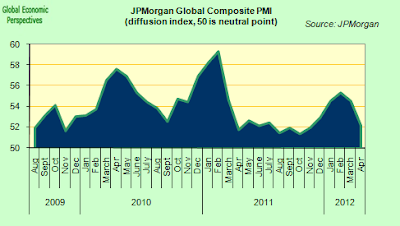
According to the JP Morgan Global Composite PMI report, "Growth of global economic activity eased sharply to a five month low in April." The authors of the report found that on aggregate across the countries surveyed – 30 across the globe – both new order inflows and job creation fell back, leading them to the conclusion  that "the world economy is set for a softer growth patch heading into midyear". Looking at the chart below, this certainly seems to be the case (the composite index is a measure derived from a weighted average of the manufacturing and services findings).
400
So momentum is weakening across the entire global economy at the present point, not just in say Europe, or China. Global output is still growing but it is growing at an increasingly weaker pace. What could change that? Well QE3 naturally. Why do I say that?  Well look at the three significant surges in the chart. The first coincides with QE1, the second with QE2, and the third, much weaker one, fits in with the so called Operation Twist.
This tells us a number of things. In the first place these massive liquidity injections are not self sustaining, i.e. they give things a hefty push forward but even so they  don't manage to jump start the various economies, especially in the developed world. They work for a bit, and then run out of steam. The fact that they systematically run out of steam tells me, at any rate, that something somewhere is broken, and that re-iterated injections on their own won't sort the problem out.
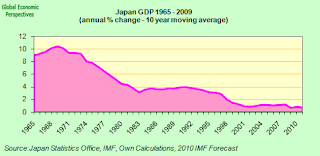
In Japan this very same "something" has now been broken since 1992, and continual liquidity injections and mounting government debt have not made it better. This is not the point to go in depth into what the something is, my story on this is scattered here and there across the various pieces of analysis I write. Suffice it to say that excessive debt and rapid population aging have to form part of the picture. Both constitute an important drag on growth. But the principal aim of this post  isn't to add to the debate about what it is that is broken, it is simply to plead for a recognition that something is, and that, as a result, the situation won't simply "right" itself. This time there is no hidden helping hand.
What the various liquidity injections do do is buy time. Some people scorn that, and would rather take their armageddon full face and now. Each to his taste. If I get to die tomorrow rather than today, I am not ungrateful.
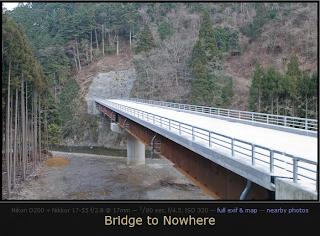
Liquidity injections are not quite the same thing as debt generation, although obviously there is a link – injections which involve straight monetisation of government debt (ECB LTRO lending against government guaranteed bank bond collateral in order to enable the bank to buy government bonds, for example) are clearly facilitating the generation of debt. While liquidity provision for its own sake in a deflated economic system is generally positive, debt generation for its own sake isn't necessarily so, since someone, someday, will have to pay it back, and if in the meantime we don't fix the problem (that "something" that is broken) then the somebody may be poorer than we are, in which case we are directly transferring income inter-generationally, from them to us. Debt to buy time for something which won't fix itself is not justified, and the money should be spent structurally, on implementing a fix. Grandiose infrastructure plans which have no real efficiency component were tried in Japan in the 1990sand they didn't work.
"Even today, Japan is having trouble climbing out of its cement pit. At its high, in the mid-1990s, infrastructure spending accounted for 6 percent of its gross domestic product, double what the United States allocated for infrastructure in the '90s and still higher than what politicians are considering spending today. In estimates of national debt, the world's second-largest national economy is near the top of the list, perched between Lebanon and Jamaica. Last year, Japan's public debt was far greater than the size of its economy, a burden that makes its demographic challenges more difficult to address".
320
320
We face a situation which seems neither to have been contemplated in either the Austrian or the Keynesian theoretical frameworks (since both assume some sort of homeostatic corrective mechanism is ultimately at work) or in the any of the various versions of neoclassical growth theory, where some sort of semi-constant equilibrium growth path is assumed to exist, and be recoverable via the application of an appropriate set of structural reforms. Yet the three oldest societies on the planet – Japan, Germany and Italy – have been losing growth momentum for decades now, and it is quite possible will drift into negative average growth rates at some point in a non too distant future. Traditional theory never really contemplated this possibility (for a brief summary of my argument on this, see this recent interview I did with Andrew Pollen).
320
320
Now for my second main point. Where's the missing link? That is, where is the link between the Feds quantitative measures (or those of the other main developed economy central banks for that matter) and global economic momentum? Well, that's a bit of a longer story – although empirically I think it is easy to see the link is there. Basically the story has to do with international "carry" (borrowing cheap in one currency to lend dear in another, preferably with the value of the first currency falling, and the value of the second currency rising, a set of relations which "carry" itself propagates in good circular fashion), and risk sentiment. The liquidity injection makes people more willing to take on risk (think ECB and the 3yr LTROs), and the existence of the carry trade enables them to do it. Nothing new here, banks by their very nature are about intermediation, and leveraging spreads, its just that in an age of financial globalisation that intermediation has a lot more distant geographical reach.
And then of course, all that extra money helps people from Rio to New Delhi and from Ankara to Jakarta borrow up to the hilt to buy themselves a nice new flat, or SUV, or whatever.
Across Latin America's largest economy, record prices for the country's commodities and surging foreign fund inflows – what the International Monetary Fund calls "favourable tailwinds" – are driving a historic boom. Property prices are soaring, consumer credit is booming and bank profits swelling. But there are growing concerns over whether Brazil is becoming addicted to this windfall of easy money. Increasingly, there are fears that Brazil is heading for a bubble.
So excess liquidity which finds no outlet in developed economies floods into emerging markets, provoking unsustainable surges in demand and fueling inflation, which leads the local central banks to penalise borrowing in one way or another, and bring the whole dynamic to a halt again. At which point we get another liquidity injection in one of the major developed economies, and off we go again.
320
It is perhaps a sobering thought  that households will be about as indebted in Brazil coming in to the next football World Cup as they were in Spain at the time of the 1992 Olympics, and then remember what happened next in the latter case. Brazil isn't facing a devastating bubble yet, but it could be one day if we don't find a better way of doing things.
Global Manufacturing In LimboLand
Even if it was services activity, rather than manufacturing, that showed the greatest global weakness during April, manufacturing was only able to gouge out a minimal improvement on what was already a weak March performance, and even then what growth there was was  very unevenly distributed.
320
Overall output, new orders and employment all continued to rise during the month, but there was a marked divergence between the world's two largest industrial regions, the US and the Eurozone. In fact, the US remained one of the principal spurs of global manufacturing growth in April, with the US PMI rising to a ten-month high, provoking indirectly yet more debate about the desirability of austerity across the EU. Nonetheless, as can be seen from the chart, the surge in manufacturing output remains modest when compared with the two earlier waves, which is why I am among those who think that the arrival of some sort of QE3 is now only a matter of time.
320
The Eurozone manufacturing PMI, in contrast, posted its lowest reading in almost three years, as operating conditions deteriorated across all of the  big-four Euro economies (Germany, France, Italy, and Spain). The US PMI is currently 8.9 points above its Eurozone equivalent, the greatest divergence in favour of the US since Eurozone data were first compiled in June 1997.
320
Meanwhile the Asia PMIs remained mixed with solid growth being signaled in India against only modest expansions in Japan, Indonesia, Taiwan and South Korea. Conditions also remained weak to subdued in China. So at this point in time, even the Asian economies as a group are hardly "powering ahead".
320
320
320
The most marked feature of the April reports as far as Europe is concerned is certainly the way in which conditions in core Europe continue to worsen. As the monthly report said,"the April PMIs also indicated that manufacturing weakness was no longer confined to the region's geographic periphery. The German PMI fell to a 33-month low, conditions deteriorated sharply again in France and the Netherlands also contracted at a faster rate". The rate of decline in new orders accelerated, and jobs were lost in German manufacturing for the first time in two years.
Indeed it is the state of the once mighty German economy that is now starting to give cause for concern. The economy suffered a mild contraction in the last three months of last year, and the possibility exists that this will be repeated in Q1 2012, in which case Germany will also be technically back in recession. Whether or not this is the case we will know in a week or so, but either way, the fact that it is a close call, and that things are evidently getting worse as we enter the second quarter certainly undermines some of the force in Angela Merkel's argument that austerity leads to growth.
320
As Tim Moore, senior economist at Markit and author of the German manufacturing report put it:
"Germany started the second quarter of 2012 with its worst manufacturing performance for almost three years, as another month of weaker order inflows finally brought production levels back into contraction. With backlogs of work failing to support output volumes in April, manufacturers cut their staffing numbers for the first time since March 2010.
"The investment goods sector was at the forefront of the downturn in April, as jitters about global economic conditions meant clients in export markets sought to delay large scale spending decisions. Investment goods producers saw export orders fall at the steepest pace in nearly three years, and in turn job losses were the most pronounced of the three main market groups monitored by the survey.
Germany's economy is export dependent. This export dependency comes from having a very high median population age. It is not a cultural quirk of the Germans. There is no fundamental issue with German competitiveness, there is not some major structural reform that is missing, there is not even over indebtedness in the public or private sectors. The only reason the German economy has fallen back into recession is that demand for its products among customers has dropped off, while the long awaited second pillar of domestic demand has once more failed to appear. It is as simple as that.
With the results of the recent French elections in the forefront of their minds, people are now starting to ask themselves just how Germany will respond to a Francois Hollande Presidency, forgetting that elections are also looming in Germany next year, and that the CDU is busily loosing ground. Whether or not Germany technically confirms a recession when the results for the first three months of the year are out in a week or so, the performance of the economy is visibly worsening and German leaders are under pressure to show they are willing and able to respond. Otherwise Angela Merkel may face wrath not only from those irritated by the having to contribute towards the bailouts, she will also have to contend with  those irritated by her economic ineffectiveness back home. And in any event, the party which would gain from a Merkel electoral defeat – the SPD – are not that far from seeing things the way Monsieur Hollande does.
Which is why Angela Merkel's approach was always far too simplistic. As I have said a number of times, I think she is right to search for some sort of financial stability in the face of the aging population issue, but the best way to get from here to there is not necessarily to walk in a straight line.  Naturally, austerity is a relative concept, but whether you are cutting your deficit from 10% to 9%, or from 3% to 2% as you go into a recession you still hit short term growth with a double whammy, as Italy is currently discovering. As can be seen in the chart below (which is the April Italian services PMI) domestic demand is plummeting on the back of the latest round of austerity, and this is leading the main centre left party in the government to at least cry ouch!
320
At the very least European fiscal policy needs to allow for a counter cyclical component, even as you pull back from a very high deficit level, and not, as at present, insist on an entirely pro-cyclical one in a recessionary environment, thus magnifying the amplitude of the demand swings. If an economy needs more than 5% deficit (or more than 10% for that matter) simply to get meaningful GDP growth, then you need to understand why this is and find solutions, since as I say above debt itself doesn't cure anything, and arguably as our populations age accumulated debt only makes things worse. But if one of the engines on the plane starts to malfunction, the objective needs to be to get the passengers to the ground safely, and not necessarily by the most direct route.
Naturally infrastructure work on the periphery which needed German technology would help German export companies, so it wouldn't be that hard to sell in the heimat. But what use would it be to the receiving countries? That we won't know until we see the proposals in detail, and discover how it is going to be financed. If such infrastructure would help exports, both within and outside Europe, then it could be a plus. If it is only to build high speed train networks that lead to nowhere (or as is currently under discussion in Spain up to a frontier with Portugal across which there will be no connection waiting on the other side) then we are simply falling into the Japan trap, and applying a simplistic 1930s version of Keynesianism that doesn't work in the present context. But at the end of the day, the fact we are having this debate in the first place only serves to highlight the fact that we still don't have a roadmap for coming out of the crisis in Europe, and we still don't know what our future is going to look like.
And meanwhile, of course, there is Greece, and that blasted ongoing economic contraction to think about.
320
As Paul Smith, Senior Economist at Markit and author of the Greece Manufacturing PMI report commented:
"April proved to be another difficult month for Greek manufacturers, with latest data again showing steep contractions across a number of key variables measured by the survey. "In line with recent reports, the issues facing manufacturers – and the Greek economy as a whole – remain deep rooted. Panelists again noted problems in accessing working capital and a culture of cash payments, implying that credit lines remain either closed or that agreements will come with restrictive terms.
"At present, it remains hard to see how these issues can be solved suggesting that the manufacturing sector is set for continued struggle in the months ahead."
Following his cue, and looking over at the latest election results in that unfortunate country, it remains hard to see how the issues arising can be solved, and it isn't clear what is going to happen next.
__._,_.___

__,_._,___

Fwd: Macroperu Grecia: Nurvas elecciones en el futuro


---------- Forwarded message ----------
From: Bruno <lbseminario@yahoo.com>
Date: 2012/5/9
Subject: Macroperu Grecia: Nurvas elecciones en el futuro


Piden a una izquierda antiajuste que forme gobierno en Grecia

POR IDAFE MARTÍN

....................................................................................................................................................................................................................................................

Es poco probabel que los partidos mayoritarios griegos puedan formar un gobierno en Gracia, de modo que nuvas elecciones son inevitables. Es probable , sin embargo, que las mismas hagan desaparecer a los partidos tradicionales con lo que el colpaso de la inetegracion con respecto a la UE sera inevitable. En las actuales circunstancias, es probable que el costo de permancer en la UE sea mayor a los beneficios. Conforma aavnce la crisisi y se persita en las actuales polemicas, se coeste alace se hara evidente. Pero, que puede ocurri en el Mundo si se disuelve la UE: Una catastrofe como esa podria ser similar a la que provoco la quiebra del mayor banco de austria en 1932. 

Tras el fracaso de los partidos tradicionales, el presidente encargó a la alianza Syriza que busque socios. Ellos quieren una moratoria de la deuda y no seguir los recortes que impone la UE. Será difícil que sume aliados y habría nuevos comicios.
Desafío. El líder de Syriza, Alexis Tsipras (c), sale ayer con colaboradores del palacio presidencial de Atenas, tras recibir el encargo de formar gobierno..
BRUSELAS. ESPECIAL PARA CLARIN - 09/05/12
El debate sobre el ajuste en Europa quedó ayer en carne viva: una alianza de izquierda griega, que intenta formar gobierno tras el fracaso de los partidos tradicionales, advirtió que, si llega al poder, su país ya no se sentirá obligado aaplicar las medidas de ajuste exigidas por el FMI y Bruselas.
Alexis Tsipras, un ingeniero de 38 años y líder de la alianza antiajuste Syriza que fue una de las revelaciones de los comicios del domingo, pidió también una moratoria sobre una parte de la deuda, una iniciativa que hizo ayer temblar la Bolsa de Atenas.
"Los partidos pro rescate ya no tienen una mayoría en el Parlamento para votar medidas destructivas para el pueblo griego", dijo Tsipras, cuya alianza salió segunda tras el partido Nueva Democracia (conservador) y adelante de los socialistas del Pasok.
Igualmente, sería casi un milagro que la izquierda (que sacó un 16.8% de los votos) consiga formar gobierno. Así, l os griegos volverían a las urnas dentro de un mes en un ambiente catastrófico, con las fuerzas tradicionales hundidas y los extremistas de izquierda y derecha en ascenso.
Los resultados electorales de las legislativas del pasado domingo dieron un parlamento totalmente fragmentado. Vencieron los conservadores de Nueva Democracia, pero ni sumando a los socialistas del Pasok podrán gobernar.
El resto del arco político rechaza la coalición porque están en contra de los ajustes, de los rescates negociados con la Unión Europea y el FMI y porque piden directamente que se deje de pagar la deuda.
La subida de los extremos es brutal. Syriza, un partido muy a la izquierda de los socialistas, fue la segunda fuerza más votada y en el parlamento entraron por primera vez los neonazis de Aurora Dorada. El resto de la cámara lo forman otro partido de extrema derecha, uno de nacionalistas populistas y dos partidos comunistas peleados entre sí.
El escenario es dantesco. La Bolsa griega cae con fuerza desde el lunes y los bancos han perdido en dos días más del 20% de su valor bursátil. Unos nuevos comicios darían, según los sondeos, un refuerzo a los extremos y provocarían que los partidos centrales se hundieran aún más.
Grecia está de rodillas. Según los datos de la Comisión Europea, el PBI griego es apenas el 2% de la Eurozona, pero el enfermo está haciendo temblar al bloque. Atenas ha perdido en cuatro años el 20% de su PBI, el desempleo subió hasta cerca del 22%, la deuda pública, que llegó al 165%, está por encima del 120% después de que Atenas hiciera una quita de 106.000 millones de euros y el déficit público rondará a finales de este año el 9%. Sus socios europeos ya le han tirado dos salvavidas –que parecen cargados de piedras–, uno por 110.000 millones de euros en mayo de 2010 y otro por 130.000 millones en febrero pasado.
Pero nada funciona. El último dato, conocido esta semana, habla de un país que se encamina a las listas del tercermundismo: uno de cada 11 griegos se alimenta en comedores sociales.
Alemania no afloja la soga del cuello griego. Berlín dijo ayer que espera la formación de un gobierno "responsable" en Atenas "que siga aplicando las reformas" prometidas. Por reformas Berlín entiende más ajustes. Si no, Europa cortaría el grifo de la ayuda.
Los partidos que suman más del 60% de los votos piden que se deje de cumplir con el servicio de la deuda. Si lo hicieran, Grecia, gracias a las brutales rebajas de salarios públicos y pensiones, ya tendría superávit fiscal, por lo que podría seguir pagando salarios y mantener la administración pública funcionando.
La prueba del hartazgo de los griegos es la entrada en el Parlamento, con el 7% de los votos y 21 diputados, del partido Aurora Dorada, una banda de neonazis, que usan un símbolo casi idéntico a la esvástica nazi. Hablan de una supuesta superioridad racial helena, exigen que se expulse a todos los inmigrantes y se minen las fronteras y obligan a los periodistas a levantarse para aplaudir cuando su líder llega a una conferencia de prensa.
__._,_.___
    .

__,_._,___

Global Economy Heading Downhill?


Global Economy Heading Downhill?
Author: Edward Hugh · May 8th, 2012 · Comments (2)
Share This Print 151 83
According to the JP Morgan Global Composite PMI report, "Growth of global economic activity eased sharply to a five month low in April." The authors of the report found that on aggregate across the countries surveyed – 30 across the globe – both new order inflows and job creation fell back, leading them to the conclusion that "the world economy is set for a softer growth patch heading into midyear". Looking at the chart below, this certainly seems to be the case (the composite index is a measure derived from a weighted average of the manufacturing and services findings).

So momentum is weakening across the entire global economy at the present point, not just in say Europe, or China. Global output is still growing but it is growing at an increasingly weaker pace. What could change that? Well QE3 naturally. Why do I say that? Well look at the three significant surges in the chart. The first coincides with QE1, the second with QE2, and the third, much weaker one, fits in with the so called Operation Twist.

This tells us a number of things. In the first place these massive liquidity injections are not self sustaining, i.e. they give things a hefty push forward but even so they don't manage to jump start the various economies, especially in the developed world. They work for a bit, and then run out of steam. The fact that they systematically run out of steam tells me, at any rate, that something somewhere is broken, and that re-iterated injections on their own won't sort the problem out.

In Japan this very same "something" has now been broken since 1992, and continual liquidity injections and mounting government debt have not made it better. This is not the point to go in depth into what the something is, my story on this is scattered here and there across the various pieces of analysis I write. Suffice it to say that excessive debt and rapid population aging have to form part of the picture. Both constitute an important drag on growth. But the principal aim of this post isn't to add to the debate about what it is that is broken, it is simply to plead for a recognition that something is, and that, as a result, the situation won't simply "right" itself. This time there is no hidden helping hand.

What the various liquidity injections do do is buy time. Some people scorn that, and would rather take their armageddon full face and now. Each to his taste. If I get to die tomorrow rather than today, I am not ungrateful.

Liquidity injections are not quite the same thing as debt generation, although obviously there is a link – injections which involve straight monetisation of government debt (ECB LTRO lending against government guaranteed bank bond collateral in order to enable the bank to buy government bonds, for example) are clearly facilitating the generation of debt. While liquidity provision for its own sake in a deflated economic system is generally positive, debt generation for its own sake isn't necessarily so, since someone, someday, will have to pay it back, and if in the meantime we don't fix the problem (that "something" that is broken) then the somebody may be poorer than we are, in which case we are directly transferring income inter-generationally, from them to us. Debt to buy time for something which won't fix itself is not justified, and the money should be spent structurally, on implementing a fix. Grandiose infrastructure plans which have no real efficiency component were tried in Japan in the 1990s, and they didn't work.

"Even today, Japan is having trouble climbing out of its cement pit. At its high, in the mid-1990s, infrastructure spending accounted for 6 percent of its gross domestic product, double what the United States allocated for infrastructure in the '90s and still higher than what politicians are considering spending today. In estimates of national debt, the world's second-largest national economy is near the top of the list, perched between Lebanon and Jamaica. Last year, Japan's public debt was far greater than the size of its economy, a burden that makes its demographic challenges more difficult to address".

We face a situation which seems neither to have been contemplated in either the Austrian or the Keynesian theoretical frameworks (since both assume some sort of homeostatic corrective mechanism is ultimately at work) or in the any of the various versions of neoclassical growth theory, where some sort of semi-constant equilibrium growth path is assumed to exist, and be recoverable via the application of an appropriate set of structural reforms. Yet the three oldest societies on the planet – Japan, Germany and Italy – have been losing growth momentum for decades now, and it is quite possible will drift into negative average growth rates at some point in a non too distant future. Traditional theory never really contemplated this possibility (for a brief summary of my argument on this, see this recent interview I did with Andrew Pollen).

Now for my second main point. Where's the missing link? That is, where is the link between the Feds quantitative measures (or those of the other main developed economy central banks for that matter) and global economic momentum? Well, that's a bit of a longer story – although empirically I think it is easy to see the link is there. Basically the story has to do with international "carry" (borrowing cheap in one currency to lend dear in another, preferably with the value of the first currency falling, and the value of the second currency rising, a set of relations which "carry" itself propagates in good circular fashion), and risk sentiment. The liquidity injection makes people more willing to take on risk (think ECB and the 3yr LTROs), and the existence of the carry trade enables them to do it. Nothing new here, banks by their very nature are about intermediation, and leveraging spreads, its just that in an age of financial globalisation that intermediation has a lot more distant geographical reach.

And then of course, all that extra money helps people from Rio to New Delhi and from Ankara to Jakarta borrow up to the hilt to buy themselves a nice new flat, or SUV, or whatever.

Across Latin America's largest economy, record prices for the country's commodities and surging foreign fund inflows – what the International Monetary Fund calls "favourable tailwinds" – are driving a historic boom. Property prices are soaring, consumer credit is booming and bank profits swelling. But there are growing concerns over whether Brazil is becoming addicted to this windfall of easy money. Increasingly, there are fears that Brazil is heading for a bubble.

So excess liquidity which finds no outlet in developed economies floods into emerging markets, provoking unsustainable surges in demand and fueling inflation, which leads the local central banks to penalise borrowing in one way or another, and bring the whole dynamic to a halt again. At which point we get another liquidity injection in one of the major developed economies, and off we go again.

It is perhaps a sobering thought that households will be about as indebted in Brazil coming in to the next football World Cup as they were in Spain at the time of the 1992 Olympics, and then remember what happened next in the latter case. Brazil isn't facing a devastating bubble yet, but it could be one day if we don't find a better way of doing things.

Global Manufacturing In LimboLand

Even if it was services activity, rather than manufacturing, that showed the greatest global weakness during April, manufacturing was only able to gouge out a minimal improvement on what was already a weak March performance, and even then what growth there was was very unevenly distributed.
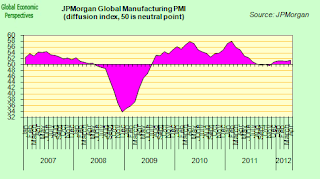
Overall output, new orders and employment all continued to rise during the month, but there was a marked divergence between the world's two largest industrial regions, the US and the Eurozone. In fact, the US remained one of the principal spurs of global manufacturing growth in April, with the US PMI rising to a ten-month high, provoking indirectly yet more debate about the desirability of austerity across the EU. Nonetheless, as can be seen from the chart, the surge in manufacturing output remains modest when compared with the two earlier waves, which is why I am among those who think that the arrival of some sort of QE3 is now only a matter of time.

The Eurozone manufacturing PMI, in contrast, posted its lowest reading in almost three years, as operating conditions deteriorated across all of the big-four Euro economies (Germany, France, Italy, and Spain). The US PMI is currently 8.9 points above its Eurozone equivalent, the greatest divergence in favour of the US since Eurozone data were first compiled in June 1997.

Meanwhile the Asia PMIs remained mixed with solid growth being signaled in India against only modest expansions in Japan, Indonesia, Taiwan and South Korea. Conditions also remained weak to subdued in China. So at this point in time, even the Asian economies as a group are hardly "powering ahead".

The most marked feature of the April reports as far as Europe is concerned is certainly the way in which conditions in core Europe continue to worsen. As the monthly report said,"the April PMIs also indicated that manufacturing weakness was no longer confined to the region's geographic periphery. The German PMI fell to a 33-month low, conditions deteriorated sharply again in France and the Netherlands also contracted at a faster rate". The rate of decline in new orders accelerated, and jobs were lost in German manufacturing for the first time in two years.

Indeed it is the state of the once mighty German economy that is now starting to give cause for concern. The economy suffered a mild contraction in the last three months of last year, and the possibility exists that this will be repeated in Q1 2012, in which case Germany will also be technically back in recession. Whether or not this is the case we will know in a week or so, but either way, the fact that it is a close call, and that things are evidently getting worse as we enter the second quarter certainly undermines some of the force in Angela Merkel's argument that austerity leads to growth.

As Tim Moore, senior economist at Markit and author of the German manufacturing report put it:

"Germany started the second quarter of 2012 with its worst manufacturing performance for almost three years, as another month of weaker order inflows finally brought production levels back into contraction. With backlogs of work failing to support output volumes in April, manufacturers cut their staffing numbers for the first time since March 2010.

"The investment goods sector was at the forefront of the downturn in April, as jitters about global economic conditions meant clients in export markets sought to delay large scale spending decisions. Investment goods producers saw export orders fall at the steepest pace in nearly three years, and in turn job losses were the most pronounced of the three main market groups monitored by the survey.

Germany's economy is export dependent. This export dependency comes from having a very high median population age. It is not a cultural quirk of the Germans. There is no fundamental issue with German competitiveness, there is not some major structural reform that is missing, there is not even over indebtedness in the public or private sectors. The only reason the German economy has fallen back into recession is that demand for its products among customers has dropped off, while the long awaited second pillar of domestic demand has once more failed to appear. It is as simple as that.

With the results of the recent French elections in the forefront of their minds, people are now starting to ask themselves just how Germany will respond to a Francois Hollande Presidency, forgetting that elections are also looming in Germany next year, and that the CDU is busily loosing ground. Whether or not Germany technically confirms a recession when the results for the first three months of the year are out in a week or so, the performance of the economy is visibly worsening and German leaders are under pressure to show they are willing and able to respond. Otherwise Angela Merkel may face wrath not only from those irritated by the having to contribute towards the bailouts, she will also have to contend with those irritated by her economic ineffectiveness back home. And in any event, the party which would gain from a Merkel electoral defeat – the SPD – are not that far from seeing things the way Monsieur Hollande does.

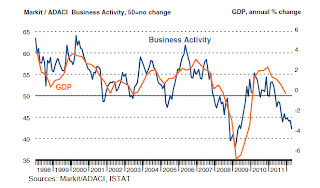
Which is why Angela Merkel's approach was always far too simplistic. As I have said a number of times, I think she is right to search for some sort of financial stability in the face of the aging population issue, but the best way to get from here to there is not necessarily to walk in a straight line. Naturally, austerity is a relative concept, but whether you are cutting your deficit from 10% to 9%, or from 3% to 2% as you go into a recession you still hit short term growth with a double whammy, as Italy is currently discovering. As can be seen in the chart below (which is the April Italian services PMI) domestic demand is plummeting on the back of the latest round of austerity, and this is leading the main centre left party in the government to at least cry ouch!
At the very least European fiscal policy needs to allow for a counter cyclical component, even as you pull back from a very high deficit level, and not, as at present, insist on an entirely pro-cyclical one in a recessionary environment, thus magnifying the amplitude of the demand swings. If an economy needs more than 5% deficit (or more than 10% for that matter) simply to get meaningful GDP growth, then you need to understand why this is and find solutions, since as I say above debt itself doesn't cure anything, and arguably as our populations age accumulated debt only makes things worse. But if one of the engines on the plane starts to malfunction, the objective needs to be to get the passengers to the ground safely, and not necessarily by the most direct route.

Naturally infrastructure work on the periphery which needed German technology would help German export companies, so it wouldn't be that hard to sell in the heimat. But what use would it be to the receiving countries? That we won't know until we see the proposals in detail, and discover how it is going to be financed. If such infrastructure would help exports, both within and outside Europe, then it could be a plus. If it is only to build high speed train networks that lead to nowhere (or as is currently under discussion in Spain up to a frontier with Portugal across which there will be no connection waiting on the other side) then we are simply falling into the Japan trap, and applying a simplistic 1930s version of Keynesianism that doesn't work in the present context. But at the end of the day, the fact we are having this debate in the first place only serves to highlight the fact that we still don't have a roadmap for coming out of the crisis in Europe, and we still don't know what our future is going to look like.

And meanwhile, of course, there is Greece, and that blasted ongoing economic contraction to think about.

As Paul Smith, Senior Economist at Markit and author of the Greece Manufacturing PMI report commented:

"April proved to be another difficult month for Greek manufacturers, with latest data again showing steep contractions across a number of key variables measured by the survey. "In line with recent reports, the issues facing manufacturers – and the Greek economy as a whole – remain deep rooted. Panelists again noted problems in accessing working capital and a culture of cash payments, implying that credit lines remain either closed or that agreements will come with restrictive terms.

"At present, it remains hard to see how these issues can be solved suggesting that the manufacturing sector is set for continued struggle in the months ahead."

Following his cue, and looking over at the latest election results in that unfortunate country, it remains hard to see how the issues arising can be solved, and it isn't clear what is going to happen next.

Filed under: Economic Growth, Euro, European Periphery, Japan

__

__,_._,___

ENTREVISTAS TV CRISIS GLOBAL

NR.: Director, no presidente ---------------------------------------------- Bruno Seminario 1 ------------------------- Bruno Seminario 2 -------------------- FELIX JIMENEZ 1 FELIZ JIMENEZ 2 FELIX JIMENEZ 3, 28 MAYO OSCAR DANCOURT,ex presidente BCR ------------------- Waldo Mendoza, Decano PUCP economia ---------------------- Ingeniero Rafael Vasquez, parlamentario 24 set recordando la crisis, ver entrevista en diario

Etiquetas

Peru:crisis impacto regional arequipa,raul mauro

Temas CRISIS FINANCIERA GLOBAL

QUIEN SOY?
claves para pensar la crisis

MATERIAS PRIMAS
-Metales
-Cobre
- plata
- oro
- zinc
- plomo
- niquel
- petroleo

-Tipo de cambio

- LA CRISIS

- BOLSA VALORES
- BANCOS
- PBI PAISES
- USA: DEFICIT GEMELOS
- UE: RIEN NE VA PLUS

CONTAGIO: CANALES

- PERU: DIAGRAMA DE CONTAGIO
- PERU: IMPACTO EN BOLSA
- MEXICO: HAY CRISIS?

LA PRENSA
COMENTARIO DE HOY

- DIARIOS DE HOY
NLACES

Coyuntura
Bancos centrales
Paginas Recomendadas

BLOGS

economiques
Interes

VIDEO

- Economia videos
- Crisis financiera global

TRICONTINENTAL

- AFRICA: daniel
- EUROPA: helene
- ASIA:
- AMERICA

COLUMNAS AMIGAS

Chachi Sanseviero

ETIQUETAS
por frecuencia de temas
por alfabetico

EVENTOS

FOTOS DEL PERU

GONZALO EN LA RED

JOBS
VOZ ME CONVERTIDOR
CLIMA
SUDOKU
PICADURAS

LOGO

LIBRO de GONZALO

La exclusion en el Peru

-Presentacion

- introduccion

- contexo economico

- crisis de la politica

- excluidos de las urbes

- excluidos andinos

- contratapa

VIDEOS ECONOMICOS
Crisis Enero 2009
Krugman
Globalizacion 1
Globalizacion 2
Crisis Brasil
Crisis bancaire
Karl marx revient

TODOS LOS DERECHOS RESERVADOS

GOOGLE INFORMA


PRESS CLIPPINGS-RECORTES PRENSA-PRESSE..

ETIQUETAS alfabetico